Autonomous Campaign Execution vs. AI-Assisted PPC Software
The difference between letting AI suggest changes and letting it run your campaigns on its own.
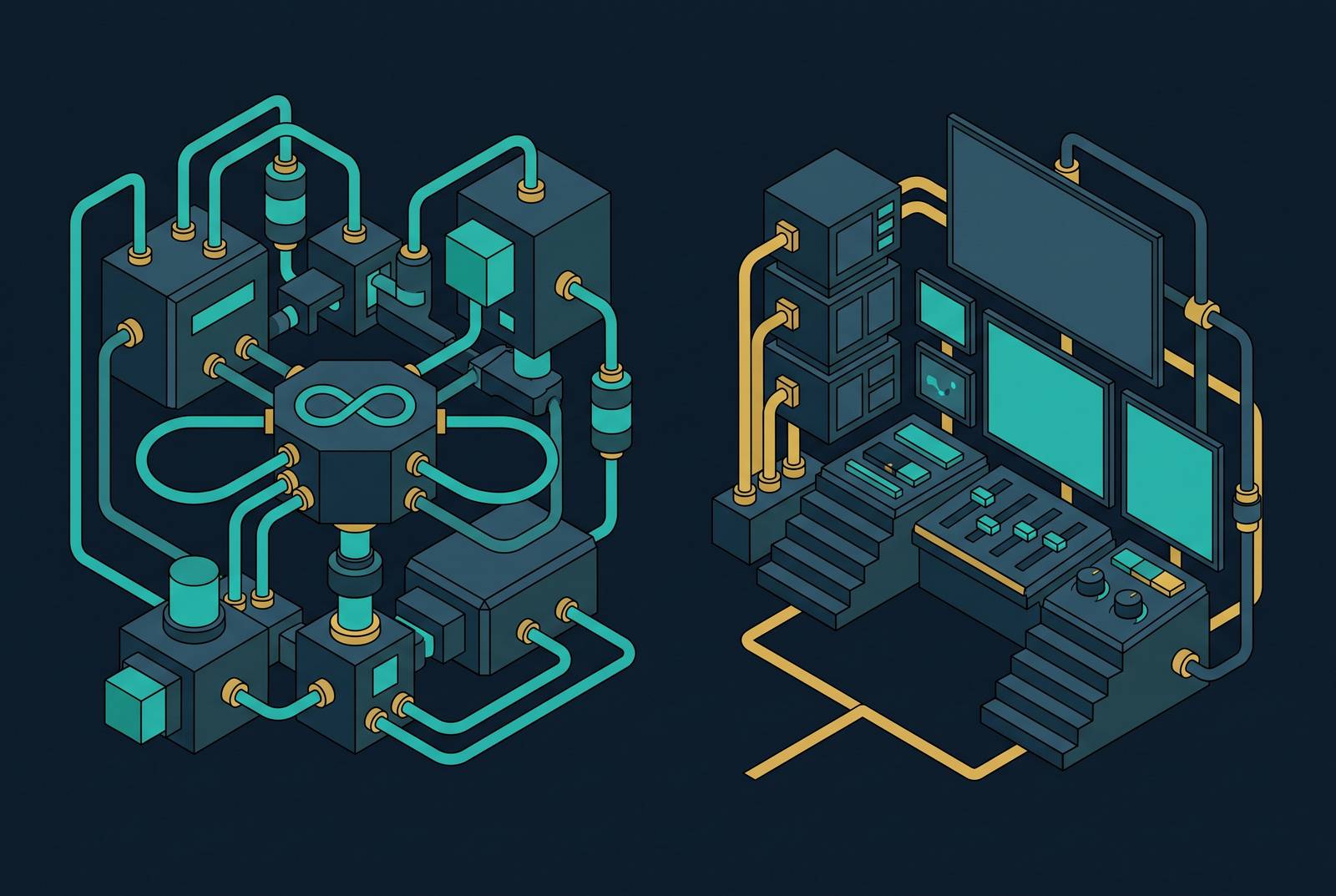
Every PPC tool now calls itself AI-powered. Every agency deck has "AI-driven" somewhere in the first five slides. And somewhere in that fog, a real distinction got lost: software gives you AI-assisted suggestions, while a system runs your campaigns on its own.
That distinction matters more than it used to. Gartner's research puts AI agents embedded in enterprise applications at 40% by the end of 2026, up from under 5% in 2025. Scott Brinker and Frans Riemersma's Martech for 2026 research found that 90.3% of marketing organizations already use AI somewhere in their stack. Adoption is nearly universal. Understanding what those agents actually do is not.
For a growth leader or VP Marketing at a sales-led B2B company, that gap is a problem. If a paid media program is generating real pipeline, whether it runs on AI-assisted software or on autonomous execution is not a feature preference. It is a decision about who is accountable when something goes wrong, and about how the program gets better (or doesn't) over time.
What separates AI-assisted PPC software from autonomous campaign execution
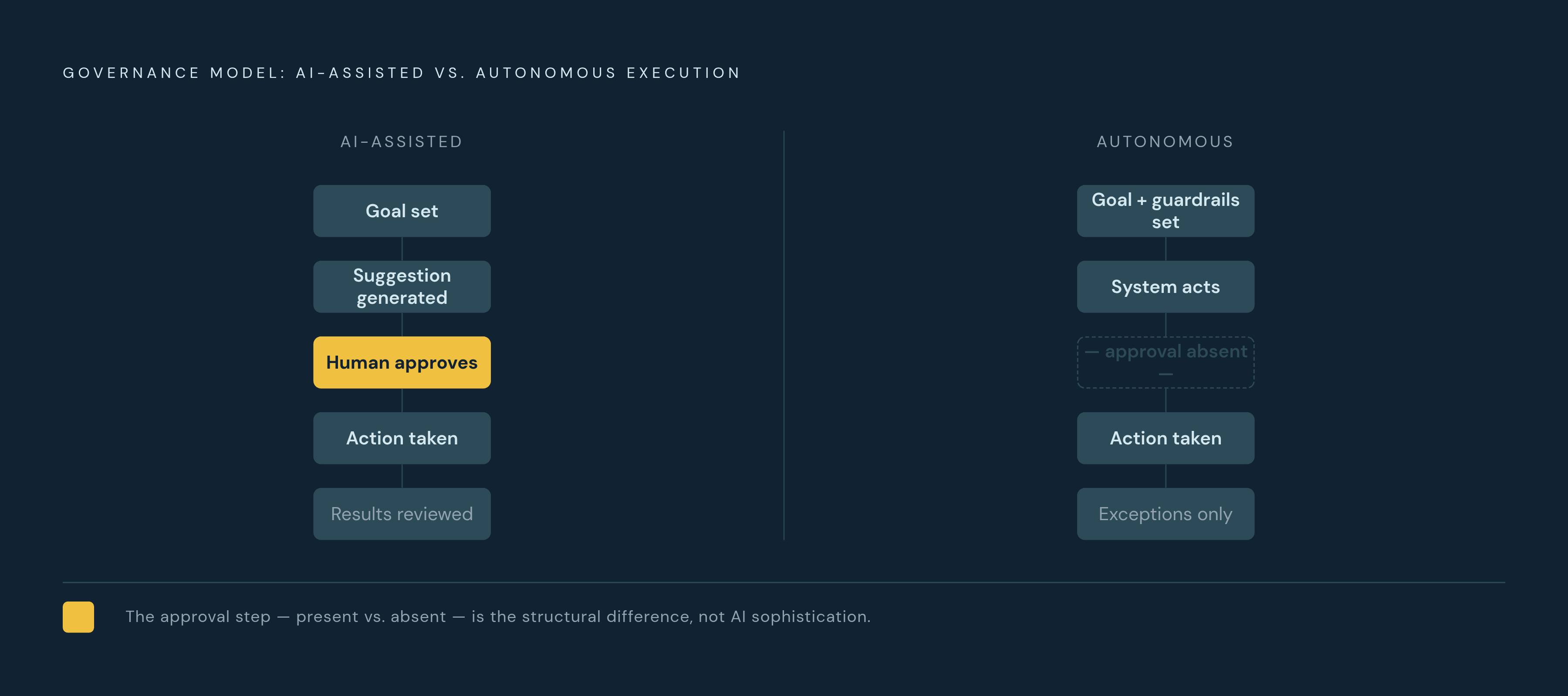
The line isn't about how smart the AI is. It's about one question: does a human approve the action before it happens, or does the system act first and report back?
AI-assisted PPC software works on a recommendation model. It surfaces bid adjustment ideas, budget reallocation opportunities, keyword expansion suggestions, all built on historical performance data. A person reviews the suggestion, then approves or rejects it. The AI is a smart analyst sitting next to the PPC manager, not the one holding the wheel. That's by design: these tools are built for experienced managers who want AI-assisted decisions, not AI-replaced ones. Ryze AI's buyer's guide points to tools like Opteo and Optmyzr, which review and approve each change one at a time, and PPC Signal or Claude paired with MCP, which stick to analysis and make no changes.
Autonomous campaign execution works on a delegation model. You hand it a business goal, something like "cut cost per qualified lead by 20%," and the system figures out on its own what needs to happen across platforms, channels, and content to get there. There's no approval step for each action. Human involvement is visible at the strategy level, in the guardrails set up front, and in handling exceptions, not in signing off on every bid change. Per COSEOM's research, this is what separates an agent from a chatbot (which just answers questions) or traditional automation (which follows fixed rules): agents plan multi-step campaigns, run them across channels, and adjust based on live results.
Ryze AI's buyer's guide lays out three tiers: free scripts you maintain yourself, SaaS tools you rent and operate, and AI platforms that operate with greater autonomy at the top tier, distinguished primarily by who holds the controls.
It's tempting to think these sit on one spectrum, and that adding more automation to a recommendation tool eventually turns it into an autonomous system, but that isn't the case. It doesn't turn into an autonomous system, because more features on a tool that still waits for your sign-off is just a tool with more features. More features on a tool that still waits for your sign-off is just a tool with more features. The governance model, who acts and who approves, is what actually separates the two categories, not the intelligence level, not the price tag, and not whether "agentic" shows up in the marketing copy.
How autonomous agents are architected differently from AI-powered software features
Traditional marketing automation runs on if-then logic. Aprimo's 2026 guide states that the system fires off the same rule every time, and it never stops to ask whether that rule still makes sense for this customer, in this moment, in this context.
Agentic systems work differently. They weigh several things at once, like past behavior, real-time signals, how content is performing, what's likely to happen next, and pick the best move rather than following a fixed script.
Vellum's 2026 marketer's guide lays out five properties that separate a real agent from a tool wearing an "AI" badge:
Autonomy: it initiates action based on conditions or triggers, not a person clicking a button
Multiple 2026 sources describe how this plays out at scale: specialized agents split up the work, one managing bids, another running creative tests, another watching attribution, coordinating to run a full campaign without a human stitching the pieces together by hand.
There's a useful test for spotting an impostor. Plenty of tools launched in the past two years bolted a chatbot interface onto an old rule-based engine underneath. The tell is what happens when conditions change: does the system replan, or does it just rerun the same rules, faster and with a friendlier interface?
Neither model, software or agent, replaces human judgment on brand strategy, creative direction, offer and positioning calls, or decisions that hinge on context only people inside the business understand. No amount of architecture changes that.
What autonomous execution runs across Google and LinkedIn in a B2B account
On Google, autonomous execution doesn't replace what Google's own AI already does. It stacks on top of it. Smart Bidding and Performance Max already handle a lot of optimization natively. AI Max for Search widens the net, finding new search queries and writing ad copy for them. Smart Bidding Exploration goes after valuable searches the campaign wouldn't normally touch, without changing the targeting itself.
The real gain from adding an autonomous layer on top isn't a smarter bid. It's removing the day-long manual build process entirely, because the agent owns the build and the ongoing optimization across channels, not just the levers inside one platform.
That said, autonomy doesn't mean ignoring the rules that make an account work. Broad match, for example, shouldn't be turned on until an account has at least 90 days of conversion data in place. Before that, phrase and exact match are the safer starting point. That's a guardrail an autonomous system needs to be built with, not a default it should reach for on day one.
Sending paid traffic to a homepage instead of a dedicated landing page drops conversion rates by 50 to 70%, so landing pages directly determine campaign conversion performance. Sending paid traffic to a homepage instead of a dedicated landing page drops conversion rates by 50 to 70%. A system that controls the whole stack, including the landing page, can close that gap. A tool that only touches bids can't.
LinkedIn runs on its own mechanics, and autonomous execution changes the picture there too:
- LinkedIn's own Accelerate campaign type delivers up to 42% lower cost per action than manual campaigns, and it's available to any advertiser on the platform.
Native Lead Gen Forms convert around 6.1%, compared to 2 to 4% for landing pages hosted off-platform, according to The Smarketers' benchmark study and The B2B House's ad benchmark tracker. That's a format decision, not a bid tweak.
- LinkedIn's AI-driven campaigns need 30 to 50 conversion events before they exit the learning phase. Most advertisers give up around week two, right before the system starts working. An autonomous system built with a longer time horizon, and the patience to hold through that learning window, captures performance that gets abandoned by manual management.
- Audience size matters too: lead generation campaigns need at least 50,000 people in the target audience to work properly. That's a structural input no agent can fix if it wasn't solved upstream.
- Timing carries its own signal. Q3 delivers the best pipeline ROI, at 6.01x return per dollar spent. Pacing budget across that calendar is exactly the kind of multi-week decision that benefits from a system managing it continuously.
There's also a compounding effect across channels: pairing paid search with LinkedIn exposure lifts search conversions by 46%, according to Brixon Group's B2B comparison. A system managing both channels together can catch that interaction. Separate tools, or separate people managing each channel, often miss it.
Budget flows back this up. Between Q3 2024 and Q3 2025, B2B companies raised LinkedIn ad budgets by 31.7% while Google ad spend grew 6%. An autonomous system running both channels has to manage two platforms with very different cost structures and very different growth curves, not just optimize each one on its own.
Why the compounding effect is structural in autonomous execution and absent in software tools
AI-assisted tools give recommendations. What they don't do is build a memory of what worked, why it worked, and under what conditions. Each session starts from roughly the same slice of data. There's no accumulated intelligence carrying forward.
Autonomous execution leaves something behind: audience insights, creative performance broken out by segment, attribution patterns, and a record of what was actually holding growth back, whether that's a weak creative, a broken landing page, or a gap in attribution. The next campaign inherits all of that.
Both models depend on data quality, and that caveat applies equally. Every AI, whether it's suggesting or executing, performs in proportion to the conversion data it has to work with. New accounts, thin budgets, and broken tracking will produce weak decisions no matter which model is running things. An autonomous system actively builds that data asset over time, rather than sitting and waiting for a human to act on each individual recommendation. Judging results at the four-week mark instead of day three isn't a delay to tolerate. It's the investment paying off.
There's also a difference in the kind of diagnosis each model can offer. A recommendation tool can tell you a bid should change. A system with full visibility across the stack can tell you the real problem isn't the bid at all, it's the landing page. That's a different category of insight, not just a faster version of the same one.
A similar dynamic plays out in account-based marketing: agents can spot accounts showing real buying intent by reading behavior patterns, engagement signals, and context, then rank those accounts by conversion potential. A recommendation tool can surface that analysis. An agent can act on it right away.
Given how long B2B buying cycles run, that speed matters. Dreamdata's 2026 LinkedIn Ads Benchmarks Report puts the average B2B buying journey at around 272 days. A system learning continuously across all 272 of those days compounds real advantage. A system that needs a human to sign off at every step loses the thread somewhere along the way.
How accountability is structured differently across the two models
With AI-assisted software, accountability sits with the human operator. The tool made a suggestion, a person decided to act on it. If that decision turns out wrong, there's no one else to call. The vendor's responsibility ends at the quality of the suggestion, full stop.
With autonomous execution run through a managed model, accountability concentrates in whoever operates the system. If an agent takes a bad action, someone specific has to own the guardrails that let it happen and the fix that follows. That's not a support ticket. That's a governance failure, and it needs a name attached to it.
Traditional agencies sit somewhere in between, and not always comfortably. They staff work with people who are occasionally assisted by AI tools, and figuring out exactly who made which call, and why, is often genuinely hard to trace. That's not a knock on any particular agency. It's a structural feature of how that model works.
A healthy autonomous execution setup needs a few things in place:
- A named person accountable for outcomes, not a dashboard and not a rotating support team
- Audit trails that show the actual decision logic (the observability property covered earlier), so accountability is something that can be exercised, not just claimed on a sales call
- Explicit guardrails spelling out what the system is not allowed to do
- Clear rules for when the agent should stop and escalate a decision instead of resolving it alone
DemandWorks' 2026 survey found that 60% of B2B organizations now primarily define marketing success by pipeline contribution. A model that's only accountable for platform-reported conversions isn't accountable for the thing the business actually cares about.
Fee structure matters too. A management fee tied to a percentage of media spend creates a built-in incentive to recommend spending more. Decoupling the fee from spend lines up the operator's interest with actual growth, not with the size of the budget they're managing.
How to read real B2B paid media benchmarks when evaluating which model to use
Start with a target CPA that's actually grounded in pipeline math. If the average contract value is $30,000 and the lead-to-close rate is 5%, each lead is worth $1,500 in expected revenue. A reasonable target CPA is 10 to 20% of that, so somewhere between $150 and $300. That's the number any model's output should be measured against, not some generic industry average.
Real accounts spread out a lot wider than most benchmarks suggest. One dataset covering over $180,000 in CRM-validated spend across three B2B clients showed this clearly. One client ran at $300 cost per conversion in a high-CPC vertical, where core keywords cost $15 to $20 a click and deal sizes ran from $50,000 to $400,000. Another client, in a lower-competition niche around B2B creative production, ran at $144 per conversion. And one campaign turned a modest amount of Google spend into a pipeline tracked in a CRM worth several times over what was spent. The lesson: cost per conversion isn't a universal yardstick. Auction dynamics and deal size decide what a good number looks like for a specific account. A model that can explain why the number is what it is beats one that just chases a generic target.
LinkedIn's costs have moved in one direction for a while. In 2026, average cost-per-click across industries hit $5.74, up 9% year over year, and average cost-per-lead reached $94, up from $87 in 2025. Since 2022, CPM has climbed 38% and CPL has climbed 52%. Whatever budget worked two years ago buys meaningfully less reach today. Competitive B2B audiences in a highly contested national market. now run several times higher per click than the low end of the earlier range.
A 2026 benchmark found that 38% of B2B pipeline (median) comes from dark-funnel sources, podcasts, communities, dark social, that leave no digital trail. Any model judged only on platform-attributed pipeline is missing a real chunk of the picture. A system built with proper attribution infrastructure across the full funnel captures more of that story, even if it can't capture all of it.
When comparing benchmarks between models, a few questions cut through the noise:
- Is the cost per conversion tied to CRM-validated pipeline, or just to what the platform reports as a lead? The gap between those two numbers tells you more than either number alone.
- Does the benchmark account for how much of that pipeline came from dark-funnel sources that platform tracking simply can't see?
- Is the target CPA grounded in this account's actual deal size and close rate, or borrowed from an industry average that has nothing to do with the business in question?
Get those questions answered honestly, and the choice between AI-assisted software and autonomous execution stops being about which one sounds more impressive in a sales deck. It becomes a question of fit: how consequential is the program, how much history is there to compound, and who's actually on the hook when something breaks.