Agentic Paid Media Platforms for B2B Pipeline Programs
Agentic AI replaces weekly manual checks with continuous, real-time campaign optimization.
Chatbots, automation, generative AI, agentic AI. People use these words like they're interchangeable. They're not, and mixing them up is exactly why so many B2B marketing teams misjudge what an agentic paid media platform can actually do for a pipeline program.
Start with the basics. Traditional automation follows rules someone wrote down ahead of time: if this happens, do that. It runs the tracks you laid, and it stops the moment something falls outside those tracks. Generative AI is a step up but still limited in a specific way: you give it a prompt, it gives you an answer, and then it waits. It doesn't go do anything with that answer on its own.
Agentic AI is different in kind, not just degree. Give an agentic system a goal, something like "cut cost per qualified lead by 20%," and it figures out the sequence of moves needed to get there, across platforms, across channels, across creative, without someone telling it each individual step. The difference for a campaign manager comes down to who notices the problem and who fixes it. With traditional automation, a person has to spot the issue and rewrite the workflow. With an agent, the system notices the drop in performance, decides what to change, makes the change, and keeps learning from what happens next.
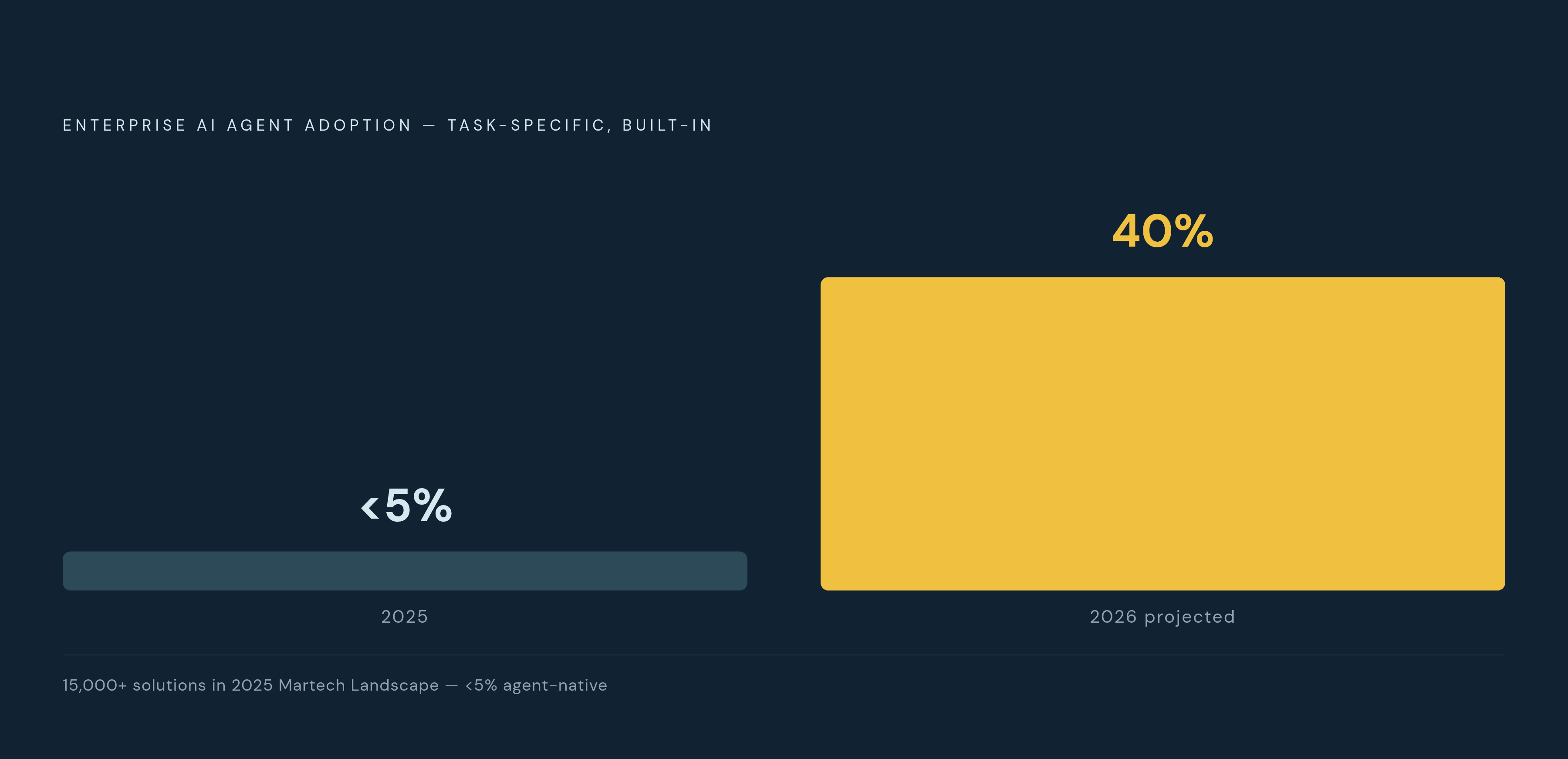
The timing matters. Gartner's numbers put this in stark relief: fewer than 5% of enterprise applications had task-specific AI agents built in during 2025. That number is projected to hit 40% by the end of 2026. That's not a slow climb, that's a door closing. And it's closing inside a market that's already flooded, with the 2025 Marketing Technology Landscape counting more than 15,000 solutions. The problem was never a shortage of tools. It's telling apart the tools that change outcomes from the tools that just add another dashboard to check.
What continuous execution actually replaces in a B2B paid media program
Most B2B paid media programs run on a rhythm: someone pulls reports weekly or every other week, spots what's broken, fixes it, and then the campaign just sits there until the next check-in. That gap between reviews is where money leaks out. Bids drift off target. Budget keeps flowing to segments that stopped converting days ago. Creative goes stale while nobody's watching. High-intent signals show up and go nowhere because no one's there to act on them in the moment. None of this is dramatic on its own, but it stacks up week after week.
Continuous execution closes that gap. Instead of waiting for the next scheduled check, agents watch performance live, shift budget, pause what's not working, and kick off new creative variants as conditions change, without needing a human to open a dashboard first.
Synter AI's case study makes the effect concrete. Campaign managers went from spending 60% of their workday on admin work down to 20%, and creative and audience testing sped up by 3x. Not from hiring more people. From handing execution to something that never stops watching. Campaign launch timelines dropped from 14 days to 2 in the same benchmark testing, and that speed compounds: faster launches mean faster learning, faster learning means faster iteration, and a program that iterates faster simply improves at a pace a once-a-week human cycle can't match.
This matters more in B2B than in most B2C contexts, because the stakes per mistake are bigger. A typical B2B purchase runs around $250,000 and pulls in more than 10 stakeholders. A week spent targeting the wrong job titles, or the wrong stage of the funnel, isn't a small miss. It's budget burned on an audience that was never going to convert, and B2B attribution is hard enough without adding avoidable waste to the mix.
What makes the agent useful here isn't that it's smarter than a person. It's that it's both fast and always on. It can act the second a signal shows up instead of waiting for the next time someone logs in to check.
How Google and LinkedIn function as a system for B2B pipeline, not as parallel channels
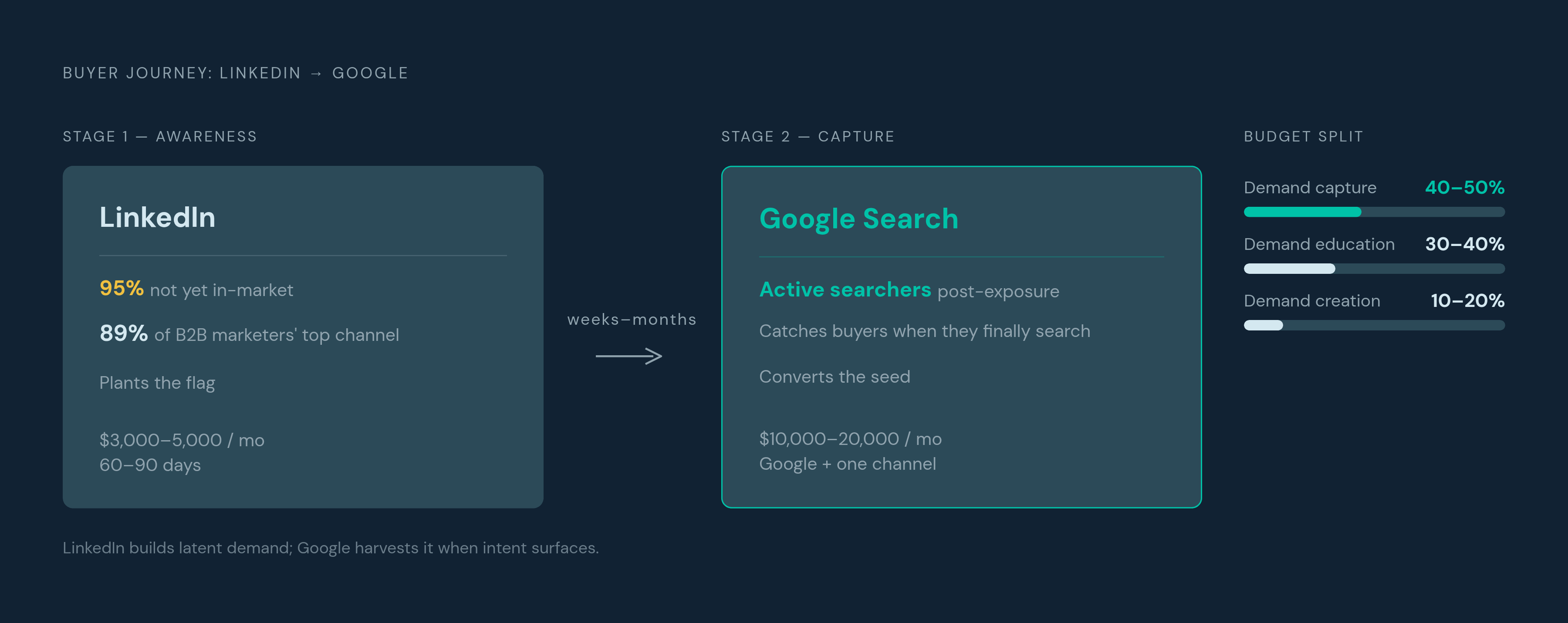
LinkedIn and Google aren't two lanes running side by side. They're two stages of the same buyer's path. LinkedIn builds awareness and fills the top of the pipeline. Google catches people who've already decided to buy and are actively searching for the answer. Treating them as interchangeable, or optimizing them separately, misses how they're supposed to work together.
LinkedIn's 2025 B2B Benchmark Report found 89% of B2B marketers name it their top channel for generating qualified leads, and it's easy to see why: a massive professional membership that includes tens of millions of decision-makers. That reach is what makes it the awareness layer.
LinkedIn's B2B Institute estimates roughly 95% of potential buyers in any category aren't in-market right now, which explains why awareness spend matters. They're not searching, they're not comparing vendors, they're just going about their day. LinkedIn's job is to plant a flag with those people before they start looking. Google's job is to be there once they do.
Sequence it out: LinkedIn runs an awareness campaign, and weeks or months later, that same person types a search into Google looking for exactly the kind of thing the brand sells. If the brand isn't showing up in both moments, a competitor probably will be. Budget frameworks reflect this split too: something like 40-50% toward demand capture, 30-40% toward demand education, and 10-20% toward demand creation. Get that split wrong across platforms and the whole logic falls apart.
Entry costs aren't trivial either. Running a real test on Google Search plus one other channel takes roughly $10,000-$20,000 a month. LinkedIn alone needs $3,000-$5,000 a month over 60-90 days before there's enough data to know which audiences and offers are actually winning.
This is where an agent earns its keep, because keeping that budget split right, day to day, across two platforms with different costs and different jobs, is exactly the kind of grinding, multi-variable task that wears down a human-run program. Someone has to notice when LinkedIn is outperforming and shift dollars accordingly, seed LinkedIn remarketing lists from Google Ads traffic, and keep creative consistent across both. Google Ads typically runs a lower cost per click than LinkedIn, and LinkedIn's higher cost per click or per lead only makes sense when it's evaluated against the quality and fit of the accounts it reaches, not raw lead volume. An agent tracking both channels in real time can make that trade-off as it happens, instead of catching it two weeks later in a report.
Where accumulated campaign intelligence separates agentic platforms from campaign management tools
Every campaign a traditional agency or in-house team runs ends the same way: a report gets written, and the next campaign starts over from close to zero. The learning sits in a spreadsheet or in someone's head. It doesn't live inside a system that acts on it.
An agentic platform built the right way doesn't let that learning go to waste. It keeps a record: which audiences actually converted, which creative angles worked for which segment, which landing page closed the gap between a click and a real pipeline opportunity. That history becomes the starting point for the next campaign instead of getting filed away and forgotten. Early campaigns end up doing the exploring. Later campaigns should be visibly smarter, spending less time rediscovering what already worked and more time pushing further on it.
This matters even more in B2B because of who's involved in a purchase. Buying groups average more than 10 people for a purchase around $250,000. Reaching every one of those people with the right message, over a sales cycle that can run for months, is only realistic if the system remembers what landed with each role the last time around.
The logic holds across programs: exclusion lists, audience refinements, and creative learnings built up over time become the starting point for what comes next. That kind of accumulated knowledge is nothing but learning made concrete, the system knows what to cut because it already paid to find out the hard way, once.
Compare that to an agency that rotates account teams or resets strategy every few months. That kind of setup can't compound the same way. Every cycle starts fresh, and the cost of relearning gets paid over and over again.
Clean data produces all of this, and none of it works without that. Roughly 85% of business leaders name the quality of their organization's data as the biggest challenge they expect from AI. Accumulated intelligence is only as good as what it's learning from, and a CRM full of bad records or attribution gaps poisons the signal before an agent ever touches it. So the real question when evaluating any of these platforms isn't "does it show me historical data." It's "does it feed that history back into what happens next." A dashboard with charts isn't the same thing as a system that acts on what those charts mean.
The platforms and tools operating in this space in 2026, and what each is actually built to do
This list covers only what's confirmed. No guessing at features, no filling gaps from memory.
Salesforce Agentforce is CRM-integrated agentic workflow, pushed into ChatGPT as a native app in December 2025. Sales teams can manage leads, update CRM records, and hand off prospecting tasks right from a ChatGPT conversation. It's built for teams whose main agentic need is CRM-connected execution and lead routing, not paid media optimization.
Demandbase One is built around account-based marketing orchestration, powered by a system that connects buyer signals, buying groups, and actions across the whole go-to-market motion. It works the full pipeline lifecycle: prioritizing accounts, activating programs, and improving performance continuously. It also offers Model Context Protocol integration, which pipes Demandbase data straight into AI assistant workflows so teams can act on signals without switching tools. Best fit: account-based programs where the hard part is identifying buying groups and routing signals correctly.
6sense covers ABM orchestration and intent data, and it launched AI agents in 2025 to handle repetitive tasks like personalized outreach and engagement sequences. Its own 2025 Buyer Experience Report found roughly 95% of potential category buyers may be out of market at any given time. That statistic is basically 6sense's whole pitch: get on the shortlist before the buyer starts actively shopping. Best fit: enterprise ABM programs where showing up before active evaluation begins is the priority.
Google Performance Max launched in November 2021 as the first major AI buying product across Google's full inventory. It automates targeting, creative, and optimization in one workflow. Its known weakness for B2B use is transparency: limited visibility into where budget actually goes and why specific placements got chosen. Best used as one piece of a demand capture strategy, not the whole plan.
LinkedIn Accelerate had a limited launch to select North American advertisers in October 2023, with a full global rollout completed in fall 2024. It automates campaign creation and optimization inside LinkedIn's own ecosystem. It carries the same caveat as Performance Max: platform-native tools optimize for what the platform reports, and that doesn't always map cleanly onto actual pipeline results.
Synter AI is an agentic paid media orchestration platform that came out of stealth on March 9, 2026. It runs across Google Ads, Meta, LinkedIn, Microsoft Advertising, Reddit, The Trade Desk, and StackAdapt through official APIs. A media buyer can type a plain instruction, something like "pause campaigns with CPA over $150" or "shift 20% of budget from underperforming ad sets to top converters," and the agents carry it out across every connected platform. Benchmark results so far: a substantial amount of pipeline generated, an 11x return on ad spend, a 133% improvement in click-through rate, a 46% cut in cost per acquisition, and an 81% lift in ROAS, with campaign launch time cut from 14 days to 2. It's built for teams that need cross-platform execution but want to keep giving the directions themselves, not hand over strategy entirely.
Concord, based in New York and Paris, is an agentic media buying platform that announced a seven-figure round of seed funding in June 2026, backed by a16z Scout, Drysdale, Motier Ventures, and Better Angle. It runs campaigns across Google (including DV360 and Google Ads), Meta, Amazon DSP, The Trade Desk, TikTok, YouTube, and other major buying platforms, all from one interface, using deep API integrations rather than protocol-layer connections. Concord's stated position is that Model Context Protocol "does less" than a direct API integration, because an agent working through MCP has to guess at targeting, tagging, and exclusion details it can't see clearly. It's built for teams that want tight control over execution across a defined set of platforms and are skeptical of protocol-based agent connections.
Delegated full-stack execution is its own category, separate from every platform above. It's not software the customer logs into and operates. It's not a platform-native tool, and it's not a point solution for one slice of the funnel like ABM. Agents run research, build campaigns, launch them, monitor them, optimize them, and learn from them, across Google and LinkedIn as one connected system, with a named person overseeing the decisions that actually carry business risk. The structural difference from every software platform, agentic or not, is accountability: software requires the customer to run it and own the results. Full-stack delegation shifts both execution and accountability off the customer's plate, with the named expert handling exceptions, governance, and the calls a platform simply isn't positioned to make. Fees aren't tied to media spend, which removes the incentive to push for a bigger budget instead of a better one. It fits sales-led B2B companies where paid media matters enough to need real attention, but the internal team doesn't have the bandwidth or specialization to run it every day, or where an agency relationship has gone quiet.
It remains to be tracked whether agents should talk to ad platforms through a standard protocol like MCP, which more AI and enterprise software platforms adopted through 2025, or through direct API integrations built platform by platform. Concord's argument for direct APIs over protocol-layer abstraction is a real, unresolved debate, not a settled one, and which approach proves out remains to be seen.
What the human judgment layer in an agentic system actually governs
None of this removes the need for a person in the loop. It changes which decisions that person is making, and how often they have to make them.
Agents are good at the decisions that come fast and often: adjusting bids, shifting budget between ad sets, pausing what's underperforming, rotating creative, launching campaign structures that were already approved, pulling together reports. These are high-frequency, data-heavy, rule-friendly decisions where speed beats deliberation.
Agents are bad at, or simply can't touch, the decisions that require judgment about the business itself: changing how the company positions itself, redefining who the ideal customer actually is, rethinking messaging when the market shifts underneath the program, approving budget above a certain threshold, making a creative call that depends on brand instinct, or figuring out whether a pipeline slowdown is actually a marketing problem at all, versus a product problem no amount of ad optimization will fix. Those calls need someone who understands the business and is on the hook for what happens next.
That last point is the real diagnostic function a human still has to provide. A system that only tunes the ad account can't tell anyone whether the real constraint on pipeline is the creative, the landing page, a hole in attribution, or something further down the funnel that marketing doesn't even control. Answering that requires someone looking across the whole system, asking a different kind of question than "which ad set has the best CTR."
What that looks like in practice, structurally, is a small team built specifically to test and supervise a single media activation agent, treating human oversight as a defined role rather than an afterthought bolted onto the software. The tools can run continuously. The judgment about what they're running toward still belongs to a person.