Agent Orchestration Architectures for Multi-Channel B2B Ad Programs
Unifying Google and LinkedIn reveals hidden leaks in siloed B2B campaigns.
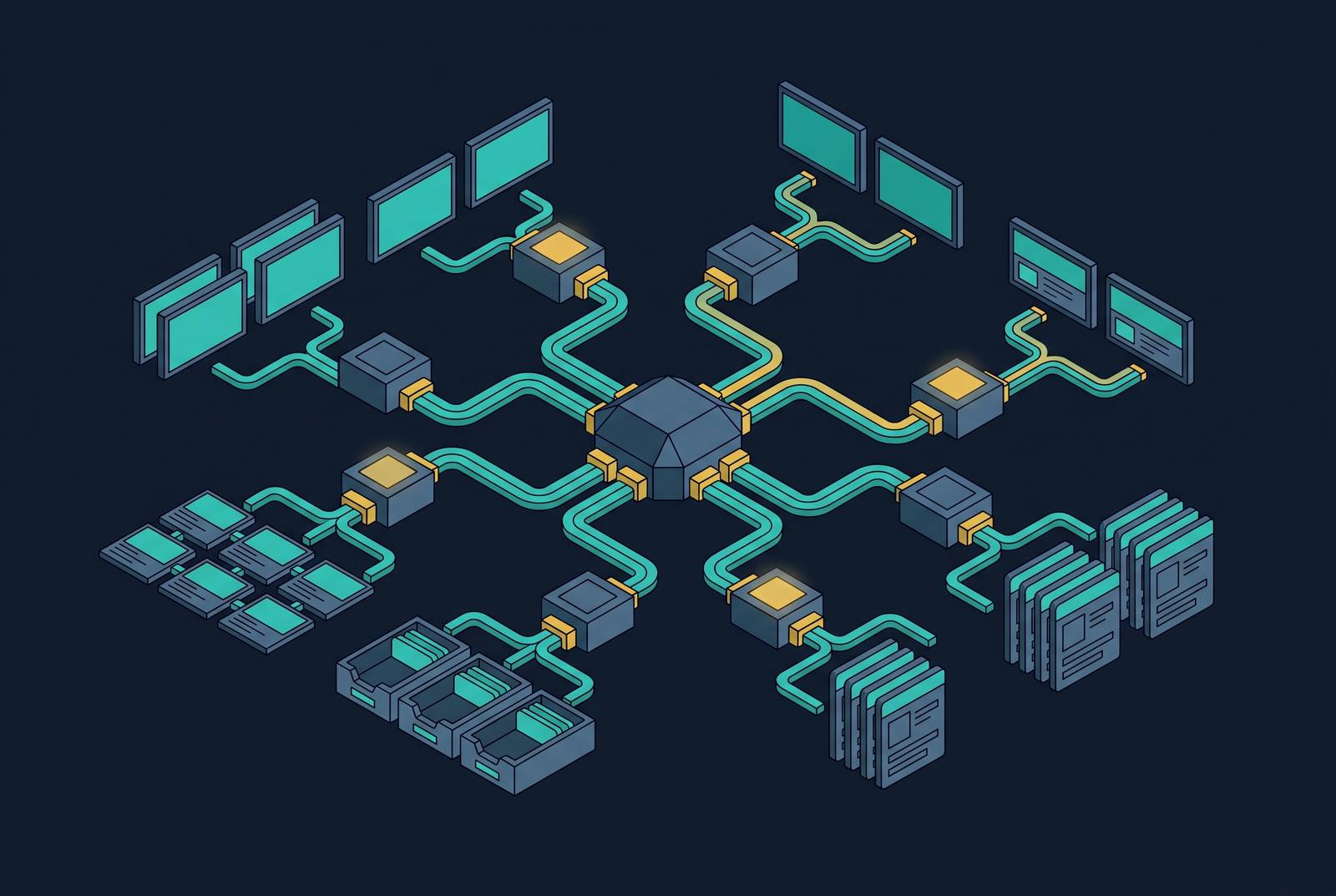
Running Google and LinkedIn as one B2B ad program, instead of two separate campaigns with two separate budgets, takes something most teams don't have: a system that passes information between specialized functions, keeps a shared memory of what's worked, and knows when to hand a decision to a person instead of a machine. Call it orchestration.
Start with the default setup, because it explains why this matters. Most B2B teams run Google and LinkedIn as parallel tracks. Different people, different budgets, different optimization loops. Whatever the LinkedIn team learns about which job titles convert never touches the Google bidding strategy. Whatever intent signal appears in Google Search (someone typing "endpoint detection pricing" at 11pm) never informs who LinkedIn targets next week.
That gap matters more in B2B than almost anywhere else, because B2B deals aren't won by reaching one person. A typical deal now involves multiple stakeholders: the economic buyer, the technical evaluator, the end users, procurement, sometimes legal. A single contact reached on LinkedIn is not the buying committee. Treating one channel, one contact, one campaign as the whole game doesn't match how these deals actually close.
Google and LinkedIn are complementary tools that catch different moments in the same buying journey. They're complementary, and they catch different moments in the same buying journey. Google finds people who already know they have a problem and are actively searching for a fix. That's commercial intent, already in motion. LinkedIn lets a team target by job title, seniority, company size, and industry before that search intent even shows up. One channel meets the moment. The other builds toward it. Run them apart and the connective tissue between "who might buy this" and "who is ready to buy this now" disappears.
Siloed execution has quiet costs that stay invisible until they raise the pipeline numbers when they come in. Creative fatigue on LinkedIn can run for weeks with nobody noticing, because nobody's watching that platform against a shared standard. A landing page that's clearly underperforming in Google's conversion data never triggers a second look at the LinkedIn ads pointing to the same page. Each platform looks fine in its own dashboard while the program quietly leaks value.
That's what happened in one B2B cybersecurity program: over 400 leads a month, cost per lead looked fine, and only 8 of those leads a month turned into qualified opportunities. A 2% lead-to-opportunity rate. Every platform-level metric said the program was working. The pipeline said otherwise. That's what a program built without shared visibility produces, almost by design.
The real question is what it takes to run Google and LinkedIn as one system instead of two. It's what it takes to run them as one system instead of two.
What an orchestration layer is and what job it does in a multi-channel ad program
Orchestration gets confused with two things it isn't. It isn't integration, which just means the platforms can talk to each other technically. And it isn't automation, which is just if-this-then-that rules running on autopilot. Orchestration is coordinated execution across specialized functions, each one aware of what the others are learning, all working toward one shared goal.
The old model ran research, then creative, then buying, then reporting, one step after another, through a single system. The better model runs several specialized functions at once, each handling its own piece, all checking in with a central planner that keeps everyone pointed the same direction.
That planner has to hold three things. Shared state: a running record of what's been learned so far. Routing logic: rules for which function acts next, and on what signal. And memory that survives past a single campaign, carrying lessons from one cycle into the next.
Gartner projects that 40% of enterprise applications will have task-specific AI agents built in by 2026, up from under 5% in 2025. That's not a gradual shift. Any program still running two disconnected platforms in a year or two won't just be behind a trend, it'll be behind an architecture most competitors already have in place.
Picture the system in three layers, stacked on top of each other. At the top: goals and constraints, things like who counts as an ideal customer, what the brand can and can't say, what compliance requires. In the middle: planning and memory, deciding what to do next based on context. At the bottom: execution, the ad platforms, the CRM, the landing pages, the reporting tools. Each layer needs direction from above and feedback from below, or the whole stack stops learning.
There's a real choice buried in how this gets built, and it deserves a side taken. Closed systems come pre-integrated and get running fast, but they lock a team into someone else's decisions about how memory works and what gets tracked. Open systems built on connectable interfaces take more setup work, but they give a team full ownership of the shared-state layer, no vendor lock-in. For a program that plans to run this way for years, the setup cost of an open system is the cheaper option long-term. The convenience of a closed system is a rental fee, and the meter never stops.
Two technical standards explain why this is getting easier to build than it was even a year ago. MCP, or Model Context Protocol, adopted by major communications platforms in 2025, standardizes how these functions access tools and data, which cuts down the fragmentation that makes shared state unreliable. A2A, or Agent-to-Agent protocol, handles the other half: how functions negotiate with each other, hand off tasks, and pass context along, not just how they reach a shared toolset.
The functional agents a multi-channel B2B program needs and what each one is responsible for
Break the system down into the jobs it actually has to do, and six functions become visible in any program running Google and LinkedIn together.
Research and intent watches third-party intent data, account engagement, and keyword activity to figure out which accounts are actively in-market, and when. It's the listening function. Everything downstream depends on what it surfaces.
Audience construction takes what research finds and turns it into platform-specific targeting. On LinkedIn, that means keeping audience size in a workable range, roughly 50,000 to 200,000, a range associated with effective B2B campaign delivery on the platform. On Google, it means match-type discipline: phrase and exact match first, broad match only once there's enough conversion data to justify it.
Creative writes and rotates ad copy and visuals, tracks fatigue across both platforms (a four-to-six-week rotation is a reasonable cadence), and keeps a record of which messages worked with which audience segments, so that knowledge carries into the next round instead of getting rebuilt from scratch.
Landing page and conversion watches what happens after someone clicks. It flags when the ad promises one thing and the landing page delivers another, and it separates a creative problem from a post-click problem, a distinction that's basically invisible if each platform only looks at its own numbers.
Media buying and budget is where speed pays off. If Google is converting at half the cost of LinkedIn for the same audience, this function shifts budget toward the better-performing channel and flags underperforming creative for action, compressing the time between signal and response.
Attribution and reporting closes the loop, and it's the most important function of the six. It passes Google Click IDs (gclid) and LinkedIn's First-Party Ad Tracking IDs (li_fat_i) into hidden fields in the CRM, tracks leads through the full lifecycle (MQL, SQL, Opportunity, Closed-Won), and uploads closed-won deal values back to both ad platforms. That last step trains the platforms' bidding algorithms on actual revenue, not form fills.
None of these functions matter much alone. A research insight only changes anything once it reaches the buying function with enough context to act on. The value sits in the handoff between functions, not in any single one of them.
How shared state and memory turn campaign history into compounding intelligence
Shared state is a running record: which audiences converted, which creative combinations wore out, which landing pages underperformed, which budget shifts actually moved qualified pipeline. That record sits there, available to every function at the start of the next cycle.
Without it, every cycle starts from zero. The same creative mistakes happen again. The same audience gets over-targeted again. The same budget split gets re-argued from scratch, with nobody able to point to what happened last time.
With shared state, research knows which intent signals historically led to real opportunities, not just form fills. Creative knows which messages actually built pipeline, not just which ones got clicks. And buying starts each cycle with a working theory, built on real history, about which platform mix produced the best lead-to-opportunity rate.
This changes where time goes. Before this kind of system, most of a marketer's time went into building campaigns, with a thin slice left for analysis. Once agents handle execution and the grind of optimization, that ratio flips, and the human role shifts toward strategy. Teams running this kind of automated optimization report a 60% cut in manual work, a 14.5% bump in sales productivity, and a 12.2% drop in marketing overhead.
Memory runs on two timelines. Short-term memory handles what's happening inside a single campaign right now: real-time budget shifts, pausing a creative that's dying. Long-term memory carries the bigger patterns across campaigns: which audience segments have historically turned into Closed-Won deals, what the seasonal pipeline pattern usually looks like.
None of this compounds on its own, and this is the part teams skip. It needs the attribution loop to actually close, offline conversions uploaded to both platforms, the CRM connection live and current, and someone (or something) writing to the memory layer after every cycle. Break any one of those links and the learning stops building. It just stops getting better, quietly, in a way that looks fine on a dashboard for months before anyone notices. It just stops getting better, quietly, in a way that looks fine on a dashboard for months before anyone notices.
Where the orchestrator routes decisions to human judgment and why the boundary must be explicit
A common mistake treats human oversight as a single checkpoint, an approval button before a campaign goes live, instead of a standing job that watches the system's judgment over time. Those are very different things, and confusing them is where most of these programs quietly break.
Some decisions are exactly what these functions should handle continuously: shifting budget within set limits, rotating creative, adjusting bids, refreshing audiences, flagging anomalies. High-frequency, data-heavy calls where speed is the whole point.
Other decisions need a person, full stop. Changing who counts as an ideal customer. Shifting the offer or the core message. Approving spend above a set threshold. Changing the platform mix in a way that reflects a real strategic bet. Figuring out why pipeline quality dropped when the data doesn't make the reason obvious. A system shouldn't be resolving any of these on its own, no matter how good its track record looks.
There's a security angle too, and it isn't theoretical. Research on multi-agent systems (OMNI-LEAK, published in early 2026) found that a single indirect prompt injection can compromise several connected functions at once and leak sensitive data, even when access controls are technically in place. Safety measures on each function separately don't add up to safety for the whole system. That gap means access control, audit logs, and human review of anything unusual aren't optional extras. They're basic requirements for any system touching CRM data, account records, and ad platform logins.
A reasonable starting point is assisted autonomy: the system recommends a budget shift or an audience change, and a person signs off before it runs. That's useful while a team is still calibrating the system and building trust in its judgment. But it's a starting point, not the destination. The goal is a setup where the system executes on its own and a person reviews the exceptions, not one where every move needs a signature forever.
Somebody has to be the named, accountable person here: the one who owns outcomes, interprets what the data doesn't explain, and makes the calls with real business consequences. Skip that person, and the orchestration layer becomes a black box with good intentions rather than a system.
And the failure rate for skipping this part is high. By one estimate, 88% of AI proofs of concept never make it to production. Another study found 95% of generative AI pilots fail to show measurable ROI. The reasons trace back to governance gaps: no clear framework, no roadmap (64% of marketing teams report not having one), and weak data (only 16% of RevOps professionals say they trust their own data). None of that is a technology problem. It's a discipline problem, and it's the one most teams underestimate because it stays invisible in a product demo.
Measurement architecture that connects agent activity to pipeline, not platform metrics
Each platform grades its own homework. LinkedIn reports leads. Google reports clicks. Neither reports pipeline contribution unless someone deliberately builds the CRM connection that makes that possible.
LinkedIn's Lead Gen Forms are the clearest example of the trap this creates. Pre-filled forms make submitting almost effortless, which inflates lead volume with people who never really engaged with anything. One cybersecurity program restructured around this exact problem: leads dropped from over 400 a month to 110, but lead-to-opportunity rate jumped from 2% to 18%, and qualified opportunities rose from 8 a month to 20. The fix was sending traffic to the actual website instead of the friction-free form. Fewer, better leads beat more, worse ones, and the only way to see that clearly is by measuring past the platform's own dashboard.
The system should be built around cost per qualified opportunity (not cost per lead), pipeline ROI (pipeline dollars generated per dollar spent), and blended customer acquisition cost across both channels. None of these live in a platform's native reporting. They only exist once CRM data is in the loop.
Math should constrain all of this from the start, not get applied after the fact. If average deal size is $30,000 and 5% of leads eventually close, each lead is worth about $1,500 in expected revenue. Target cost per lead should be about 10 to 20% of that. Build that math into the system up front, and it stops treating every lead as equally valuable.
A useful structural discipline here is a three-layer split for demand: roughly 40 to 50% toward demand capture (Google Search, high-intent keywords), 30 to 40% toward demand education, and 10 to 20% toward demand creation. Splitting budget this way forces measurement to follow the same split, which makes it obvious where the program is actually falling short instead of hiding weak spots behind an averaged-out number.
The mechanism that closes all of this is the offline conversion upload: sending closed-won deal values back to Google Ads and LinkedIn Ads so their bidding algorithms train on real revenue. Skip that step, and both platforms keep optimizing toward form fills, which means all the shared intelligence built up in the system is aimed at the wrong target. Gartner expects 80% of advanced marketing teams to be using AI to optimize multichannel campaigns in real time by 2026, and none of that works without a measurement setup that feeds the system real signal, pipeline and revenue, instead of platform-level proxies.
What a functioning orchestration architecture looks like in practice for a sales-led B2B program
Put it together, and Google and LinkedIn stop being two campaigns and become two channels inside one program, sharing audience data, creative learning, and attribution through a single coordinating layer.
A cycle runs something like this. Research flags which accounts are in-market right now, using intent signals plus what's worked in past pipeline. Audience construction turns that into platform-specific targeting: job title, seniority, and company size combinations on LinkedIn, keyword and audience layering on Google. Creative builds variants based on what actually drove pipeline last cycle, not just what got the most clicks. Budget starts from the three-layer demand split, and buying adjusts inside that range based on real-time conversion efficiency. Landing page and conversion watches for a specific mismatch: a Google Search visitor and a LinkedIn visitor hitting the same page but converting at different rates, which usually means the page doesn't match the intent level of one of the two audiences. And attribution closes the loop: gclid and li_fat_id into the CRM, lifecycle tracking through to Closed-Won, offline conversion data uploaded back to both platforms.
What builds up over time is the record: which account segments turned into real pipeline, which creative combinations lasted and which burned out fast, what the platform mix looked like during the strongest lead-to-opportunity stretch. That's the memory the next cycle starts from, instead of starting cold.
LinkedIn's cost per click, often $8 to $25 or more, means budget decisions carry real weight, and the guardrails matter: a floor on audience size (that 50,000 minimum), match-type discipline on Google, both there to stop the system from chasing efficiency into low-quality reach. B2B companies typically put somewhere between 20 and 35% of total marketing budget into paid media, and within that, often 10 to 20% goes to retargeting on Meta. In a properly orchestrated program, that retargeting layer runs inside the same system, not as a separate line item nobody's watching.
And the human checkpoints stay explicit through all of this. A person sets the ideal customer definition before research ever runs. Spend above a set threshold needs a human sign-off. A sudden drop in pipeline quality triggers a human review before the system changes targeting on its own. Everything else runs continuously, without waiting on anyone.
That's the real difference between this and the alternatives. An agency rebuilds context every time a new engagement starts. Software hands the operator a dashboard and expects them to interpret it and act. An orchestrated system with a named, accountable person running it keeps building context cycle over cycle, and routes the decisions that actually matter to someone who answers for the outcome.