Landing Page System Integration in Agentic Campaign Architectures
Agents can't optimize campaigns when landing pages stay disconnected from their decision loops.

Most agentic campaign setups have a hole in them, and it sits exactly where the ad ends and the page begins. Nothing comes back out of it.
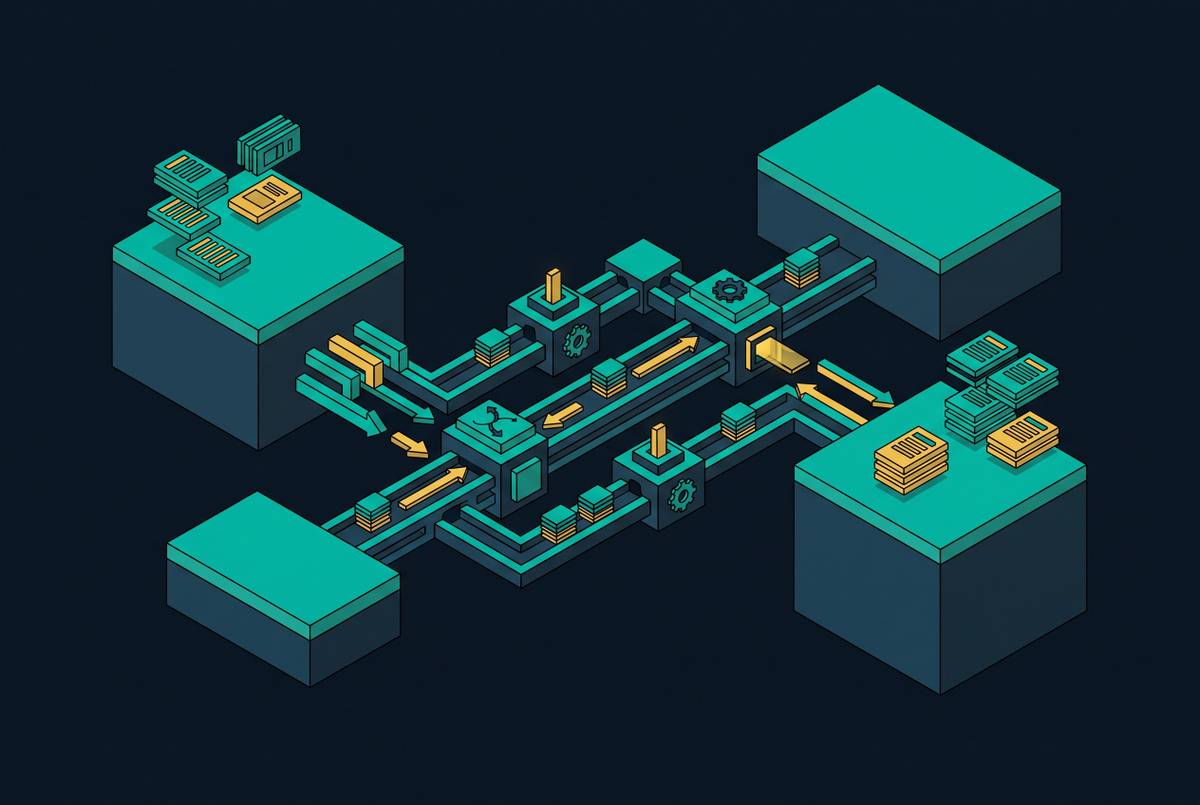
That design made sense when campaigns were built by hand and reviewed weekly. It breaks down the moment the rest of the stack goes agentic. Agentic AI systems run on iterative perception-reasoning-action control loops: they watch, they think, they act, and they watch again. Every piece of that loop is wired together and feeding itself fresh data, except the landing page, which in most deployments still just sits there collecting form fills.
That gap means what happens after someone lands on the page, whether they read, scroll, hesitate, leave, or convert, never makes it back into the system doing the deciding. And the post-click experience is where the real information lives. Losing that signal doesn't just shrink the dataset a little. It removes the most informative part of the entire loop, right at the moment it would have been most useful.
What every component owes an agent loop
Fixing a landing page starts with knowing what "fixed" actually means for a component inside an agent loop. Any component that wants to be a live part of that loop, rather than something the loop merely points at, has to serve all five. That standard applies the same way to a bidding algorithm, an audience model, or a landing page. There's no special exemption for pages just because they used to be static.
Production-grade agent architectures handle this by separating cognitive reasoning from execution, connecting the two through typed tool interfaces. It reads a defined, structured interface instead. That has a direct consequence for landing pages. A page can't be read by an agent's reasoning layer unless it exposes that same kind of structured interface, the agent equivalent of being legible.
Walk through what each of the five jobs means at the page level. Action means the agent can actually do something with what it learns, across channels it's credentialed to touch. And that's where a disconnected landing page becomes a real liability: any boundary between systems adds latency and a chance for something to break, and a page sitting outside the agent's integrated, credentialed environment is precisely that kind of boundary.
Put together, the test for whether a landing page is actually part of the loop is direct. If the page can't expose real-time behavioral event streams, and outcome data from it doesn't flow back into a unified profile, it's a wall the system runs into on every single cycle.
The data connections that make a landing page readable by an agent
Getting a landing page to the point where an agent can actually use it comes down to two things: unified identity and real-time behavioral data, both resolving to the same place the agent already keeps its profile information.
Identity resolution is the foundation. On its own, that ID is nearly useless. It needs to stitch to the account and contact record already sitting in the system, so the agent logs which specific person, on which account, at which stage of the buying process, landed on which version of the page. Without that stitch, every page visit is an anonymous event floating outside the system the agent actually reasons with.
Behavioral data is the second piece, and it needs to be far more granular than a form fill. A form fill by itself is too blunt an instrument for an agent to act on. Two visitors can both fill out the same form and have had completely different experiences getting there, and an agent that can't see that difference is working with a fraction of the information available.
Both of these need to move in real time, not in batches. Analytics that refresh overnight defeat the purpose of running an agentic loop. The integration has to be event-stream based, where each scroll or click or exit fires as it happens, rather than summarized into a session report delivered the next morning.
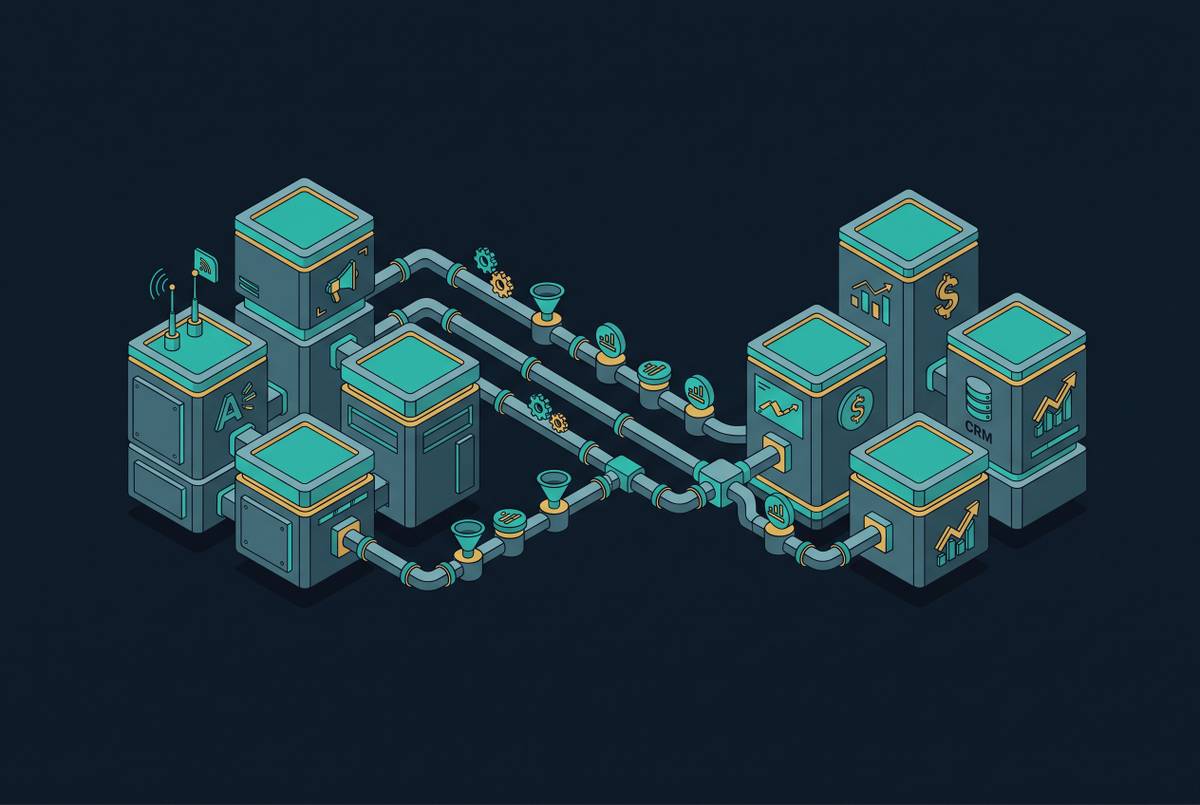
The structural prerequisite is programmatic page generation. Platforms that connect landing page creation to data sources by API, linking to tools like Zapier, Airtable, Clay, and similar systems, let an agent generate, vary, and update pages from the same pipeline it already uses for everything else in the campaign. Where the orchestration environment and the page layer share that kind of connective tissue, the page stops being a separate tool the agent has to reach across a gap to use. It becomes a node inside the same graph as everything else.
Feeding landing page signals into creative and audience decisions
Once that data is flowing, the next question is what the agent actually does with it. This is where the integration starts paying for itself, because page signals change what the agent understands about creative and audience, not just who clicked.
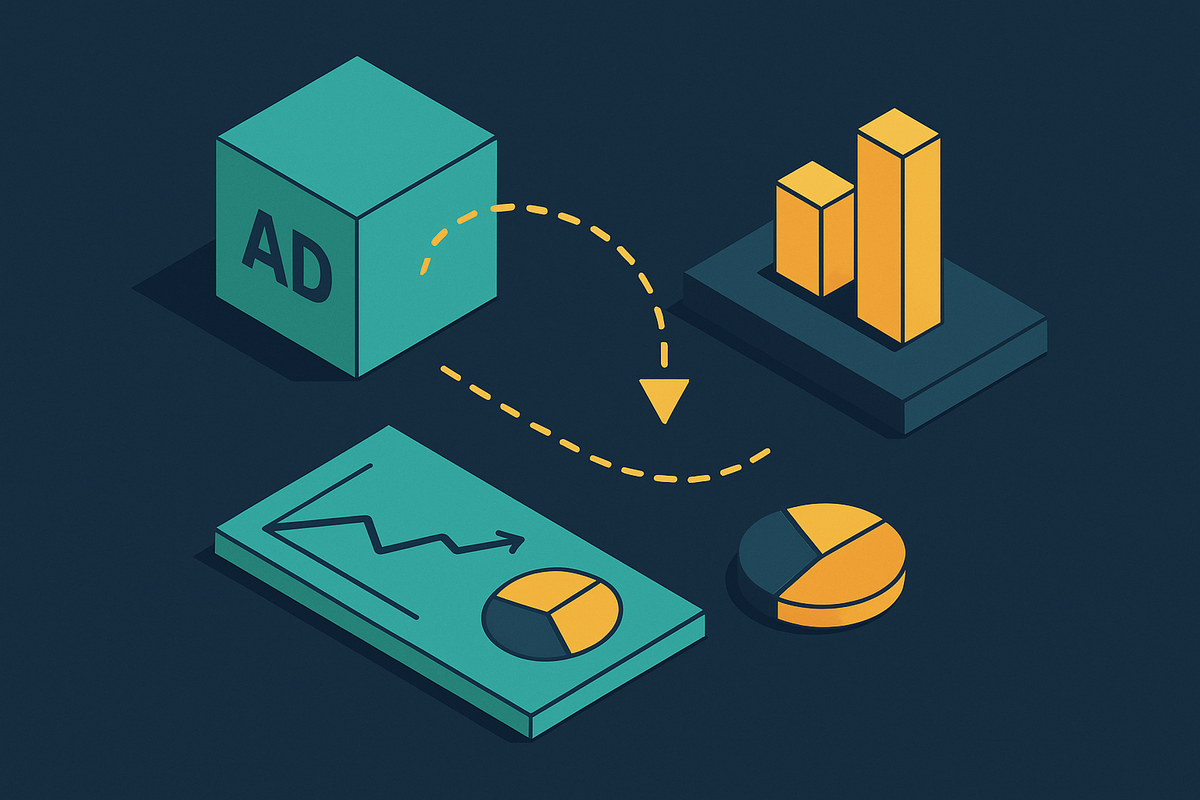
Click-through rate tells the agent one thing: the ad was interesting enough to act on. Page engagement data fills that gap. A high click-through rate paired with an immediate exit is a mismatch between what the ad promised and what the page delivered, and an agent that can see both halves of that equation can catch it immediately instead of continuing to spend against a broken funnel.
Section-level engagement makes this even more specific. Say an ad targets CFOs, and the resulting visitors spend real time on a cost-efficiency section but drop off once they hit implementation detail. That's a message-resonance signal the agent can act on directly, either by routing that persona to a variant built around their actual priorities or by flagging the gap for a human to revise the creative.
The same data supports something closer to detective work on buying committees. An agent that can see this builds a far richer picture of the buying group than a single conversion event ever could, and it can use that picture to decide which ad variant each of those people sees next.
All of this feeds the memory function directly. Each campaign cycle that folds page-level signal back in narrows the hypothesis space for the next one. Creative decisions stop starting from a blank brief and start from an accumulating record of what specific personas respond to.
There's already a real-world example of this feedback direction built into a major platform. Google's AI Max for Search, which exited beta in April 2026, auto-selects and generates ad text variants directly from landing pages. The page is an input the ad creative gets built from in that system.
Personalization at the page level as an agentic execution task, not a design task
If signals are flowing back into the agent, the logical next step is signals flowing forward too, with the agent acting on what it learns by changing what the page actually shows. That reframes personalization. It changes from something decided once, before a campaign launches, into something the agent keeps doing throughout the campaign, in parallel with everything else it's optimizing.
Account-based marketing makes the shift concrete. Agentic systems generate that content from a single brief, across many accounts, in parallel.
HubSpot's Campaign Agent shows what this looks like in practice: it takes an objective along with context (audience, brief, historical performance, brand identity) and uses that to plan a campaign, generating draft landing pages, forms, and emails for review as part of that same plan. The page isn't produced separately and handed off afterward. It comes out of the same planning step as everything else in the campaign.
The speed difference this produces is not small. That gap is a difference in architecture: one process routes through a person at every step, the other doesn't have to.
At scale, this requires the page layer itself to be programmatically addressable. An agent managing hundreds of variants across different accounts, personas, and funnel stages needs to create, update, and retire those variants without a person opening a CMS for each one individually. That's not a nice-to-have. Without it, the variant count an agent can realistically manage collapses back down to whatever a human team can click through by hand.
What doesn't get handed to the agent is the narrative frame: the brand voice, the value proposition, the overall architecture of what the company is claiming and why. Those are set by a person, and the agent works inside them. That boundary, between what gets executed automatically and what gets decided by a human first, is exactly where the next section picks up.
Governance boundaries at the landing page layer
Every agent loop integrated this deeply needs boundaries drawn before it runs, not after, and the landing page is where those boundaries matter most. The decisions that show up at the page layer are different in kind from a bid adjustment or an audience exclusion. A page that makes an unauthorized claim to a buyer belongs to a different category of problem.
Production-grade agentic systems are built around an enterprise hardening checklist that covers governance, observability, and reproducibility, and the landing page layer is where all three are hardest to hold onto if the boundaries weren't designed in from the start. Getting those brand and legal decisions wrong carries consequences that a performance dashboard doesn't track.
The guardrail framework for this has to exist before the first autonomous campaign runs, not after. Constraining an agent that's already generating and updating live pages is a far harder problem than designing the constraint into the system from day one.
HubSpot's Campaign Agent offers a working example of the right pattern: it holds assets in review and does not publish them without a human signing off first. The agent drafts and proposes. A person approves before any of it reaches an actual buyer. That sequence, propose then approve, is what keeps the system trustworthy enough to extend further.
Observability has to run alongside that approval step. Every page variant an agent creates or modifies needs to be logged along with the reasoning that produced it, not just a record of what changed but why the agent made that choice. That's what lets a human reviewer actually judge whether the agent's call was sound, and correct it when it wasn't.
Skipping this structure produces a predictable failure mode.
None of this is conservatism for its own sake. The governance layer is what makes the whole integration trustworthy enough to run at scale. An agent nobody trusts doesn't get the access the architecture depends on, so the guardrails are what let the system go further than it otherwise could.
Attribution across the full loop: connecting page signals to pipeline, not just conversions
The measurement underneath the preceding integration work has to go past the form fill, or none of that work matters much. Most B2B marketing reporting still measures page performance by conversion rate, form fills divided by visits, and that number tells the agent nothing about whether those conversions ever became qualified opportunities, let alone closed revenue. An agent optimizing against conversion rate alone is optimizing against a signal that looks complete and isn't.
What the agent actually needs to optimize well: cost per pipeline opportunity, opportunity rate broken out by creative variant, pipeline-to-spend ratio by page variant and audience segment. Without that connection, the agent can tell a team which page got the most form fills. It can't tell anyone which page actually produced paying customers.
The buying-committee example makes this concrete. Say a CFO visited a page variant built around return on investment, a CTO visited a variant built around security, and the deal closed. Answering that requires identity-resolved, account-level attribution that tracks every touch, not a single conversion event tied to whichever form happened to get filled out last.
This connects straight back to the memory function described earlier in the loop. An agent working from that limited memory will drift toward optimizing for metrics that look encouraging on a dashboard without actually predicting revenue.
The practical requirement: a landing page has to be instrumented to do more than fire a conversion event when a form gets submitted. It needs to pass a session and identity token the CRM can stitch to the opportunity record, so that whatever revenue eventually results traces back to the specific page variant and creative frame that produced it. That's the only way the attribution chain actually closes.
Fee structures matter here too, in a quiet but direct way. Accountability runs the entire length of the loop, from the ad to the page to the opportunity record, instead of stopping wherever it's convenient to stop counting.
Readiness for treating landing pages as integrated execution nodes
Treating a landing page as a live node in an agent loop is a readiness question, and most teams aren't ready yet because the gaps are data and governance problems.
The data side needs unified identity resolution that ties a click ID to an actual account and contact record, real-time behavioral event streams instead of next-morning analytics, and programmatic page generation wired to the same data pipeline running the rest of the campaign. And the governance side needs a guardrail framework, built before the first autonomous campaign goes live, that draws a hard line around which decisions an agent can make on its own and which ones require a person to sign off first.
Any team missing one of those three pieces hasn't failed at building an agentic landing page. It simply hasn't reached the point where a landing page can be one yet.