Workflow Automation Integration Between Agentic Ad Systems and RevOps Tools
AI insights mean nothing unless they trigger real actions across your revenue stack.
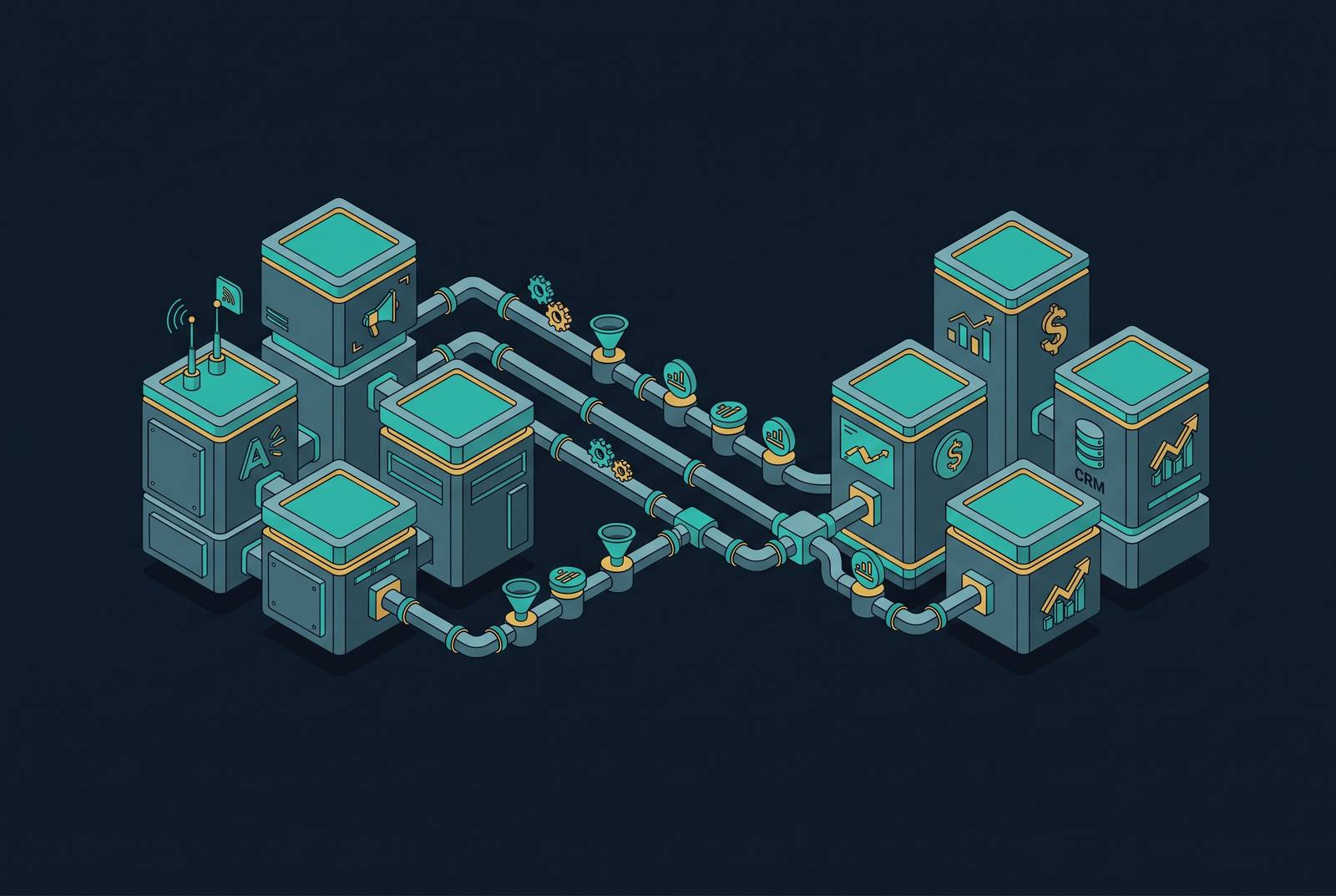
Most agentic ad systems don't fail because the AI underneath them is weak; they fail because the insight that AI produces has nowhere to go. It sits inside the ad platform, dressed up as a recommendation, while the systems that actually run the business, the CRM, the finance tools, the support desk, never hear about it.
AI agents can read signals and generate recommendations just fine, but without a way to trigger automation across CRM, ERP, marketing, finance, and support platforms, those agents can only suggest and can't act. That's a narrow failure point with a wide blast radius, because almost every claim made about agentic marketing assumes the agent can do something with what it finds.
Think about what that gap actually looks like day to day. An agent spots a cluster of accounts showing real buying intent, the kind of pattern a human analyst might take a week to notice. So what happens to that insight? It becomes a line in a dashboard. It becomes an entry in a report somebody might check on a slow Tuesday, not a revenue action.
For sales-led B2B companies, that delay costs real money. And somewhere in that stretch, there's a narrow window where a signal is actually worth acting on, before the account cools off or a competitor gets there first. A recommendation that sits unread in a tool during that window produces the same result as no recommendation. Same result.
That's the problem this entire piece is built to answer. Integration is the thing that makes the AI's output mean anything in the first place, not some nice-to-have you bolt on after the AI is working. Without it, you've built a very smart observer with no hands.
What RevOps integration means for an agentic ad system
Integration, in the way this article means it, is a two-way street. Data moves from the ad system into the CRM and attribution tools, and it moves back the other way too, continuously. That's a different animal than exporting last month's campaign numbers into a spreadsheet once a week.
Celigo frames the upside clearly: once systems are wired together through a real integration platform, AI agents stop being passive analysts and start orchestrating action across the whole revenue process. The connection itself is what turns insight into something that actually happens.
Tofu's 2026 guide to agentic marketing lays out what a system actually capable of this needs to do: write and personalize landing pages, draft and send emails, launch ad campaigns, update CRM records, and notify sales reps, all as one coordinated motion. None of that works on a nightly data sync. It needs live access, in both directions, all the time.
The piece of plumbing that makes this kind of coordination possible is a protocol called Model Context Protocol, or MCP. Picture a paid media agent, a content agent, a conversion analysis agent, and a CRM update agent, all looking at the same live data at the same time, instead of passing information down a chain where each hand-off adds delay and loses detail.
What actually matters here is the back-and-forth: the CRM tells the ad system which accounts are already in the pipeline, so the system doesn't waste money chasing an existing customer or a deal that died three months ago. Thunder's own setup wires its agentic ad system directly into a customer's CRM, attribution tools, and pipeline data, so an agent's insight becomes an executable action instead of a suggestion sitting in a queue nobody opens.
What CRM data lets an ad agent decide
Giving an ad agent live access to CRM data shifts something fundamental: it stops optimizing for audiences in the abstract and starts making decisions about specific accounts.
That unlocks a handful of things that used to require a person manually pulling lists and uploading them. When an account moves from cold to a marketing-qualified lead, or from qualified lead to sales-qualified, the agent can shift ad budget toward that account right away instead of waiting for the next time someone rebuilds the campaign.
The clearest example of what this makes possible is creative personalization by deal stage. The same logic covers alerts: when the ad system picks up a sudden jump in engagement from a named account, a CRM-connected agent can notify the assigned rep the moment it happens, rather than that signal getting buried in a performance report someone skims once a week.
None of this works if the CRM data feeding it is a mess. Duplicate records, stale deal stages, and missing fields will teach the agent the wrong lessons just as fast as good data teaches it the right ones. That's a real cost to keep in mind, but it doesn't change the basic shift: once CRM data is live and reliable, the ad agent is making account-level decisions grounded in specific accounts.
Closing the attribution loop into the ad system
There's a real difference between attribution that feeds a dashboard and attribution that feeds back into the ad system's decision-making. A dashboard tells a marketer what already happened. A closed loop tells the agent what to change next. One is a post-mortem. The other is a feedback mechanism the system can actually use.
This matters more in B2B than almost anywhere else, because B2B buyers touch a long list of channels before they ever sign anything, and most companies only track a fraction of those touchpoints. An agent optimizing against reported conversions, when those reported conversions only capture part of the real picture, ends up optimizing against the wrong signal without anyone realizing it.
The gap stays invisible until attribution gets connected all the way to CRM pipeline data. Without CRM-connected attribution, that gap stays invisible, and the team keeps funding the ad that looks better on a lead-count chart while quietly starving the one actually building revenue.
Making an agent's feedback loop trustworthy takes more than one attribution method bolted on. It takes a few, stacked across different time horizons. Incrementality testing checks whether a channel is actually causing conversions or just sitting near them and taking credit. That third layer matters because without it, an agent can keep scaling a channel that looks productive on paper but isn't actually moving the needle.
Pipeline signal as the real-time input that keeps ad spend synchronized with sales reality
If there's one automation that moves the needle most in a sales-led B2B ad program, it's the one that notices an account has entered an active buying stage and reconfigures what the ad system does for that account immediately, without a human updating a target list or spinning up a new campaign by hand.
Several kinds of signals belong in this loop. And when an account that was actively engaging suddenly goes quiet, that should trigger a suppression of ad spend on that account and a flag for sales follow-up, rather than continuing to burn impressions into silence.
What ties all of these together is timing. Without a live pipeline connection, an ad agent is working off last week's campaign numbers instead of this hour's account behavior, and targeting stays frozen between whatever campaign update a human last got around to making. An applied-AI company running paid media end-to-end, Thunder being one example, operates agents across Google and LinkedIn Ads with live access to a customer's growth stack, which is what genuine bidirectionality actually requires: the ad system and the CRM trading account status and intent signals back and forth in real time, so decisions get coordinated instead of handed off in sequence with gaps in between.
The specific workflow automations that wire these integrations together operationally
All of the integration arguments made so far only produce real value once they're built into specific, named workflows, each with a clear trigger, a clear action, and a clear owner. General connectivity between tools doesn't get you there on its own.
The first workflow handles account-stage escalation. RevOps sets the threshold that defines the trigger, and the agent runs the bid and creative logic continuously from there.
The second workflow covers suppression for closed-lost deals and existing customers. The action: that account and its contacts get pulled out of prospecting campaigns across Google and LinkedIn right away, with no one needing to upload a suppression list by hand. This one runs fully automated, with RevOps periodically auditing the exclusion list to catch any records that got mis-categorized.
The third workflow reallocates budget based on attribution. The agent handles the reallocation within limits it's already been approved for; a person reviews anything that looks like an outlier.
The fourth workflow triggers off intent signals. RevOps decides which signals count as a real trigger, the agent executes, and the AE gets the alert along with the context behind it.
The fifth workflow feeds pipeline data back into creative decisions. The agent manages the ongoing reallocation, while a person reviews and confirms the pattern before it becomes the new default.
Across all five, the structure repeats: a person defines the boundaries, the agent runs the continuous execution inside those boundaries, and judgment calls that fall outside the rules get routed to a human.
Where human judgment remains load-bearing in an integrated system
The automations above are built to handle continuous, repeatable execution well. What they can't handle are the decisions that hinge on context, consequence, and ambiguity, the kind of calls where a rule-based answer is often the wrong one. Those are exactly the decisions that need a human owner attached to them.
Take a budget reallocation signal that looks like a channel quality problem. A human able to look across the whole picture makes that call correctly far more often than an agent following a fixed rule, which might shut down a program that's actually doing its job.
Messaging and creative decisions carry their own kind of risk, the brand and competitive kind, that an agent isn't built to weigh. A person has to decide what the company should actually be saying in the market, and those two goals don't always point the same direction.
Exceptions are common, too, and arise constantly in practice. An intent signal that looks like a buying moment might actually be a competitor poking around your pricing page. These are the moments where judgment earns its keep.
None of this is an argument against automation. It's an argument for governed automation over automation nobody's watching. A named owner, someone setting the trigger thresholds, reviewing the anomalies, handling the exceptions, and answerable for how it all turns out, isn't redundant next to the agents doing the work. That ownership makes it safe to hand the agents more to do.
Evaluating whether your stack is integrated or just connected
Plenty of B2B marketing stacks have connectivity. Data moves from one tool to another. But connectivity isn't the same as integration in the sense this article means it: data that arrives late, flows in only one direction, or lands somewhere with no workflow built to act on it leaves an agent exactly where it started, unable to turn insight into action.
A few honest questions can surface the gap pretty quickly. When a deal stage changes in the CRM, does the ad system find out within the hour, or only whenever someone next sits down to update the campaign by hand? When attribution shows a creative driving real pipeline but modest lead volume, does the agent actually shift behavior based on that pipeline signal, or does it keep chasing the volume number because that's the metric the platform happens to surface first? When an engaged account suddenly goes quiet, does the system pull back spend on its own, or does it keep running impressions until a person happens to notice? When the agent makes a reallocation call, is there a specific person reviewing it and accountable for it, or does it run with no one checking? And does each campaign leave behind a record of what worked and why, so the next one starts from real evidence?
A team that answers "whenever someone gets to it" to most of those questions has connectivity, not integration. The agents in that setup generate recommendations that sit and wait for a human to notice and act, landing close to the same place as having no agents.
The real decision is whether to build the integration layer in-house, configure it through an existing platform, or hand the whole thing to a team built around it. Assembling and maintaining the CRM, attribution, and pipeline connections described throughout this piece takes real engineering time from RevOps, ongoing attention to data quality, and a human owner who can govern the decisions that fall outside the automated rules. That's a genuine, ongoing cost, and it gets worse if the person who owns it leaves or the stack changes underneath them.
Whichever path a team picks, the integration work doesn't end once it's built. It needs continuous governance as the CRM evolves, as the attribution model gets refined, and as the agent's logic improves based on what each new campaign teaches it. For teams that run the diagnostic above and find they don't have the ownership structure to keep that governance running, delegating the work to a team built around exactly this kind of integration, Thunder among them, is a reasonable answer to a problem that doesn't go away on its own.