CRM to Ad Platform Data Sync Architectures for B2B Pipeline Attribution
Most B2B teams can't reconcile CRM and ad platform data on the same deal.

Picture one closed deal. Salesforce says it came from an email nurture sequence. An ad platform says it closed because of a social ad someone clicked four months ago. Google Ads says it owns the credit because of a search conversion imported three weeks late. Same deal, same dollar amount, three systems, three different stories about who gets the win. Demand Gen Report's benchmark survey found that only 29% of B2B marketers say their CRM and ad platform reporting agree on which channel drove a closed deal. That's a systemic failure, and the survey found it's now the single biggest obstacle marketers report when trying to prove ROI, ahead of budget limits, ahead of hiring gaps, ahead of the cost of the tools themselves. Marketers are struggling to prove the money did anything, not to spend it.
Nearly half of B2B marketing teams run on at least three disconnected attribution sources at once: CRM closed-won data, ad platform conversion APIs, and some third-party analytics layer sitting on top, with nothing reconciling the three against each other. Each system is counting something different and calling it the same word. Meta logs a social action. Salesforce logs a stage change in the pipeline. Google Ads logs a value-based conversion pulled from an offline import that might be weeks stale by the time anyone looks at it. None of these were ever built to agree with each other, because none of them were built with the other two in mind.
Three systems claiming credit for one closed deal doesn't give a revenue team three data points to weigh against each other. It gives them zero they can trust. This isn't a dashboard glitch or a data hygiene issue somebody can clean up with a better spreadsheet; it's a board-level credibility problem, because budget decisions get made on these numbers every quarter, and the numbers are quietly lying in three different directions at once.
Three structural causes that make CRM-to-ad-platform pipelines break by design
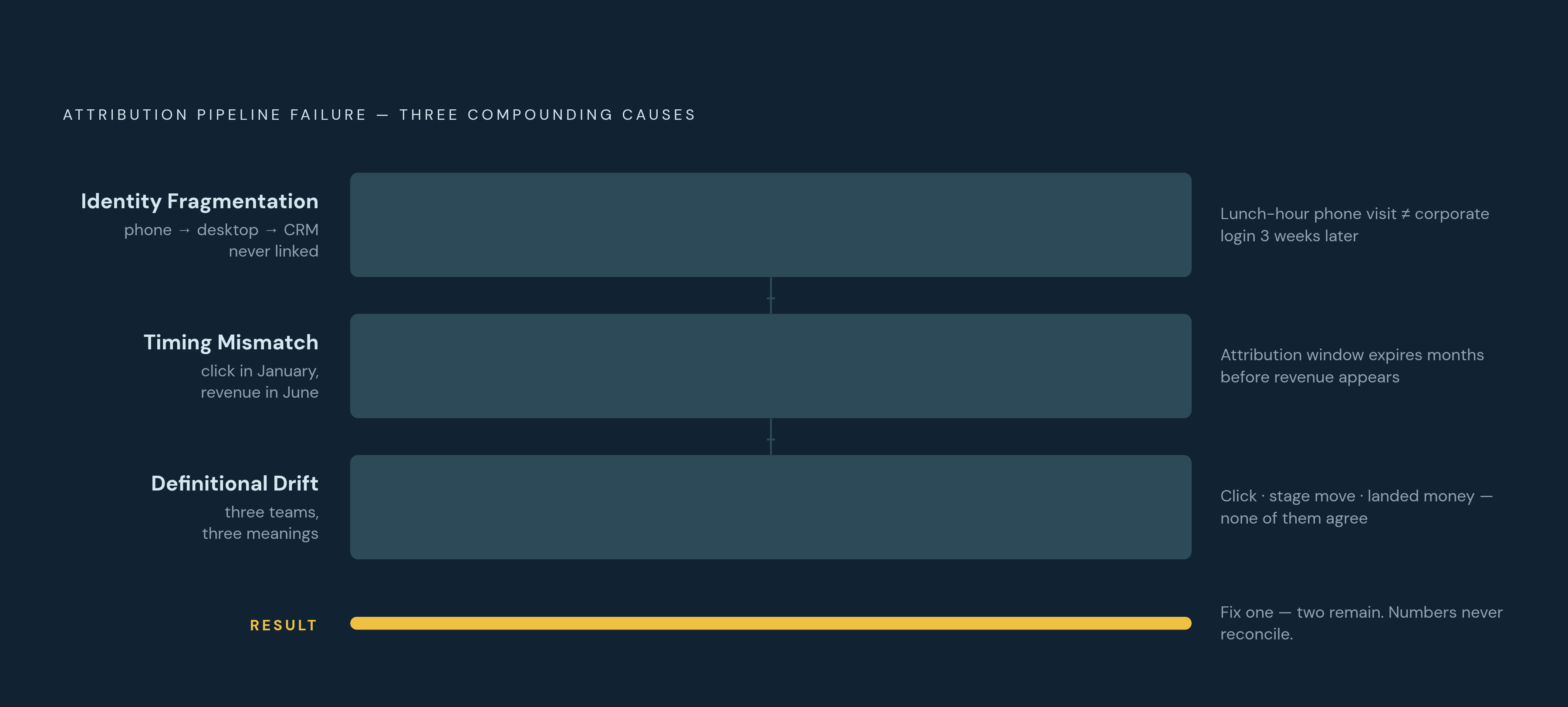
Swapping one ad platform for another, or buying a slightly shinier CRM add-on, won't fix any of this. Attribution pipelines break for three distinct reasons, and those reasons stack on top of each other rather than taking turns. Most teams notice one of the three, fix that one, and wonder why the numbers still don't line up. They still don't line up because the other two were never touched.
The first is identity fragmentation. Someone fills out a form on their phone during a lunch break. Three weeks later, that same person logs into a demo from their corporate email, and Salesforce has no built-in reason to connect the two. Without a real identity layer stitching those together, match rates fall apart fast, and the ad platform and the CRM end up describing two different people who happen to share one brain. Bot traffic and other low-quality clicks inflate top-of-funnel conversion counts that never register as a stage change in the CRM, and that gap is visible before a single salesperson touches the lead.
The second is timing mismatch. A lead can enter the funnel in January and close in June, and if the systems tracking that lead aren't built to hold the thread across five months, the ad platform closes the book on that click long before revenue appears.
The third is definitional drift. "Conversion" means something different to everyone measuring it. Ad platforms count a click that became a lead. CRMs count a stage moving forward in the pipeline. Finance counts money that actually landed. Three legitimate definitions, three completely different numbers, and no one forced an agreement on which one counts as the truth.
All three of these run at the same time, in the same organization, usually without anyone naming them separately. That's why patching one, say, buying a slightly better identity resolution tool, doesn't close the gap. The other two keep producing mismatched numbers regardless.
The four architectural layers a reliable sync pipeline requires
A pipeline that produces numbers worth trusting is an engineering build of four layers, stacked and wired together, and skipping any one of them brings back the exact failures the other three exist to prevent.
Layer one is the ad platform API connection. Pull performance data directly from each platform's API, separately, rather than trusting what shows up on that platform's own dashboard. The dashboard has already run its own attribution model on the data before showing it; it's reporting its own conclusion, not the raw material.
Layer two is CRM and conversion event sync. This is where pipeline stages and closed-won revenue get connected back to the original ad interaction, through offline conversion imports. Skipping this layer stops attribution dead at the lead or the booked-demo stage, so a team learns nothing about whether any of it turned into real business. If a lead that started as a LinkedIn campaign closes as a paying customer six weeks later, that revenue event has to trace back to the touchpoint that started it, and that tracing has to be built on purpose. No ad platform or CRM does this by default.
Layer three is server-side event capture. Client-side tracking, the kind that lives in a browser, keeps losing ground to ad blockers and cookie restrictions. Server-side capture gives every downstream system a full view of the customer's path instead of a path with gaps chewed out of it by whatever browser happened to be in use that day.
Layer four is a neutral reconciliation layer, usually a CDP or a purpose-built attribution tool. It pulls data from both the CRM and the ad platforms, forces one shared definition of conversion across all of it, and produces a single reconciled view. This layer doesn't replace CRM reporting or ad platform reporting. It sits between the two and settles the argument. UTM parameters matter here because they're the one thing that lives in the analytics layer rather than inside any platform's own attribution model. A UTM captured the moment someone fills out a form belongs to that one event, and no platform gets to claim it as its own. The job of this layer is to treat CRM closed-won data as the final word and work backward from there, not to average the three competing numbers into something that feels fair but means nothing.
Four layers, each doing a specific job. A strong reconciliation layer can't make up for a broken sync between the CRM and the ad platforms underneath it. The layers only work as a connected system.
Identity resolution is the variable that determines whether the rest of the architecture works
Out of all four layers, one decision carries more weight than the rest combined: whether identity resolution is deterministic or probabilistic. Get this one wrong, and the other three layers still run, they just run on bad information, which makes the whole pipeline a more expensive way to be wrong.
Deterministic matching uses hard identifiers: a hashed email address, a phone number, a logged-in user ID. It stitches an ad click to a CRM contact record with real precision, and it keeps working as cookies disappear, since it never relied on browser state. Probabilistic matching works off guesses instead, device fingerprints, IP address ranges, patterns that suggest two signals might belong to the same person. That approach keeps getting weaker as privacy restrictions tighten. eMarketer's ongoing coverage of identity resolution points to marketers pouring more investment into first-party data and interoperable identity systems specifically because the old cookie-based signals are fading out. A deterministic system will outperform a probabilistic one every time this comparison runs, and the gap isn't a small edge, it's built into how each approach works.
Four technical pieces have to be in place for deterministic matching to actually hold up: a consistent UTM naming scheme across every campaign, server-side event capture, a reliable way to connect an anonymous visitor to a known user, and two-way syncing between the CRM and the billing system. If any one of these is missing, the deterministic match starts to crack. UTM taxonomy might be the easiest of the four to overlook, but if campaign parameters are named inconsistently, touchpoints can't be grouped correctly downstream no matter how good the identity matching is on its own.
The objection that comes up fastest is privacy. Doesn't deterministic matching mean collecting personal data that GDPR and CCPA were built to restrict? Hashed identifiers answer that directly. A SHA-256 hash of an email address still counts as personal data under those regulations, but it supports compliance with them while still enabling precise matching, because the platforms receiving it never see the raw email, only the hash. Google Enhanced Conversions, LinkedIn's Insight Tag, and Meta's Conversions API accept hashed inputs by design.
Teams that build their pipeline on probabilistic identity resolution are building something that degrades quietly as privacy restrictions keep tightening, feeding them numbers that look like signal but drift further from reality every quarter.
Offline conversion sync cadence and the feedback loop that trains ad platform bidding
How often a team pushes CRM outcomes back to the ad platforms matters as much as whether the connection exists. Google Ads, Meta, and LinkedIn all support offline conversion imports that tie CRM outcomes back to the original ad interaction. The mechanism is there, built and ready, in all three platforms. The failure is almost always in how often, or how rarely, teams actually use it.
Pipelines running well take verified closed-won revenue and high-intent sales milestones straight from the CRM and feed them into Google Ads Enhanced Conversions and Meta's Conversion API on a tight, regular cadence. That trains the bidding algorithm to chase actual revenue instead of cheap leads that looked good on day one and went nowhere. A team syncing daily for six months has handed the algorithm hundreds of real revenue events to learn from. A team syncing monthly has handed it a fraction of that signal, and what little it gets arrives diluted by weeks of lag. Over six months, that gap in signal quality turns into a real gap in how well each team's ad spend performs.
The clearest symptom of a broken version of this loop is the paid search overattribution trap. Paid search tends to show up right before a deal closes, since by then the buyer already knows what they want and is just searching for the vendor. The bidding algorithm gets credit for catching that moment, so the team pours more budget into paid search. Pipeline doesn't grow to match, because the demand that paid search captured was created weeks or months earlier by brand awareness work the attribution system never logged. Leadership sees a clean number pointing at paid search, reallocates budget toward it, and the misallocation gets worse the next quarter, not better.
How Google and LinkedIn attribution architectures differ
Google and LinkedIn aren't doing the same job in a B2B funnel, so treating their data the same way in a sync layer guarantees a distorted read on both.
Google Search Ads catch buyers who already know what they want. They're searching for a solution, reading reviews, comparing two or three vendors against each other. Because that search happens right before the close, Google ends up claiming credit for conversions that were actually set in motion by brand work much earlier in the funnel. Google Enhanced Conversions closes part of this gap by accepting hashed first-party data, an email address collected at form fill, to match the ad interaction to the CRM outcome even once browser identifiers are gone, as long as the buyer was signed into a Google Account at the time of that original ad click. Reconciling Google's numbers means pulling performance data straight from the Google Ads API, separately from the dashboard, and comparing it to CRM closed-won data using UTM as the shared key, rather than accepting whatever attribution window Google's own reporting hands over as the final answer.
LinkedIn Ads live at the opposite end of the funnel. They reach decision-makers before those people are even thinking about a purchase, targeted by job title, seniority, company size, and industry. The problem here isn't who gets unfair credit, it's distance in time: the conversion event, a form fill or a content download, can sit months away from any revenue outcome tied to it. LinkedIn's Conversions API runs as a separate server-side integration that works alongside the Insight Tag, and skipping it means browser restrictions will keep eating into LinkedIn's tracked signal specifically, faster than on other platforms. Account-level attribution carries extra weight here too, since B2B deals usually involve a buying committee rather than one decision-maker. A sync layer that only tracks individual contacts from LinkedIn will undercount its real influence on any deal where multiple people from the same company engaged with it.
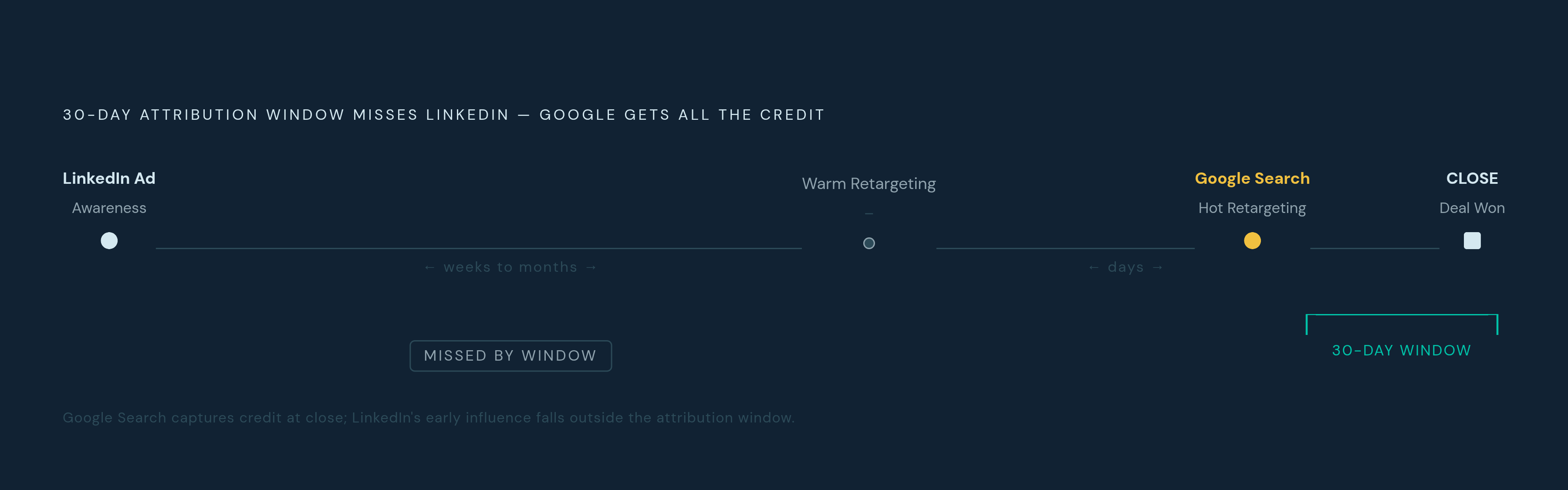
Line all three stages of a typical B2B funnel up, awareness, warm retargeting, hot retargeting, and the touchpoints from LinkedIn at the top and Google at the bottom are separated by weeks or sometimes months. A 30-day attribution window will catch the Google touchpoint near the close and miss the LinkedIn touchpoint that started the whole thing, and that gap is how the paid search overattribution problem from the last section takes hold. A reconciliation layer that treats Google and LinkedIn data identically, same attribution window, same weighting, same assumptions, will misread the funnel in a specific, predictable direction every time: overcrediting the platform that closes the deal, undercrediting the one that opened it.
What the attribution tool landscape looks like
Picking an attribution tool is really picking a philosophy about where attribution should live, and each approach trades integration depth against operational overhead in a different way.
One major approach is the CRM-native platform. Instead of asking a team to log into a separate attribution dashboard and export data to piece it back together, these tools write attribution data directly onto the CRM's own standard objects, so sales and marketing are reading the same record instead of two competing versions of the truth.
Heeet is a working example of this approach. It's built natively for Salesforce and HubSpot, available through each platform's own marketplace, and it supports first-touch, last-touch, linear, U-shaped, W-shaped, and fully custom attribution models. It includes server-side, cookieless tracking, which matters given how much client-side tracking has already degraded. What sets its architecture apart is that attribution data lives on standard CRM objects rather than in a separate system that sales has to be told to go check. For a team whose biggest problem is sales and marketing arguing over two different numbers, keeping the data on the same record both teams already live in removes an entire category of disagreement before it starts.
No single tool fixes identity fragmentation, timing mismatch, and definitional drift by itself. What a tool like this changes is where the fight happens, inside one shared system instead of across three disconnected ones, which is most of the battle to begin with.