Handoff Loss Between Ad Platform Data and Revenue Attribution in B2B Stacks
Multiple disconnected systems create data loss that no single platform can fix.
A CMO opens the ad platform dashboard on Monday morning and sees a healthy number attached to pipeline influenced. Nobody did anything wrong. Both numbers are accurate readings of the system that produced them, and that is the actual problem: the ad platform and the CRM were never built to agree with each other.
Every system in a typical B2B stack (ad platform, web analytics, marketing automation, CRM) keeps its own identity layer, its own attribution logic, and its own reporting clock. None of these systems were built to interoperate at the identity level. The root cause is structural: most attribution tools were designed for B2C performance marketing and adapted to B2B afterward. That adaptation breaks every assumption the tools make about who the buyer is, how long a decision takes, and what counts as a single unit of measurement.
Picture a prospect who clicks a LinkedIn ad, attends a webinar three weeks later, downloads a case study, then replies to a sales email. Without dedicated attribution infrastructure sitting between these systems, the CRM records one touchpoint at best. The rest of that journey simply does not survive the trip.
This section is a diagnosis, not a fix. Marketing and finance end up defending different versions of the same quarter because they are reading from systems with different rules for counting, not because one side is lying to the other.
Ad platforms are structurally incentivized to over-credit their own channel
Handoff loss starts before the data ever reaches the CRM, and it starts with the platforms themselves. Ad platforms are not neutral measurement instruments. Their reporting is built, by design, to show that their own channel deserves credit for the sale.
Each major platform runs its own attribution model, with its own default window, and each will claim credit for a conversion a buyer reached through several channels at once. Without an attribution layer sitting independently of any single platform, ROAS math ends up built on data that has already been counted twice, once by each platform that touched the buyer.
Platform-native attribution also tends to default to last-click or last-touch within its own walled garden. Anything that occurred on a different platform, or offline, simply does not register, because this is the predictable output of a business model where the platform's own revenue depends on proving its channel works. An independent attribution layer, one that ingests data from every channel and deduplicates conversions against a single identity, is the structural answer. Swapping attribution models within a single platform does not touch the underlying incentive.
The identity layer mismatch that breaks data at the first handoff point
Once the inflated platform number tries to make its way into the CRM, it hits the first real wall: identity. Data dies in a B2B attribution stack at the moment a user ID inside an ad platform cannot be reliably matched to a contact record sitting in the CRM.
Attribution accuracy falls apart whenever CRM records, marketing automation records, and data warehouse records cannot be matched to each other consistently. Before trusting any model's output, a revenue team needs a clear target for what counts as an acceptable match rate, because without one there is no way to tell a real gap from a round of bad luck.
Cookie deprecation makes this worse every year. In 2026, browser-based pixels are blocked or degraded by ad blockers and ongoing privacy changes, so the identity signal platforms depend on to stitch a journey together arrives incomplete before the handoff even happens. Server-side tracking is the infrastructure response to this, capturing conversion events outside the limits of the browser. It requires deliberate setup, and it does nothing to repair identity gaps that already existed upstream of it.
The practical result: a single buyer's journey appears as several disconnected sessions spread across different systems, each one attributed differently, long before a single unified contact record exists anywhere in the CRM.
Why contact-level identity measurement fails for account-based buying committees
Suppose identity resolution actually works at the individual level. Attribution still misses the mark, because B2B buying is done by committees, not individuals.
The structural failure here is simple to name: contact-level measurement applied to a buying process that happens at the account level. Most of what teams credit to "switching attribution models" is really the result of switching the unit of analysis from contact to account. A deal with multiple stakeholders means the person who fills out the demo request form is almost never the person who first decided the category was worth looking into. Standard attribution gives full credit to whoever submitted the form and quietly drops everyone else who shaped the decision.
One company is a useful illustration of what this looks like when it's left unaddressed for years rather than months. The company went six years without trusting its own marketing data, a stretch long enough to make clear that the problem was never a missing dashboard. It was a buying-committee structure that contact-level tools were never built to represent.
Account-level attribution requires connecting touchpoints across every contact tied to an account, which is a genuinely different data model from tracking individual contacts one at a time. General-purpose attribution tools tend to struggle here precisely because they were built around the contact as the atomic unit. That's also why board-level discussions increasingly feature account-level reporting instead of lead-level numbers: it matches how the buying actually happened.
Attribution window defaults exclude most of the B2B buying journey
Even with identity resolved and the unit of analysis correctly set to account, one more mismatch remains: time. Attribution windows inherited from B2C were calibrated for purchases that happen in days. B2B buying journeys run for months. A window built for the first kind of decision will structurally miss the early stages of the second kind, exactly where demand gets created.
Standard ad platform windows were built for consumer purchases. B2B attribution needs windows matched to the actual length of the sales cycle, and for many enterprise deals that cycle runs well past anything a platform sets as its default. The consequence isn't random. Brand awareness programs, early-stage content, and top-of-funnel channels all operate in the part of the journey the attribution window can't see. They generate the demand that paid search later captures, and the window gives full credit to the capture event while giving none to the event that created the demand.
That produces a predictable, recurring distortion: paid search looks like the best-performing channel because it appears at the exact moment a buyer declares intent, not because it did the work of creating that intent. Add to this the dark funnel: offline events, conversations in private communities, word-of-mouth referrals, and content consumed with no tracking pixel attached. None of it generates an attributable signal. It's real influence with no data footprint, and no amount of adjusting the window recovers it after the fact. Matching the window to the sales cycle, rather than reaching for a different attribution model, is the lever that actually corrects for this kind of misattribution.
The CRM is the only credible place to verify revenue attribution
Every problem named so far (platform incentives, identity mismatch, committee structure, window mismatch) eventually has to land somewhere, and that somewhere is the CRM. Revenue lives in the CRM and nowhere else, which is what makes it the one place attribution claims can actually be checked against reality. It's also the place where every upstream error gets multiplied instead of resolved, because the CRM's own data is often dirty in ways that compound whatever arrived broken.
A consistent, CRM-visible difference in deal velocity, win rate, and average deal size between accounts with meaningful marketing exposure and accounts without it is the one attribution claim a CFO can check independently. Anything that lives only in a marketing dashboard, outside the CRM, will not hold up in a finance conversation. But duplicate contacts, inconsistent account hierarchies, missing lifecycle stage fields, and incomplete activity logging all cause attribution to fragment or double-count before any model gets anywhere near the data.
This is the tension that sits at the center of the whole problem: the CRM is required, and the CRM is often broken in exactly the ways that make attribution unreliable. The gap between marketing's self-reported influenced pipeline and what the CRM can verify is a credibility problem, not evidence that anyone is faking numbers, and it persists no matter which attribution tool happens to be running on top of dirty underlying data. Self-reported attribution, simply asking a buyer how they first heard about the company, is a useful and underused complement to behavioral tracking here, especially for dark-funnel sources that leave no digital trace. It belongs sitting in the CRM next to the behavioral data, as a second signal, not as a replacement for the tracking that already exists.
Closing the handoff gaps in a B2B attribution stack
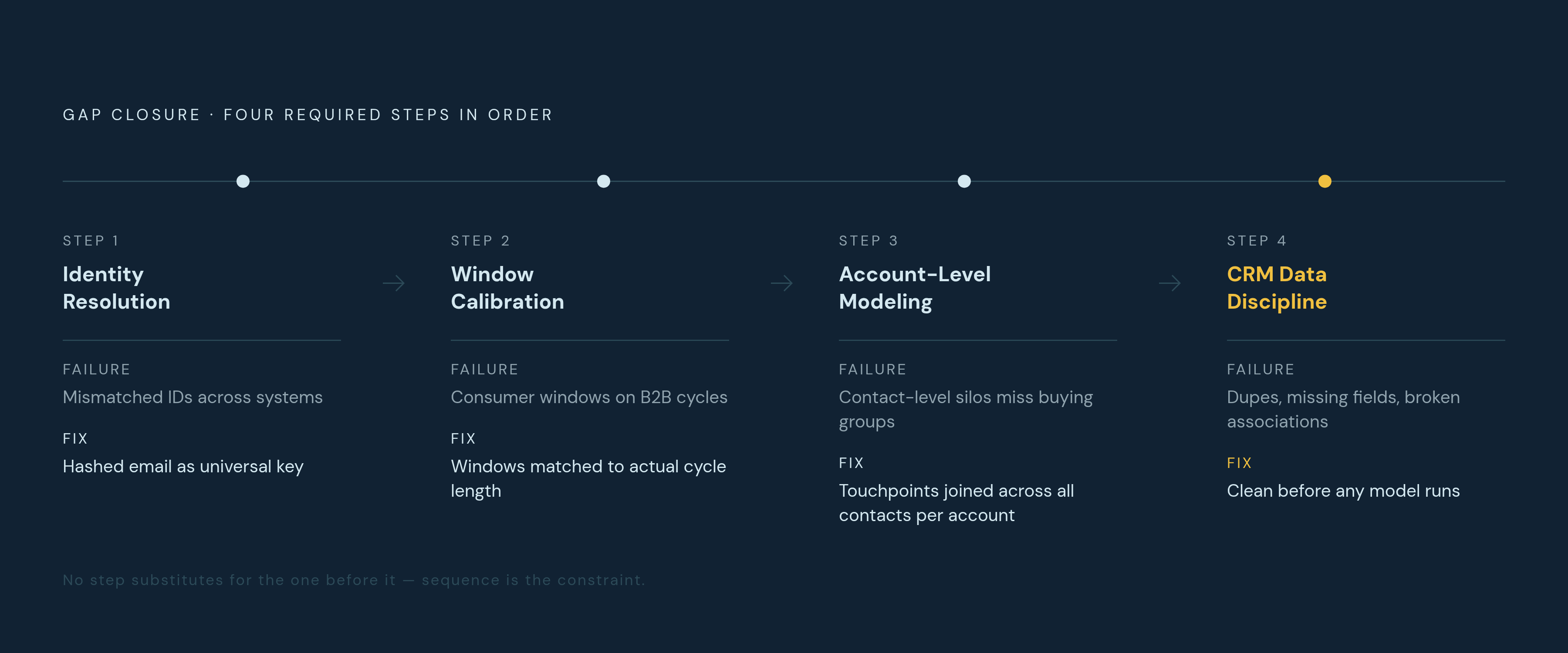
None of the problems described above get solved by picking a better attribution model. Closing the gap between what the ad platform reports and what the CRM can verify means solving four distinct problems, in order: identity resolution, window calibration, account-level data modeling, and CRM data discipline. No attribution tool substitutes for doing this work.
Identity resolution comes first. That means establishing one consistent identity key, typically a hashed email, that can be matched across the ad platform, the marketing automation system, and the CRM before any attribution model gets applied to the data. Server-side tracking is the infrastructure that makes this matching possible once browser-based signals are too degraded to rely on.
Attribution windows need to reflect how long the actual sales cycle runs, not whatever a platform sets as its default. Sales-cycle-matched windows, an account-level unit of analysis, and disciplined CRM hygiene all matter more to accuracy than which model gets selected on top of them.
Account-level attribution has to become the actual unit of analysis, connecting touchpoints across every contact tied to an account. Tools built specifically for B2B buying-committee complexity handle this data model in a way general-purpose tools don't, because it requires a different underlying structure, not just a different report.
An independent attribution layer, sitting outside any single ad platform, is what deduplicates credit across channels. In 2026, running campaigns across multiple platforms without that independent layer means accepting double-counted results as the baseline.
CRM hygiene is a prerequisite for any of this to matter, not a side project to get to later. Duplicate contacts, missing account associations, and incomplete lifecycle stage fields all need to be cleaned up before attribution data means anything.
The teams that come out ahead are the ones whose attribution system tells them where to put the next dollar of revenue investment, not the ones running the most sophisticated credit-allocation model. Comparing several models side by side, rather than committing to one and trusting it blindly, is what gets a revenue team to a number a sales leader will actually stand behind in a room, even if it isn't mathematically perfect.
How B2B attribution platforms differ
Once the foundation is in place, the platform choice matters, but it matters less than the sequencing that came before it. General-purpose attribution and analytics tools are usually built around the contact as the basic unit of tracking, which is the same limitation described earlier: they were designed for a buyer, not a committee. Running account-based B2B attribution on top of a contact-first tool means fighting the tool's own data model the entire time.
Purpose-built B2B attribution platforms start from the account. Dreamdata is one example of this architecture in practice. Its own data platform describes trustworthy agentic B2B attribution as starting with an account-based data model, and its listing describes unifying go-to-market data into a single account-based data model, organized by account and tied to revenue. That's a meaningfully different starting point than a tool that tracks individual leads and tries to roll them up into an account after the fact.
The practical distinction for a revenue team evaluating platforms is whether the tool's underlying data model matches the way the business actually buys. A tool built around individual contact records will keep fragmenting credit across a committee of stakeholders, no matter how many features get added on top. A tool built around the account from the start is structured to carry touchpoints across every stakeholder in a deal, which is the actual shape of a B2B sale. Evaluating platforms on this basis, architecture first, feature list second, is a more durable way to choose than comparing dashboards alone.