CDP Integration Patterns for Agentic B2B Ad Targeting
Agent-driven B2B ads need CDP architecture built for real-time API access, not dashboards.
Agentic B2B ad targeting keeps underperforming, and the usual response is to blame the model. The thinking is that swapping in a smarter agent sharpens the targeting, but that's the wrong diagnosis. The real gap sits between what an AI agent needs to act on its own and what most CDP setups actually let it see or touch.
An agent can't work off a dashboard built for a human to click through once a week. It needs an API it can call constantly, act on, and write results back into, forming a loop that never fully closes until the campaign ends. That's a different kind of access than most customer data platforms were built to give. The architectural choices made years ago, long before anyone planned for autonomous agents, decide today whether an agent can act in real time or just watch from the sidelines. Every pattern discussed from here on grows out of that single constraint.
The three-generation arc of CDP architecture
Every generation of CDP was built with a specific user in mind, and that choice shapes what an agent can and can't do once it shows up asking for access. Three distinct waves of design help explain why.
The first generation, the packaged CDP, was built for marketers clicking through a UI. Data came in on a batch schedule, storage stayed locked inside the vendor's own system, and segmentation ran on fixed if-then rules. There was no AI built in and no door for an agent to walk through programmatically. If you wanted something done, a person had to do it.
The second generation, the composable CDP, moved the data layer into the cloud warehouse, which gave data engineers more control and let data move between tools more freely. But it slowed the whole system down in a different way. Data sat in the warehouse while execution happened somewhere else entirely, in a separate email or ad platform, and results took hours to make their way back. An agent working inside that setup has to hop across several separate systems just to complete one targeting decision, and each hop adds lag and risk of something breaking.
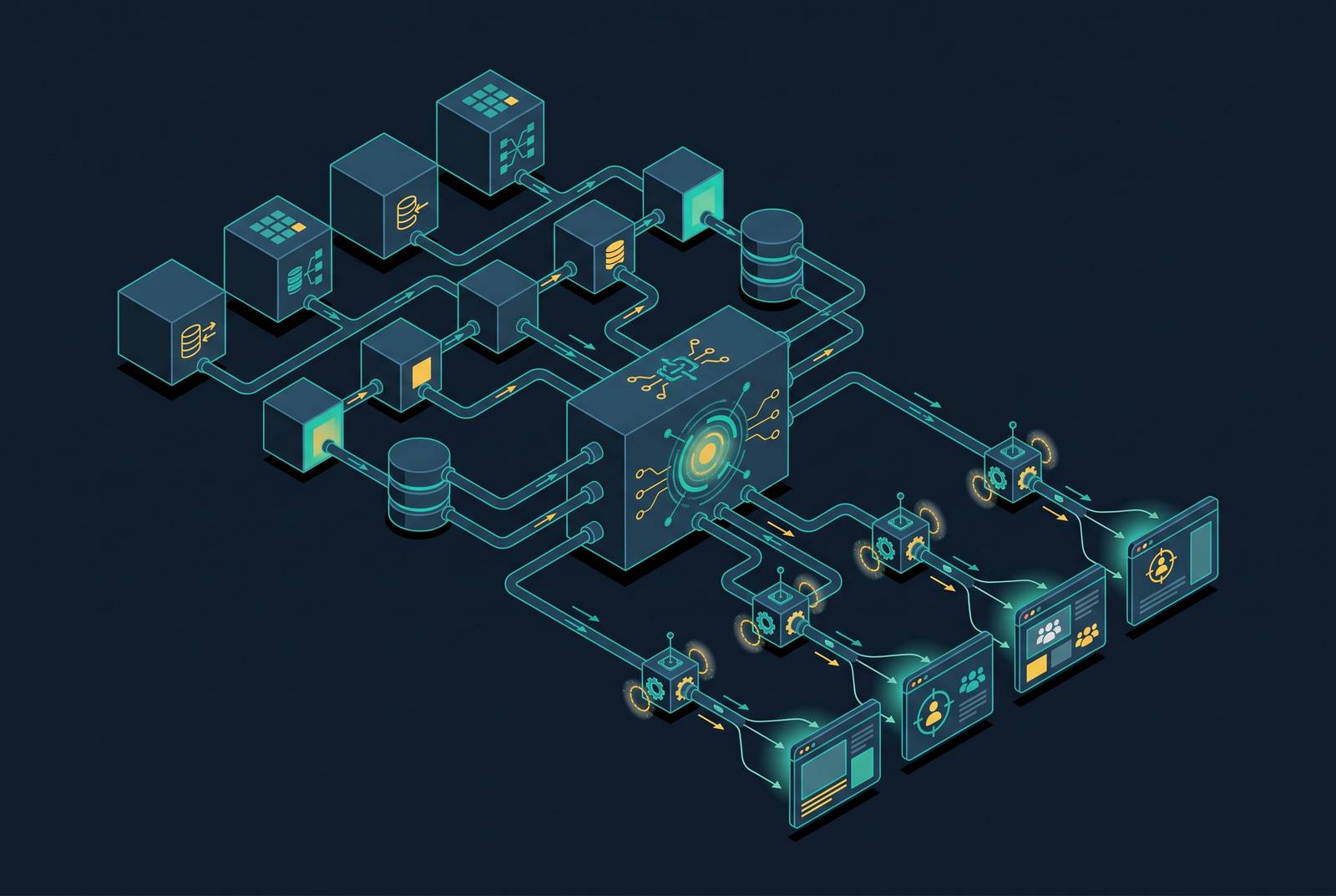
The third generation, the agentic CDP, gets built around a different idea from the ground up: it's infrastructure for an agent, not a dashboard for a person. It exposes unified customer profiles, decision logic, and the actual channels for running campaigns, through MCP (Model Context Protocol), APIs, command-line tools, and ready-made agent skills, so an agent can take in information, decide what to do, and act, all without waiting on a human to click a button. People don't disappear from the picture. Their job changes from running campaigns by hand to setting the goals, the guardrails, and the overall creative direction the agents work within.
What actually separates generation three from the first two is that the loop closes. An agentic CDP bundles the customer data platform, the messaging system, and the AI together in one place, so the results of a campaign flow straight back into the data layer inside that same platform. Nothing has to leave and come back through a different door. That's what cuts the delay that kills compounding before it starts.
What account-level identity resolution must do
An agent can't make a good call about an account if the CDP hasn't already figured out which people belong to that account and merged their behavior into one connected view, because without that step every decision downstream is a guess dressed up as a targeting rule.
B2B buying looks nothing like a single consumer browsing a website. Identity resolution here works differently than it does in B2C. A typical B2B purchase involves somewhere between six and ten people weighing in, often across different departments and job titles. That means the CDP has to track engagement at the level of the whole account, not just one contact at a time, to understand when a buying committee as a group is starting to show real interest.
Two basic methods handle this. Deterministic matching ties records together using something known and fixed, like an email address, across every touchpoint tied to that contact. Probabilistic matching uses machine learning to guess at connections across devices where no clean match exists. In B2B, where sales cycles stretch for months and the stakeholders are usually known by name and title (the CFO, the IT lead, the person who actually signs the check), deterministic matching carries more of the weight, because there's less need to guess at who someone is.
Resolution itself is starting to look less like a one-time setup and more like ongoing work an agent has to keep doing. Databricks CustomerLake, for example, combines fixed rules with agent-driven logic to handle identity resolution, because the people on a buying committee shift as a deal moves forward. A contact who mattered three months ago might have left the company. Someone new might have just joined the evaluation. The identity graph needs enrichment too, since first-party data alone rarely tells the whole story. CustomerLake's identity marketplace plugs into third-party data providers including Acxiom, Epsilon, LiveRamp, TransUnion, and Adstra, giving an agent more to work with than what a company collects on its own.
Until that account-level profile comes together cleanly, segmentation is just noise dressed up as strategy. Firmographic data, behavioral data, and intent signals all need to merge into one coherent view of the target organization before any scoring or segmenting makes sense.
How agents use account-level signals for autonomous targeting
Once that account-level profile exists and an agent can reach it through an API, the entire idea of a "campaign trigger" changes. Instead of a scheduled send tied to a calendar, the agent runs a constant decisioning loop that reacts to buying-committee signals as they happen.
One thing that loop does is decide when to reach out. Rather than following a preset send date, the agent watches real-time signals across the whole buying committee and acts the moment the pattern suggests the group, collectively, is ready to engage. It also keeps re-scoring accounts continuously. As new behavioral or intent data comes in, a score can rise or fall without anyone touching it, and the list of accounts worth targeting updates itself as engagement shifts, rather than sitting fixed until the next quarterly review. And it coordinates across channels at once, syncing email sequences, ad targeting, and alerts to sales simultaneously across everyone on the buying committee, work that a human campaign manager would otherwise have to stitch together one channel at a time.
The same models producing the insight about an account are the same models driving the action, with no copies of the data sitting in some side pipeline and no delay waiting for a batch job to run, and that's where the real shift happens. That means every decision the agent makes becomes usable evidence for the next one, almost instantly. The system is learning from its own output as it goes, rather than starting over blank with every new campaign. Faster execution is a nice side effect. The real change is that each decision feeds the one after it, in a way a human-run campaign cycle, with its weekly reporting meetings and manual list pulls, simply can't match.
The four integration patterns a CDP must support for agents to activate paid media
Knowing which accounts to target means nothing if the CDP can't push that decision into an actual ad platform in the same continuous loop. This is usually where things fall apart, right at the handoff between data and action.
Audience sync has to happen in real time, not on a nightly schedule. If an account crosses a scoring threshold at 11 a.m., the agent needs to update a LinkedIn Matched Audience or a Google Customer Match list at 11 a.m., not that night or the next morning. Treasure Data, for example, offers over 400 integrations including leading B2B solutions, and that range matters because an agent can only act on a channel the CDP is connected to.
The CDP also needs two-way API access, not just a read-only feed. An agentic CDP exposes profiles and channels through MCP, APIs, a CLI, and pre-built agent skills, and the two-way part lets an agent write back what it learns, which ads an account actually saw, which ones landed, which ones triggered an alert to sales. CustomerLake's native integrations and reverse ETL connect Databricks with two-way pipelines across the marketing and ad tech stack, carrying insight sitting in the warehouse back out to wherever the campaign actually runs. A one-way connection from CDP to ad platform isn't enough. If impression and conversion data from the ad platform can't flow back into the account profile, the agent's next move is made blind to what the last one actually produced.
Consent has to travel with the data at every step. When an agent pushes a contact-level list out to an ad platform, each contact's consent status needs to move along with it through every system it passes through. Enterprise ad platforms don't all handle consent signals the same way, and a mismatch here creates two problems at once: real compliance exposure, and a shrinking audience the agent can't explain, because excluded contacts just vanish from the list with no flag attached. This is one of three integration gaps that make agentic campaigns genuinely hard to run at enterprise scale, alongside identity resolution across system boundaries and writing back into the CRM.
CRM writeback closes the loop with sales. Marketing and sales coordinate naturally when they're looking at the same data, and the gap between the two teams is what quietly kills a lot of B2B deals. For an agent, that means a targeting decision that puts an account into an active campaign has to trigger a sales alert at the same moment, so the account executive isn't blindsided by inbound interest they had no warning about. The gap here is about write access specifically: the agent has to be able to update CRM records, not just read what's already there, so the context sales sees matches the exact signals the ad targeting is acting on.
Where the integration fabric breaks in practice
These four gaps aren't rare exceptions. They show up constantly across enterprise martech stacks, and they tend to break at the same predictable points every time.
CRM writeback is one of the most common failures. An agent that can read account signals but can't write back into the CRM creates a one-way flow of intelligence. Sales keeps working off stale information while the agent keeps targeting based on engagement the CRM never records.
Legacy CDPs make this worse by design. They run on a waterfall model: campaigns get planned and executed across dozens of disconnected tools, take weeks to ship, and leave customer data stuck outside the core AI platform. That fractures identity and makes real personalization impossible at any real scale. An agent built on top of that kind of infrastructure doesn't fix the silos. It inherits them.
The cost appears in the compounding that breaks, or never starts, when one handoff in the loop fails. Every time an agent finishes a targeting cycle and the result can't make it back into the unified profile, because the integration only reads and never writes, because consent propagation broke somewhere along the chain, because the CRM API only updates in batches, the system lands back close to where it started. Compounding depends on a closed loop. One broken handoff is enough to pry it open.
Adobe's 2026 CDP Trends Report found that nearly all organizations say CDPs are essential for getting ready for an agentic future. The gap is between that belief and actually having integration infrastructure built to support agents doing real work. Most programs stall right there, somewhere between recognizing what's coming and building the plumbing it needs to run on.