How Agentic Marketing Platforms Accumulate Campaign Intelligence
Each campaign teaches the system what works, making the next one smarter than the last.
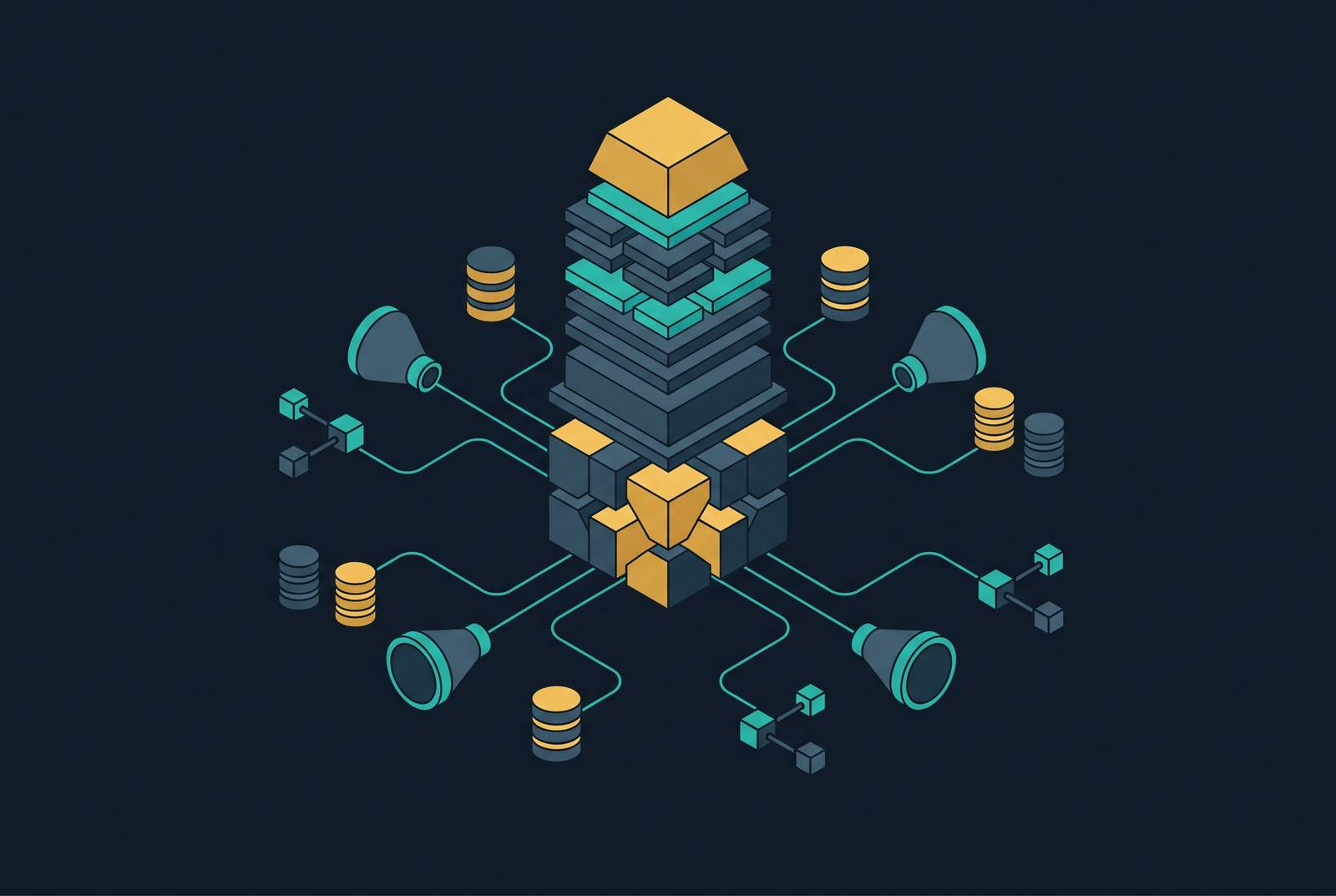
Marketing agents don't just execute campaigns faster than a human team could. The good ones get smarter every time they run, because they carry evidence from one campaign into the next instead of starting over. That's the whole story of accumulation, and it's why some agentic platforms outperform others by a wide margin, even when the underlying AI models are basically the same.
What a feedback loop deposits after each campaign run
Every campaign leaves a trail. Most of that trail gets thrown away the moment the campaign ends, or it sits in a dashboard nobody reads twice. An agent built to accumulate treats that trail as fuel instead.
Four kinds of evidence come out of a single run:
Audience signal. Which job titles, company sizes, and behavior patterns actually engaged, and at what point in their journey. Creative signal. Which headlines, formats, and offers drove someone to buy, versus just click, versus do nothing. Conversion path signal. Where people dropped off. The landing page. The form. The handoff to sales. Attribution signal. Which channel and which touchpoint actually put a deal in the pipeline, as opposed to which one the ad platform is claiming credit for.
None of this comes from some quarterly report. It comes from live streams: web visits, email opens, ad clicks, CRM updates, intent data from outside vendors. All of it flows in continuously.
Depositing evidence isn't the same as logging it. A log just sits there as a record. A prior shapes the next decision before it's even made. When an agent's campaign data becomes a prior instead of a log, every future run starts from a better guess. That's the mechanical difference between a system that remembers and one that merely stores.
And this is exactly where most paid media programs go wrong. They tune the ad platform, bid up, shift budget, adjust targeting, without ever figuring out whether the real problem is the creative, the landing page, or a broken attribution model. Evidence that accumulates across runs makes that bottleneck visible instead of hiding it behind a platform metric that looks fine on the surface.
How accumulation compounds rather than simply adding up
The first campaign an agent runs is basically a guess. Broad audience assumptions, a handful of creative directions, wide variance in results. That's normal. Nobody knows what works yet.
The second run doesn't repeat that guess. It starts from what the first run ruled out. Fewer blind swings, more targeted tests. By the third or fourth run, the system isn't rerunning the same experiment, it's running a sharper, narrower version of it. That's compounding: each cycle shrinks the space of things still worth testing.
Speed is what makes this possible at scale. Agentic systems can push out campaign creation and execution many times faster than manual teams can, according to McKinsey. But the real value of that speed is the number of learning cycles it packs into a given stretch of time. It's the number of learning cycles it packs into a given stretch of time. A human-run program that updates its approach infrequently gets only a handful of shots at learning per year. An agent iterating continuously gets far more than that, simply because it's not waiting on a scheduled meeting to decide what changes next.
This is also why a new campaign inside an accumulating system doesn't start from zero. The agent already knows what worked for this audience last time, because that knowledge didn't leave with anybody. Compare that to a typical agency handoff, where the person who understood the account leaves and takes the context with them. Or a new in-house hire who inherits a dashboard but not the reasoning behind it. Accumulation survives people leaving. Institutional memory usually doesn't.
But accumulation only works if the data has somewhere to live that isn't locked inside one campaign or one channel. McKinsey's research points at the real obstacle here: most marketing tech stacks run on a patchwork of separate systems, a CMS here, a DAM there, a CRM somewhere else, none of them built to share a data model. Evidence gets fragmented before it ever has the chance to compound. A company can have all the AI tools it wants and still not get smarter, the pattern McKinsey calls the "gen AI paradox," because the architecture underneath won't let the evidence stick together.
The performance gap between programs that accumulate and programs that reset
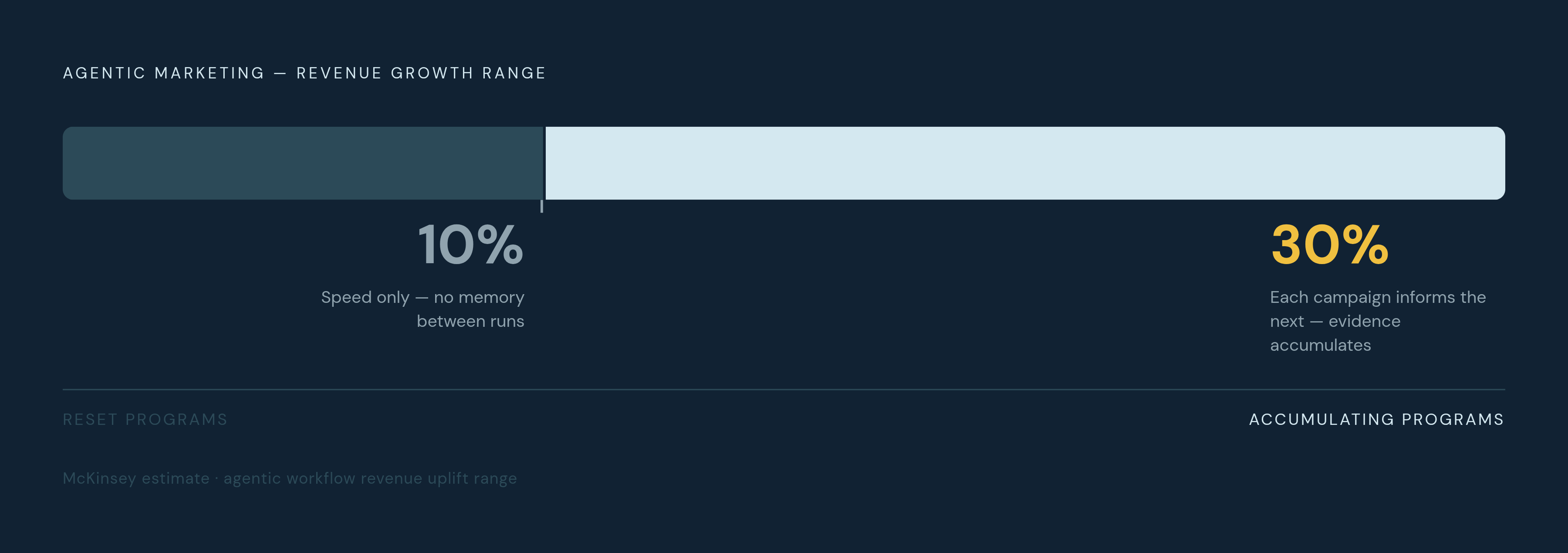
McKinsey estimates agentic workflows in marketing can produce anywhere from 10 to 30 percent revenue growth through hyperpersonalized marketing. That's a wide range, and the width itself tells a story.
The 10 percent end likely belongs to programs that adopted agents purely for speed. Faster execution, same lack of memory between runs. The 30 percent end belongs to programs where each campaign genuinely informs the next one, where the evidence gets to build.
Other numbers point the same direction. Marketing operations research from 2024, covering roughly 310 B2B marketing ops leaders and curated by The Starr Conspiracy, found a 42 percent average drop in the time it takes to go from campaign brief to launch when generative AI gets built into briefing, creative production, and QA. That's a speed win on its own. Paired with accumulated intelligence, it turns into something bigger: not just faster campaigns, but faster campaigns that also keep getting better.
McKinsey's data on high-growth companies backs this up. Those companies are far more likely to have raised AI investment by double digits year over year, 71 percent of high-growth companies versus 25 percent for everyone else. The gap comes down to which companies rebuilt their workflows so the evidence had somewhere to accumulate, not which company bought more software. It's about which companies rebuilt their workflows so the evidence had somewhere to accumulate.
And that's the trap most organizations fall into. AI adoption across companies has become widespread. Adoption is not the problem. The problem is that the AI usually stays boxed inside one tool, one team, one channel. Output goes up: more ad variants, more content, more campaigns launched. But nothing connects those outputs into a shared understanding. McKinsey calls this a "patchwork of disconnected pilots," and it's a fair label. More activity, fewer real gains at the company level.
For B2B paid media specifically, this means something blunt: a program that resets every time the agency changes, or the in-house owner leaves, or a new contractor takes over, cannot compound. Doesn't matter how talented the people running it are. The structure itself won't allow the evidence to build.
How current agentic platforms implement the accumulation mechanism
Several platforms already build accumulation into their architecture, though the strength of the mechanism depends heavily on how unified their data model actually is.
Salesforce Agentforce for Marketing ships pre-built skills for campaign setup: brief generation, audience segmentation, email and SMS drafting, and journey assembly inside Flow. On top of that sits a continuous optimization layer that flags underperforming ads, pauses them against thresholds someone sets, and returns budget recommendations aimed at improving return on ad spend. The accumulation runs through Marketing Cloud's unified data, which keeps audience and engagement history across campaigns rather than treating each one as a fresh snapshot. Cloud Campaign's 2025 analysis notes heavy Salesforce lock-in, a required Data Cloud subscription, and a UX complex enough that adoption tends to run low. Evidence only accumulates for organizations willing to live entirely inside that ecosystem.
HubSpot Breeze splits into a general assistant (Breeze Copilot) and task-specific agents (Breeze Agents) that handle content generation, lead scoring, and campaign personalization, all grounded in CRM data. The CRM itself acts as the shared memory layer, feeding audience behavior and engagement history into every action the agents take. Cloud Campaign's 2025 review notes the same kind of ceiling: Breeze hits full strength only inside a fully committed HubSpot setup, and the more advanced agentic features sit behind Professional and Enterprise pricing tiers.
Google's agentic tools for Ads include an Agentic Expert that recommends keywords, suggests creative changes, structures ad groups, and applies changes once an advertiser reviews and approves them, plus a Data Expert inside Analytics that surfaces trends without being asked. A Marketing Advisor sidebar for Chrome, described as coming soon, would extend page-aware guidance across Ads, Analytics, and CMS platforms. The accumulation here runs on Google's own data: search query history, auction dynamics, Quality Score signals build up nicely inside the platform. Cross-platform accumulation, outside Google's walls, is limited.
Demandbase One is built specifically for account-based go-to-market work. It unifies first-party engagement data, third-party intent signals, and firmographic data into a real-time view of each account. That account intelligence layer, tracking who's engaging, what stage they're at, which buyer roles are active, updates continuously, so a new campaign aimed at an account starts already knowing that account's history rather than treating it as a stranger.
ActiveCampaign's Active Intelligence takes a plain-language goal, and its Goals agent works out subject lines and channel mix and produces the assets. Audience building works conversationally: describe the customer, and the agent turns that into an actual segment. Behavioral signals feed back into segmentation and sequencing on the next campaign, which is the accumulation mechanism doing its job quietly in the background.
Adobe Experience Platform's Agent Orchestrator interprets a stated goal, builds a task plan, and coordinates Adobe's own agents alongside custom and third-party agents inside one governed framework. Because everything routes through a single orchestration layer, evidence from one agent's work becomes available to the others without a human passing it along by hand. Creative performance data, for instance, can shape an audience segmentation decision automatically.
Mint.ai narrows in tightly on advertising operations: autonomous media planning, budget allocation, real-time financial reconciliation, and continuous optimization across scattered multi-channel budgets. Its "outcome over spend" framing implies performance data from each allocation decision feeds directly into the next one, built for large enterprises juggling complex multi-channel buys. Mint.ai is purpose-built for advertising operations rather than full-funnel marketing, so accumulation here is deep but narrow.
Across all of these, the pattern holds: the data model underneath determines how good the accumulation is, and the pattern holds across all of these. Platforms that split data by channel, by campaign, or by tool break the feedback loop before it ever gets the chance to compound.
Where human judgment remains load-bearing inside an accumulating system
Agents handle continuous execution well. Watching signals, testing variants, adjusting bids, flagging anomalies, pulling together performance reports. These are tasks that reward speed and consistency, and accumulation makes them sharper over time.
What accumulation cannot do is replace judgment on questions that are genuinely ambiguous and carry real consequences:
- Whether a conversion the platform is counting actually reflects a qualified deal in the pipeline, or just a form fill that goes nowhere.
- Whether a creative direction fits the positioning the company is trying to build, or quietly undercuts it.
- Whether a budget shift the agent recommends is a real opportunity, or just noise in the data.
- What to do when the market shifts and the agent's accumulated prior, built on the old market, is now simply wrong.
McKinsey frames the practical version of this as a hybrid model: one marketing professional overseeing a team of agents that handle most of the execution. The person designs and watches. The agents execute and accumulate.
A lot of current setups miss that oversight. Agents accumulate evidence about what happened, but if nobody is explicitly deciding which evidence deserves trust and which decisions need a human to step in, the system can compound mistakes just as efficiently as it compounds wins. A stale audience signal from six months ago. A platform-reported conversion that never became real revenue. A creative pattern that worked once, in one market, and is now getting over-relied on everywhere. Left unchecked, all of these become embedded assumptions the agent keeps optimizing toward, harder and harder to unwind the longer they sit there.
Accumulation is a real structural advantage. But only when someone is actually governing it. Without that, it's just a faster way to get more confident about the wrong answer.
A B2B paid media program with accumulation working
Most B2B paid media programs start every campaign from category-level guesses, because there's no accessible history to build on. An agency changes hands and the institutional knowledge resets with it. The person running the program in-house leaves, and whoever inherits it starts from scratch. A contractor comes in, executes what's asked, and leaves nothing behind that compounds.
A program where accumulation is actually working looks different from the first campaign onward:
Audience signal tells the team which account profiles, seniority levels, and behavior patterns have historically turned into pipeline versus stalled out. That shapes targeting before a single impression runs. Creative signal narrows down which message angles, formats, and offers have already worked for specific segments, before the first new variant even goes live. Channel signal gets calibrated against actual pipeline contribution, not whatever return-on-ad-spend number the platform itself reports.
That last point determines how the numbers get interpreted. Metadata.io's 2025 dataset, built from 153 advertisers and a substantial amount of spend across 211,000 leads, puts LinkedIn at $202 per lead against Google Search at $524. On cost-per-lead alone, LinkedIn looks like the clear winner. But Platform-level benchmarks tell a fuller version of the story, with LinkedIn and Google showing meaningfully different cost and conversion profiles across B2B programs. Optimize purely on cost-per-lead, without accumulated revenue attribution, and the channel mix ends up wrong, even though every individual number looked reasonable at the time. An accumulating system that connects spend all the way through to closed revenue, not just to a lead form, catches that gap. It shows which of those cheap LinkedIn leads actually became paying customers, and which of those expensive Google leads converted nicely on the platform's own dashboard and then quietly went nowhere.
That's the diagnostic payoff of accumulated evidence. After enough campaign cycles, the system can point at the actual constraint on growth, such as the creative, the landing page, a gap in attribution, or a broken handoff between marketing and sales, instead of defaulting to a bid adjustment every time performance dips. Programs that have run through two or three full cycles of accumulated evidence aren't competing on who can spend the most or move the fastest. They're competing on who already knows more about their own audience than the next campaign would otherwise reveal.