Audience Segmentation Models for LinkedIn B2B Targeting
Precision in LinkedIn targeting requires separating fit, account, and behavioral models.
LinkedIn is the only paid channel that lets an advertiser stack job function, seniority, company size, industry, and skills into a single targeting layer, and that combination is what makes it the default B2B channel (job title and job function can't be combined in the same layer, but everything else can). That same flexibility is the problem. A platform this granular makes it easy to build an audience that looks precise on paper and behaves like a blunt instrument in practice.
When a campaign mixes fit-based filters, behavioral signals, and account-based lists into one undifferentiated audience, LinkedIn's delivery algorithm doesn't know which signal to optimize toward. So it picks the cheapest one. It finds whoever is easiest to reach, and the cheapest member to reach is almost never the best-fit buyer. The algorithm is doing its job. The targeting just handed it the wrong job to do.
Size makes this worse. The range that works for ABM campaigns is 5,000–30,000 buyers per campaign. That ceiling only holds if someone has done the work to define who belongs inside it, with deliberate segmentation rather than the "cast wide and let the algorithm sort it out" approach that passes for strategy on a lot of accounts.
LinkedIn charges a premium CPM over other paid channels, and that premium is defensible: professional context and targeting precision are worth paying for. But precision is a feature of the targeting setup, not a property of the platform itself. The premium only earns its keep when the segmentation logic genuinely isolates buyers who are qualified to purchase, and on most programs it doesn't. The rest of this piece is about what it takes to fix that, by treating LinkedIn targeting as three separate models working together rather than one broad net.
Where fit-based segmentation belongs in the funnel
Fit-based segmentation answers one question: who could buy this. It leans on firmographic and demographic filters (job title, seniority, company size, industry) to draw the ICP boundary before any behavioral data gets layered on top. It's the scaffolding every other model gets built on.
That's fine, as long as the offer matches the stage. Fit-based targeting does its best work at the top of the funnel, against cold audiences who fit the ICP but have never engaged with the brand before. Thought leadership, report downloads, category-level educational content. These are the right asks at this stage, because a cold audience and a soft ask are a matched pair. Nobody who has never heard of a company is booking a demo off one impression, and treating fit-based reach as anything more than an introduction sets up the wrong expectation for what the audience is ready to do.
The error creeps in when fit-based targeting gets applied past that point, across mid-funnel and retargeting campaigns too. A high-intent buyer who has already engaged with the brand multiple times and a cold prospect who just matched a job title filter end up seeing the same creative and the same offer. That flattens the entire logic that should separate a cold stranger from someone circling a purchase decision, and it's the single most common reason fit-based programs plateau: the model was never built to carry that much weight on its own.
Account-based segmentation and LinkedIn's Matched Audiences
Account-based segmentation starts somewhere different. Instead of describing a profile (the right title, the right seniority, the right company size), it starts from a named list of target accounts, uploaded directly into LinkedIn's Matched Audiences feature. The campaign no longer chases anyone who fits a pattern; it addresses specific, named companies.
That shift changes what gets excluded, not just what gets included. The boundary is the account itself, so a member holding the exact right title at a company that was never on the list gets filtered out entirely. Uploading a target account list can meaningfully cut down on wasted spend compared to pure profile matching, though the specific 20-35% figure sometimes cited for this comes from exclusion-list tactics (filtering out students, freelancers, and off-target seniority levels), not from account-list targeting on its own, and no published benchmark pins down a precise savings range for account lists specifically.
The other thing account-based segmentation solves is coverage of the buying committee. A single deal at a target account rarely runs through just one person. It usually involves multiple stakeholders spread across different functions, and account-based segmentation lets a campaign speak to that entire group at once, rather than the single-persona slice a job-title filter would have captured.
Platforms like Clay have become infrastructure for exactly this kind of research: connecting to hundreds of data providers to attach firmographics to a raw account list, surface the actual stakeholders inside each buying group, and score every account against ICP criteria before any of it reaches LinkedIn's Campaign Manager.
None of this works without a list, though, and building a list is upstream work that has to happen before Matched Audiences can do anything. Account-based segmentation is a sharper instrument reserved for accounts that have already cleared a qualification bar, not a replacement for fit-based targeting at cold, top-of-funnel scale. Treat it as the second layer.
Behavioral segmentation and LinkedIn's signal layers
Fit tells an advertiser who could buy. Account selection tightens that down to who, specifically, is worth pursuing. Neither one answers the question that actually determines timing: who's showing signs of buying right now. That's the job behavioral segmentation does, and it pulls from three data layers at once: CRM activity, website engagement, and signals recorded inside LinkedIn's own Campaign Manager.
On the native side, LinkedIn can track video views, lead form interactions, engagement on a company page, and retargeting off the Insight Tag installed on a company's website. Someone who watched a full product video or filled out a lead form has told the advertiser something a title and company size filter never could.
LinkedIn's native signals stop well short of where third-party intent data starts, and the two get conflated constantly. What's described above (video completions, form fills, page engagement, retargeting) all happens inside LinkedIn's own walls. Richer intent signals, the kind that flag a company researching a competitor or searching for a solution category across the open web, come from third-party data providers and get layered in separately. Both matter, but they're not the same data source, and treating them as interchangeable leads to confusion about what a campaign is actually reacting to.
LinkedIn's own behavioral tooling changed meaningfully in February 2024, when it retired lookalike audiences altogether. Predictive Audiences took their place. Instead of a static demographic expansion built off a seed list, Predictive Audiences feeds a company or contact list into LinkedIn's model and asks it to find members who are likely to convert the way existing customers already did. That's a probabilistic, behavior-driven prediction, not a simple "more people like this" expansion, and the distinction matters for how much weight a team should put on the output.
Layering the three models into a campaign architecture
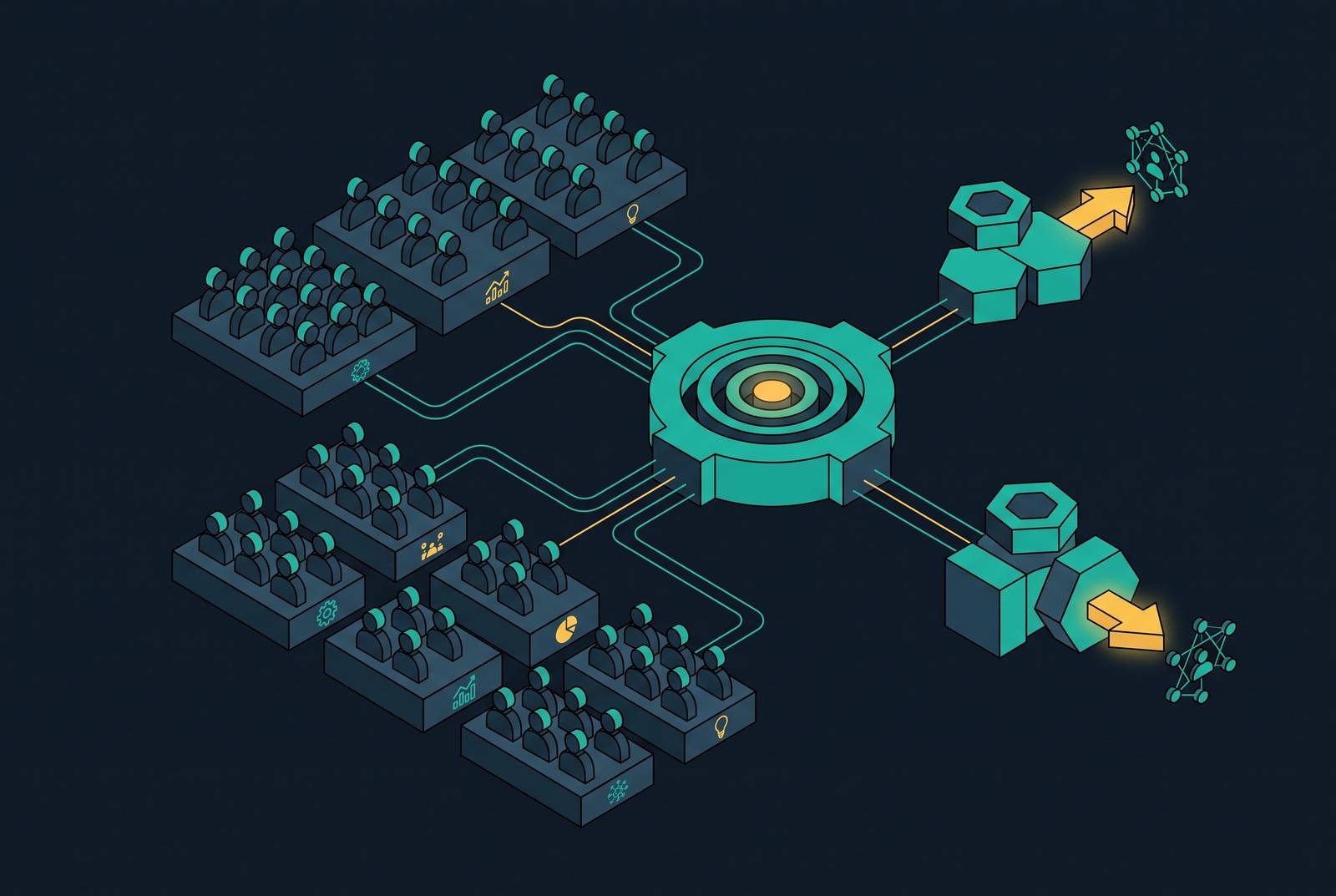
None of the three models is a substitute for either of the others. Fit defines the outer boundary of who's even eligible. Account selection tightens precision within that boundary. Behavioral signals decide timing and the right offer. Treating any one of them as a complete strategy on its own produces waste dressed up as reach.
Mapped onto an actual funnel, the architecture looks like this. Cold audiences that match the ICP profile but haven't engaged get top-of-funnel thought leadership. Named target accounts that have cleared account-based qualification and are somewhere in the buying-group evaluation phase get mid-funnel content like case studies and comparison guides. Accounts actively showing behavioral signals, whether that's retargeting engagement, CRM activity, or third-party intent data, get the harder asks: demo requests, audits, direct sales offers.
A cold audience handed a demo request will convert at close to nothing, a sign the ask outran the relationship rather than that the targeting was wrong (though wrong timing is its own kind of wrong). That same account, offered something lower-commitment like a relevant report, engages, and weeks later, once behavioral signals confirm real intent, the harder ask lands and gets accepted. The offer ladder is a mechanism for not wasting budget on asks nobody at that stage is ready to say yes to.
LinkedIn launched Thought Leader Ads in 2023, and they sit specifically in that mid-funnel layer. Reported click-through rates for the format run higher than Single Image Ads, and the reason tracks with what's happening at the mid-funnel stage: an account that's evaluating, not just discovering, trusts a person's voice more than a brand's. The trust gap between a company talking about itself and a named individual saying something that reads like it wasn't written by the marketing team explains the difference, not a coincidence of format.
The failure this architecture is built to prevent is specific and avoidable: dumping fit-based, account-based, and behavioral audiences into a single campaign hands LinkedIn's delivery algorithm a signal it can't interpret, and it defaults to optimizing for cheap reach instead of qualified reach. Keeping each segmentation model in its own campaign is what keeps that optimization signal legible. It's the mechanism that makes the whole layered system actually work as designed, not a nice-to-have for organizational tidiness.
Why measurement breaks before the segmentation does
A layered segmentation model only pays off if someone can trace a result back to the layer, offer, and account that produced it. Without that traceability, the optimization signal that's supposed to improve over time has nothing real to learn from, and it ends up compounding noise instead of insight.
You can't fix that by picking one single attribution method. AI-powered marketing operations teams in 2026 are combining multi-touch attribution, marketing mix modeling, and incrementality testing side by side, because each method sees something the others miss, and leaning on just one reproduces the same blind spots that already broke single-method attribution once before.
LinkedIn's CRM integration, rolled out in June 2025, matters specifically because of what it closes: the gap between platform-level engagement and pipeline that actually gets recorded in a CRM. It only works for teams whose CRM data is clean enough to match against platform activity in the first place. Messy CRM hygiene doesn't just limit reporting quality, it breaks the loop this integration was built to close.
The consequence for segmentation specifically is direct. And without that distinction, the compounding improvement that a layered model is supposed to generate over time simply doesn't happen. The segmentation can be built exactly right and still fail to improve, because nothing downstream is confirming which parts of it are working.
Continuous signal processing and segmentation decisions in practice
Segmentation built once a quarter off a CRM export starts decaying the moment it's finished, because buyer behavior doesn't wait for the next export cycle. An account that looked cold three months ago can be showing real intent today, and the segment Campaign Manager has it filed under won't update on its own to reflect that.
That shift means segment membership, offer assignment, and budget allocation can move on roughly the same timeline that actual buying signals move on, instead of lagging behind them by most of a week.
LinkedIn's Predictive Audiences feature is the platform-level version of this same shift. LinkedIn discontinued lookalike logic in February 2024, so instead of requiring someone to manually rebuild it, the model continuously re-evaluates which members resemble recent converters. The behavioral segment updates itself inside whatever parameters the campaign sets, so it never sits static until a person rebuilds it.
The Madison Logic and AgentSync case is a useful illustration of what this looks like at scale. The reported ROI outcome wasn't a function of better creative or a cleverer offer. It came from timing, from reaching those accounts while the intent signal was live instead of after it had already cooled.
Every cycle that updates a segment, tests an offer against a behavioral cohort, and records what converted leaves something behind: audience insights, creative performance data, account-level engagement patterns. Every cycle leaves behind evidence that didn't exist before it ran, so each cycle's segmentation decisions can get sharper than the last, instead of starting over from the same baseline every time.
What a functioning segmentation system requires from the team
None of this runs on autopilot. Someone accountable for pipeline outcomes has to make the judgment calls that determine which accounts belong in the ABM tier, which behavioral signals represent real intent versus background noise, and which creative belongs with which segment, not a platform algorithm handed the job wholesale.
McKinsey's B2B Pulse research backs this up from a different angle: high-growth companies aren't distinguished by which specific AI tools they've adopted, but by their ambition to rewire entire workflows end to end. Segmentation is one of those workflows. Its value comes from the operating model wrapped around it, beyond the targeting mechanics sitting inside the platform.
A lot of programs fail at the reporting stage before they ever fail at the strategy stage. A Ninjacat study found that a large majority of teams still run highly manual reporting processes, despite near-universal AI adoption elsewhere in their stack. That means the exact signal the segmentation system needs in order to improve is getting lost in manual spreadsheet work instead of feeding back into the next round of targeting decisions.
This creates a real structural fork for any team running a program like this. The work splits into two distinct jobs: continuous execution (updating segments, testing offers, reallocating budget day to day) and strategic judgment (defining the ICP, selecting accounts, assigning funnel stages). Those two jobs need different owners, so teams have to choose between in-house ownership, agency management, and delegated execution.
In-house teams can own both, agencies can manage both under a different fee structure, or a team can split the two deliberately: route continuous execution to automated systems or agents and keep a named, accountable person responsible for the judgment calls and the pipeline numbers behind them. Each model (in-house, agency, delegated) carries real tradeoffs in cost, control, and speed, and which one fits depends on what a given team is actually equipped to own.
Whatever structure a team lands on, there's one test that cuts through most of the ambiguity. A program measured by impressions and click-through rate has no way of knowing whether its segmentation is actually working. The only measure that answers that question is qualified pipeline influenced, traced back through CRM-recorded opportunities rather than platform-reported engagement. Everything this piece has walked through, the layering, the measurement stack, the continuous updates, exists to make that one number move. If a program can't produce it, the segmentation isn't finished yet.