Model Routing Architectures for Heterogeneous Marketing Workloads
Different marketing tasks need different models to run efficiently and cost effectively.
Audience research, ad copy generation, bid optimization, and attribution analysis sit on the same campaign timeline, but they have almost nothing else in common. Research means digging through messy, unstructured data and pulling a coherent story out of it. Copy means writing something short, sharp, and on-brand, fast, and in volume. Bid optimization means crunching numbers and making a call in real time, often in a fraction of a second. Attribution means tracing a chain of cause and effect across a pipeline full of structured data to figure out what actually drove a result. Pointing one AI model at all four jobs forces something to give. Either the model is too small to handle the hard reasoning tasks and quietly produces bad answers, or it's a frontier-grade model running simple formatting jobs it has no business being that expensive for.
This isn't a hypothetical architecture debate. Most companies have already voted with their deployments. The average enterprise runs about seven AI models across its environment, each one tuned for a specific job, and Datadog's research found more than 70% of organizations are now running three models or more. It's an admission that one model can't carry four different job descriptions well.
The cost of getting this wrong cuts in both directions. Sending a simple task to an expensive model leaks the budget out one inference call at a time. Sending a hard task to a cheap model produces results that look fine until the decision built on top of it falls apart. Cognition, the company behind the coding agent Devin, said as much in its Devin Fusion announcement: frontier-level intelligence has gotten expensive enough that running everything on it is no longer sustainable for engineering teams. Marketing agent stacks running continuous campaign work face the identical math. A campaign system generating thousands of ad variants a day, optimizing bids in real time, and diagnosing attribution gaps on the side can't afford to run all of that through one model, and it shouldn't have to.
The fix is a layer in front of the models that figures out which task is which and sends it to the right place.
How model routing works as an architectural layer
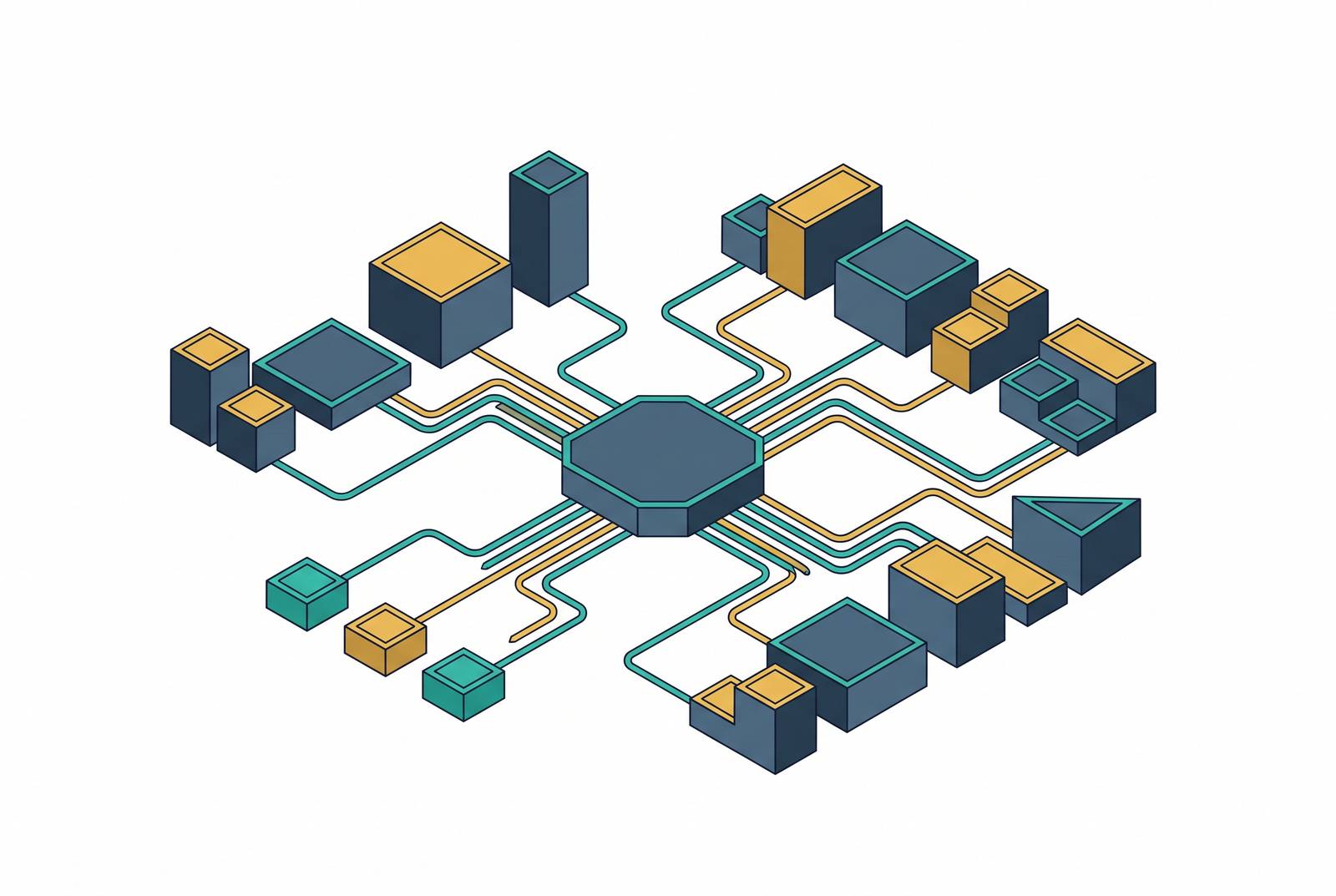
A model router is a piece of middleware that sits in front of every request before it reaches a model. It looks at what's being asked, checks that against a set of signals, and sends the request to whichever model in the available pool fits the job best.
The router sits between the marketing agent or campaign system on one side, and the pool of available models on the other. It doesn't belong to any one model and has no reason to favor one over another. Its only function is matching request to model.
What does it actually look at when it makes that match? Generally, that includes how complex the task is, how much each model costs per token, how fast each provider is responding right now and how loaded its systems are, whether a given model is even available, and whether there are compliance constraints to respect, like a rule that personal data has to stay on company servers.
None of this is a one-time setup. A router that only makes its routing decision once, and never updates it, is really just a fancier version of picking one model and sticking with it. Real routing has to reflect what's happening right now, not what a static rulebook assumed at setup. Load changes. Pricing changes. Task patterns shift as a campaign evolves. The routing decision needs to track all of that in real time, not run on assumptions baked in at setup.
One fair question: doesn't adding a whole decision layer in front of every request slow things down? In practice, the overhead is small enough to ignore. A routing study of the Solyx AI Grid system measured the cost of updating routing decisions at 0.2 milliseconds across every configuration tested, a rounding error next to the time an actual inference call takes.
The stakes get higher once you stop thinking about a single request and start thinking about a workflow. Marketing campaigns rarely run as one isolated prompt. Audience research feeds into the copy brief. The copy brief feeds into creative generation. Creative generation feeds into performance measurement. If the model handling the research stage gets something wrong, or loses information along the way, that error doesn't stay contained. It flows downstream and degrades every stage built on top of it. Model selection is now a question of whether the whole workflow holds together, not just a per-request cost question.
This is exactly the problem a framework called Atlas was built to formalize. Atlas treats a multi-stage AI workflow as an execution-plan selection problem: pick which model variant runs at each stage, decide where it runs on the available infrastructure, and do all of that while satisfying limits on latency, throughput, memory, and cost at the same time. A marketing agent stack doing research, copy, bidding, and attribution in sequence is precisely this kind of multi-stage problem. Routing isn't a cost optimization bolted onto the workflow. It's part of how the workflow is built.
What the three routing patterns are suited for
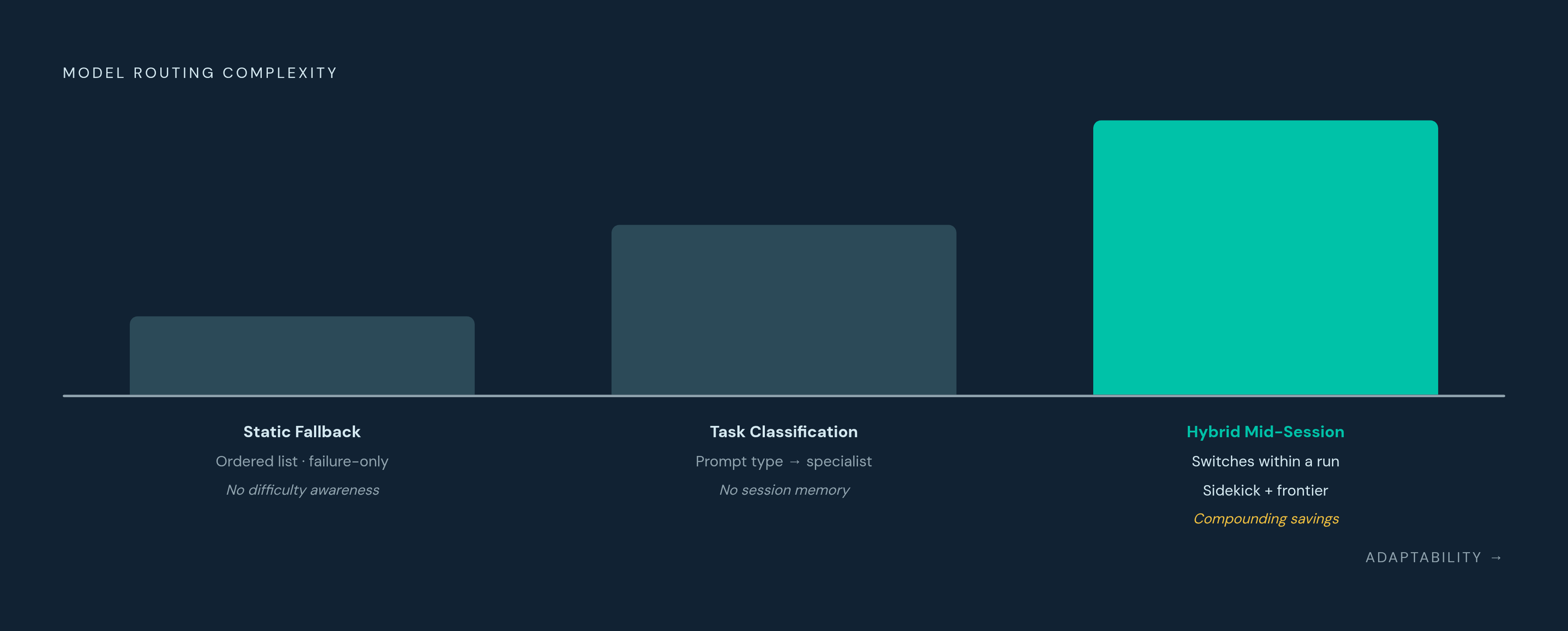
Three distinct patterns have emerged for how routing actually gets implemented, and they sit at different points on a curve running from simple-but-rigid to sophisticated-but-adaptive. Marketing workloads tend to map onto that curve in a fairly predictable way, and most teams end up moving along it as their campaign operations grow more complex.
The simplest pattern is static fallback routing. The setup is an ordered list of models: try Model A, and if it fails, fall back to Model B. It's supported out of the box by OpenRouter, LiteLLM, Portkey, and basically every major model gateway, and it's genuinely easy to stand up. It handles outages gracefully, so if a provider goes down, traffic shifts automatically.
Fallback routing has no way to tell an easy task from a hard one. Fallback only triggers on failure, never on difficulty. A simple ad-copy reformatting job and a complex attribution diagnosis get treated identically, routed to the same model, because the system has no concept of "this one's harder." For a narrow, uniform workload, like reformatting the same piece of copy into multiple ad sizes, that's a tolerable limitation. For a mixed marketing workload spanning four different task types, it leaves real savings on the table, because there's no mechanism distinguishing the cheap jobs from the expensive ones.
The next step up is task-based classification routing. Here, the router actually looks at what kind of request has come in, say, code, reasoning, summarization, or creative writing, and sends it to whichever model is built for that category. OpenRouter's Auto Router is a working example: it picks a model per prompt from a curated pool using its own market-spend-based routing logic (it used to rely on a system called NotDiamond, retired in August 2026), and a dial called cost_quality_tradeoff let users bias the choice between capability and price; that dial has since been replaced by a parameter called cost_tier.
This pattern is a real improvement, but it has a blind spot: it classifies one prompt at a time, with no memory of what came before. A lot of marketing tasks don't reveal their difficulty in a single prompt. A campaign brief might start simple and get genuinely hard three turns into the conversation, once ambiguity about audience or budget enters the picture. A router making a one-shot classification per prompt has no way to track that shift.
That gap is what the third pattern, hybrid-agent mid-session routing, is built to close. Instead of locking in a model choice per request, the router switches models mid-session: routine subtasks go to a cheap, fast "sidekick" model, while a frontier model gets reserved for the moments that actually require judgment, interpreting ambiguity, making a final call, forming a plan. Devin Fusion is the clearest working example of this logic in production, built for engineering work, but the underlying design translates directly into marketing terms. A campaign orchestration agent can hand off mechanical work, formatting a keyword list, calculating a bid adjustment, labeling creative variants, to a cheap model, while keeping the expensive model in reserve for decisions that actually need a frontier-level brain: defining an ambiguous audience segment, or justifying a budget reallocation.
The payoff compounds the longer a campaign runs. A one-off task doesn't benefit much from mid-session switching, since there's only one decision to make. But a continuous, multi-stage campaign program, running for weeks, generating decisions constantly, is exactly where the savings from routing easy work away from expensive models start to add up. Most teams start with static fallback because it's the easiest thing to wire up, then graduate toward classification and eventually hybrid routing as their campaign workloads get more varied and more continuous. That progression is the normal path toward a routing architecture that actually matches how marketing work gets done.
Classifying marketing tasks by the routing signals they require
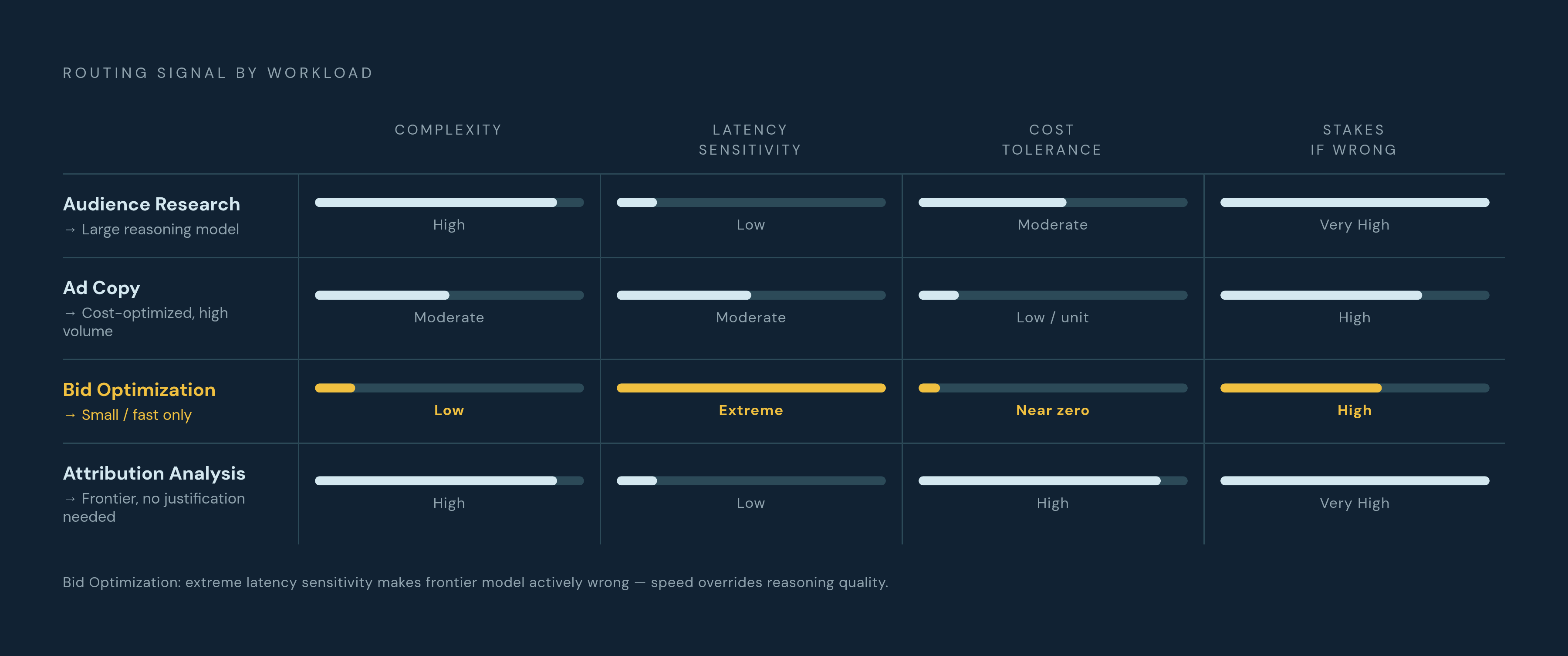
Each of the four core marketing workloads produces its own signature made up of four things: how complex the task is, how sensitive it is to latency, how much cost it can tolerate, and how high the stakes are if the output is wrong. Reading that signature correctly is what tells a router where to send the work.
Audience research and ICP enrichment carry high complexity, low sensitivity to latency, a moderate tolerance for cost, and very high stakes if the output is wrong, since mistakes here flow straight into targeting and copy downstream. The routing call is to send this work to a large model with strong retrieval and synthesis ability. Speed isn't the constraint. Accuracy is. A model that invents firmographic data or misreads intent signals doesn't just produce a bad research report, it corrupts everything built on top of it. The Atlas framework includes a component called the Markovian Accuracy Predictor, built specifically to estimate how an error at an early stage degrades accuracy at every stage after it, and audience research is the stage where that risk is highest in a typical campaign workflow.
Ad copy generation and creative variants carry moderate complexity and moderate latency sensitivity, but cost tolerance per unit is low, because the volume of variants needed is high, and the deciding quality factor is creative fluency rather than depth of reasoning. This is the workload most suited to routing by cost. A smaller, instruction-tuned model handles straightforward variant generation perfectly well, and a frontier model only earns its cost when the task is something genuinely novel: a new brand voice, an unfamiliar positioning angle, a creative decision with real stakes attached. Cost-based routing on straightforward queries like these can cut expenses by 60 to 80% with no drop in output quality, and ad copy at scale is close to the textbook case for that kind of saving.
Bid optimization and real-time budget allocation carry low complexity per individual decision, but extreme sensitivity to latency, very low tolerance for per-inference cost, and a high volume of decisions overall. Here the binding constraint is speed over reasoning depth. Small, fast models, or models built specifically for numerical work, are the right fit, and a frontier model is actively the wrong choice, because its extra latency costs more than any quality gain it offers. An empirical study of the Solyx AI Grid system found that routing aware of hardware telemetry, GPU metrics, the application-level metrics from the vLLM serving layer, and live network signals measurably cut tail latency, which for bid optimization directly means missed auction windows. For bid optimization, that tail latency is the difference between placing a bid inside an auction window and missing it. The same study found that DCGM hardware signals flagged trouble before it showed up as an actual SLO breach at the application level, giving the system time to drain traffic away from a struggling node before latency actually degraded, which matters most exactly for time-sensitive bid decisions like these.
Attribution analysis and pipeline diagnosis carry high complexity, low latency sensitivity, high cost tolerance (these tasks run infrequently but carry real weight), and the dominant quality factor is multi-step causal reasoning. This is the one workload where using a frontier model needs no justification. Figuring out whether a conversion drop traces back to weak creative, a broken landing page, or a hole in attribution tracking takes a depth of reasoning that smaller models don't reliably deliver. The metric that should govern this workload is Cost-per-Pipeline-Opportunity, not cost-per-lead: routing a cheap model to attribution analysis to save a few dollars in inference cost can produce a wrong diagnosis that gets a working channel defunded, a mistake that costs vastly more than whatever was saved on the model bill.
Routing signals: what the router measures to make a dispatch decision
The routing architecture is only as good as the signals feeding it, and most systems that underperform on mixed marketing workloads do so because their signal set is thin: just token count and whether a provider is up. A router built for marketing work needs more than that. It needs to classify the task itself before deciding anything about cost or speed.
Task-complexity classification comes first, because without it, nothing downstream works correctly. Enterprise tool use and software engineering tasks need different feedback mechanisms, and treating them the same breaks the system's ability to learn from its own results.
Marketing work needs the same discipline. A classifier built for this domain has to be able to tell apart at least four kinds of requests: retrieval-and-synthesis work like research, generative-creative work like copy, numerical-optimization work like bidding, and causal-reasoning work like attribution diagnosis. Sending any one of these to the wrong class of model is a structural mismatch between what the task needs and what the model is built to do, and no amount of prompt tuning fixes a mismatch at that level. Getting the classification right is the one piece of the routing layer that every other decision, cost, latency, compliance, depends on.
Sources
- RouteBalance: Fused Model Routing and Load Balancing for Heterogeneous LLM Serving
- Solyx AI Grid: Hardware-Telemetry-Aware Routing Across Geographically Distributed GPU Clusters
- Atlas: Optimizing Deployment of Compound AI Workflows on Heterogeneous Clusters
- LLM Model Routing in 2026: The Guide Every Team Should Read - DEV Community
- AI model routing multi-model AI architectures | As of 2026
- TRACE-ROUTER: Task-Consistent and Adaptive Online Routing for Agentic AI