AI Bid Optimization Logic in Google Ads for B2B Conversion Patterns
Google's algorithm chases form fills, not future buyers, unless you teach it the difference.

Google's Smart Bidding does exactly what you tell it to do. That's the problem. In B2B accounts, what teams tell it to do is "find more people who fill out this form" - and the algorithm listens, faithfully, without asking whether the people filling out that form are anywhere close to buying anything.
Why Google's algorithm optimizes for the wrong buyers in B2B by default
Smart Bidding has one job: chase whatever conversion signal you feed it. Feed it purchases on an e-commerce site, and it goes hunting for people who buy. Feed it form fills in a B2B account, and it goes hunting for people who fill out forms. Those sound like the same task. They are not.
A form fill on a B2B site catches students doing research, job seekers checking out the company, competitors scoping the messaging, and small businesses with no budget or authority to buy anything. None of them will ever become a customer. But they convert, and they convert cheap, so the algorithm learns to find more of them. It's optimizing correctly against the wrong target.
The math gets ugly fast. In poorly set up programs, fewer than 4% of paid search leads progress past the first call. Run that out across a real budget, and the campaign can spend a lot of money generating pipeline worth a fraction of the spend. The algorithm isn't broken. It's just been trained on the wrong lesson.
Part of the trouble is structural. E-commerce advertisers can target by intent signals tied directly to purchase behavior. B2B advertisers don't get that same precision in Search: there's no job title targeting. Some firmographic targeting exists through Detailed Demographics (company size, industry), but it's a blunt tool next to what you'd actually want, which is "show this to whoever has budget and a mandate to buy." Without that, Google learns who your best prospects are entirely from the conversions you hand back to it. Hand it junk, and it optimizes for junk.
How Google's bidding AI has evolved beyond single-event optimization
The old model was simple to a fault: Smart Bidding watched for one event, like a form fill or a purchase, and learned from that single moment. It had no idea what happened next. Did the lead close? Did the call go anywhere? The algorithm didn't ask.
That's changed. Bidding now runs on three coordinated mechanisms working together, not one signal in isolation.
Smart Bidding Exploration widens the pool of queries the system will bid on, beyond the tightest target return on ad spend, whenever conversions still look likely. Targeting doesn't get looser. The query universe gets bigger. It launched for Search in 2025, then extended in May 2026 to Performance Max (open beta), Performance Max with product feeds (beta), and Shopping (beta).
Journey-aware bidding looks past the form fill entirely. It tracks whether a deal actually closed, whether a call turned into a real lead, and learns from that downstream outcome instead of stopping at the first click of a mouse.
Demand-led pacing shifts spend toward the days when demand is predicted to run higher, rather than spreading budget evenly across the calendar regardless of what's actually happening that week.
Google reports the combination of these three drives a 27% increase in unique converting users on Search, along with a 66% drop in manual budget adjustments needed to keep campaigns on track. Smart Bidding Exploration specifically produced an 18% increase in new converting search query categories and a 19% increase in total conversions among campaigns using it.
None of that changes the core lesson from the first section, though. These systems are smarter about how they search for conversions. They're still only as good as what "conversion" means in your account.
The conversion signal architecture B2B accounts need to build before touching bid strategy
Before anyone touches a bid strategy setting, the account needs to teach Google the difference between "filled out a form" and "turned into revenue." That's the whole job of this section, and it rests on two moves: Enhanced Conversions for leads, and value-based bidding. Together, they shift the account from a machine that chases lead volume into one that chases revenue.
Offline conversion imports connect Google Ads back to the CRM, so stages like MQL, SQL, Opportunity, and Closed-Won all flow back into the ad platform. This is the piece that makes journey-aware bidding actually work for B2B. Without it, the algorithm has no way to know a lead ever turned into anything.
Proxy value formulas solve a related problem: how do you assign a dollar figure to a stage that hasn't closed yet? Work with Revenue Operations to back into a number using something like:
Proxy Value = Close Rate × ACV × (adjusted for stage probability and margin)
Every stage gets a dollar signal instead of a flat "1" or "0." That gives value-based bidding strategies something real to chase.
There's a threshold problem, though. Smart Bidding generally needs 30 or more conversions a month to optimize cleanly. Below that, Target CPA and Target ROAS tend to underperform even plain Manual CPC, because the algorithm simply doesn't have enough data points to learn from.
For accounts under that threshold, the fix isn't to force Smart Bidding to work anyway. It's to build a micro-conversion ladder first, things like pricing page visits or case study downloads, which give the algorithm enough signal volume to learn without training it to chase low-quality events. The practical path for low-volume accounts: run Manual CPC while uploading offline conversions to build up signal, then migrate to Target CPA once volume actually clears the threshold.
Which bid strategy fits which B2B account, and what the benchmarks actually show
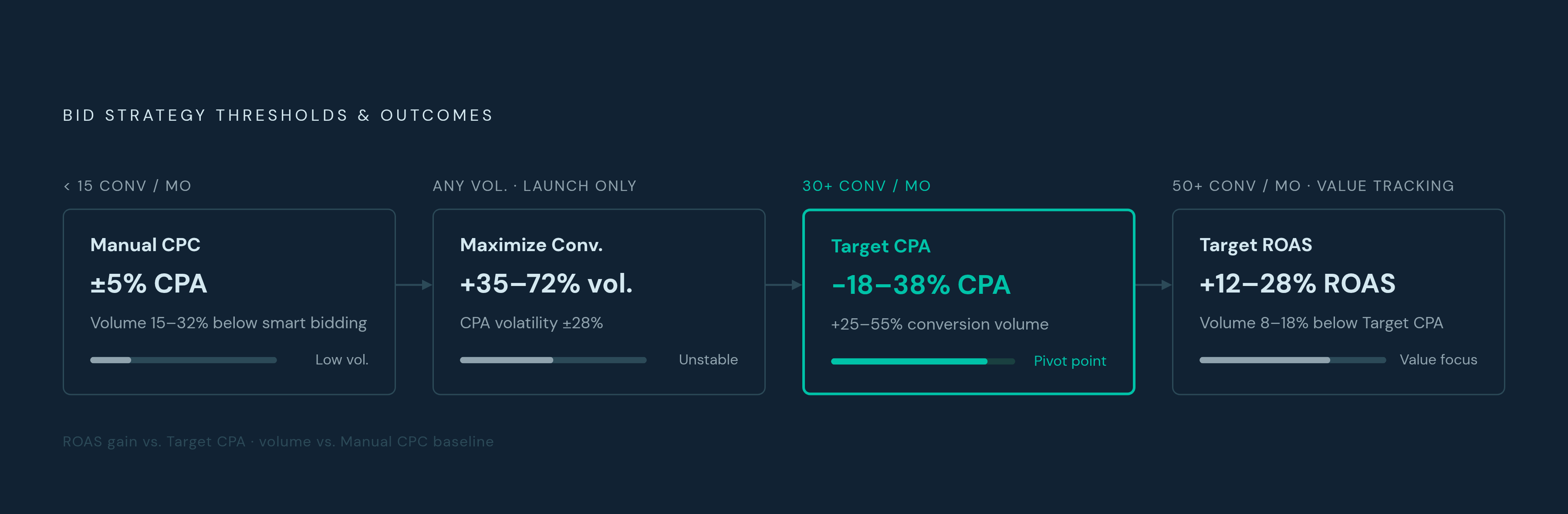
Get the bid strategy wrong, and it's expensive in a very specific way: bid strategy mismatch is the second most common source of wasted spend in B2B SaaS Google Ads accounts, behind only Quality Score neglect, and it can cost 15 to 35% of Search budget. On identical budgets, the right strategy versus the wrong one shows up as an 18 to 38% better cost per acquisition, at 25 to 55% higher conversion volume. That's not a rounding error. That's the difference between a campaign that works and one that quietly burns money while looking fine on the surface.
Here's how the major strategies actually behave:
Manual CPC: tightest control over cost per click, holding within about 5% variance, but it caps conversion volume 15 to 32% below what smart bidding could reach. Best reserved for branded campaigns, accounts under 15 conversions a month, or enterprise accounts with $250K+ ACV where volume rarely clears the smart bidding threshold anyway. Target CPA: once an account hits 30+ conversions a month with offline conversion data flowing in, this delivers 18 to 38% lower CPA than Manual CPC, at 25 to 55% higher conversion volume. This is the reasonable default for most B2B SaaS Search campaigns. Target ROAS: needs 50+ conversions a month plus value tracking tied to deal size or lifetime value. In exchange, it delivers 12 to 28% higher ROAS than Target CPA, though conversion volume runs 8 to 18% lower. Fits best for $25K+ ACV accounts with pipeline that spans multiple value tiers. Maximize Conversions (uncapped): produces the highest raw volume, 35 to 72% above Manual CPC, but CPA swings wildly, with volatility around 28%. Useful for a new launch that needs to build signal fast. Not something you want running steady-state.
Deal size changes the calculus, too:
SMB ($5K to $25K ACV): Target CPA as the default. Mid-market ($25K to $100K): Target CPA on Search, with a Target ROAS layer added on the highest-value campaigns. Enterprise ($250K+): usually stuck below the smart bidding threshold. Manual CPC plus offline conversion uploads until SQL volume builds up enough to justify anything smarter.
Campaign architecture that reflects B2B intent stages, not keyword themes
Most accounts get organized by keyword theme: one campaign for "product features," another for "integrations," another for "pricing." That structure feels tidy. It also has nothing to do with where a buyer actually is in their decision.
A better structure organizes campaigns by intent stage, with budget flowing in priority order down five tiers:
- Brand: highest conversion rate, lowest cost per click. Defend this before spending a dollar anywhere else.
- High-Intent Product: bottom-of-funnel searches where someone already knows the category or solution type they want.
- Competitor: buyers actively comparing alternatives. Often high value, but it demands messaging that actually differentiates rather than just naming the other guy.
- Problem-Aware: buyers searching for their problem before they know your solution, or any solution, exists. This is where Smart Bidding Exploration earns its keep, since it's built to widen the query net into exactly this territory.
- Remarketing: re-engaging people who've shown intent already but haven't converted yet.
Why does the Problem-Aware tier matter as much as it does? Because of how B2B buying actually works. In 95% of deals, the eventual winner was already on the buyer's shortlist. If you're not showing up when someone is still typing their problem into a search bar, you're not getting on that shortlist. You're hoping to fight your way onto it later, which is a much harder position.
Google is increasingly routing high-intent search queries through Performance Max rather than standard Search. Accounts that skip PMax entirely risk losing impressions that Search alone used to catch. The workable approach isn't picking one over the other. It's running PMax alongside Search, not as a replacement for it.
What a cost-per-qualified-pipeline metric actually requires from your measurement stack
A $250 cost per lead campaign and a $150 cost per lead campaign are worth comparing. Which one is better? The honest answer is: it depends entirely on what happens after the lead comes in. If the $250 leads convert into pipeline at a much higher rate, that campaign is the more profitable one, full stop, even though it looks worse on the surface metric everyone glances at first.
That's the trap with optimizing for MQL volume without checking pipeline quality behind it: it trains the algorithm, and the team running it, to chase volume at the expense of revenue. Everyone hits their number. Nobody hits the number that matters.
Getting to a real cost-per-qualified-pipeline figure takes a specific measurement setup:
CRM integration that passes lead stage events back to Google Ads as offline conversions, not just the initial form fill, but every stage after it. Deal value or ACV passed at the opportunity stage, so Target ROAS has an actual dollar figure to optimize against instead of guessing. Multi-touch attribution that connects a buyer's full path, someone who saw a Problem-Aware ad, came back twice through remarketing, then finally converted on a brand search needs to be recognized as one journey, not three disconnected events. Reporting built around pipeline generated and cost, not just whatever conversion count the platform reports on its own.
None of this is something marketing can build alone. The proxy value formula from earlier, a proxy value formula tied to close rate, deal value, and stage probability, needs real numbers from Sales and Revenue Operations. Guess at those inputs, and the whole measurement stack inherits the error.
The operational reality of maintaining signal quality over time
Setting all of this up once is the easy part. Keeping it accurate is the actual work, and it's ongoing.
Sales cycles stretch. CRM hygiene slips as reps get busy. Deal stages get redefined by someone in RevOps who didn't think to mention it to the person managing the ad account. Campaigns scale into new segments with different buying patterns. Every one of these is a small drift in the signal, and small drifts compound.
Smart Bidding learns continuously, which is exactly what makes drift dangerous. If the definition of an MQL changes, or the offline conversion upload lapses for a few weeks, the algorithm doesn't pause and ask what happened. It just keeps learning, from a signal that's now slightly wrong, and retrains itself in the wrong direction with no alert telling anyone it's happening.
That dynamic cuts both ways. Feed the system clean, consistent signal, and each campaign cycle gets a little sharper than the last. Let the signal degrade, and the account compounds toward worse buyers at higher cost, quietly, without anything on the dashboard flagging it as a problem.
Keeping signal quality intact takes a short list of habits, run on a regular schedule rather than treated as a one-time setup:
Offline conversion uploads on a reliable cadence, not a single integration done once and forgotten. Negative keyword audits as new query categories show up, especially now that Smart Bidding Exploration is actively widening the pool of queries it bids on. Conversion value recalibration whenever ACV, close rates, or margin assumptions shift. A proxy value formula built on last year's numbers quietly misleads the algorithm this year. Campaign architecture reviews whenever PMax or AI Max routing changes which queries get captured where.
None of this is glamorous work. But it's the difference between an algorithm that gets smarter every month and one that's confidently, efficiently finding you the wrong buyers, at scale, forever.