Evaluating Agentic Platform Vendors Before Delegating Live Ad Spend
Agents moving fast on incomplete B2B data make confident mistakes no dashboard will catch.
What agentic platforms do to your campaigns (the mechanics before the marketing)
Start with a clean definition, because "agentic AI" gets used loosely enough to cover almost anything with a chatbot bolted on. Agentic AI means a system that reads a situation, works through a multi-step plan, and takes action toward a goal with little to no human input at each step. Rule-based automation still needs a person to approve or trigger every branch of the decision tree. Agentic AI doesn't wait for that person.
A real agentic ad platform, once switched on, does several things without asking permission first:
- Moves budget between ad sets and channels based on performance
- Adjusts bids in real time as signals change
- Segments audiences and rotates creative
- Pauses underperforming ads and launches replacements
- Reasons across channels, not just inside one platform's walls
Why hand over that much control? Because the volume of decisions has outgrown what a human team can reasonably process. A B2B team running campaigns across Google and LinkedIn at the same time is looking at a stream of bid tweaks, audience tests, budget shifts, and creative swaps that, done by hand, either slows down or gets sloppy. Usually both.
Generative AI made content cheap to produce. Reasoning AI made decisions sharper. Agentic AI made execution fast enough to keep pace with both. Each layer shifts what a human is actually needed for, and the shift that matters most is the last one: marketers now supervise a system that moves faster than they do. Supervising something that fast takes different guardrails than supervising a person. That's the entire subject of this piece, and most companies skip past it on their way to the demo.
The B2B buying environment these agents are navigating raises the stakes for getting optimization wrong
An agent is only as good as the picture of reality it's optimizing against. In B2B, that picture is badly incomplete for most of the buying journey. That's exactly the environment where a fast, confident, wrong decision does the most damage.
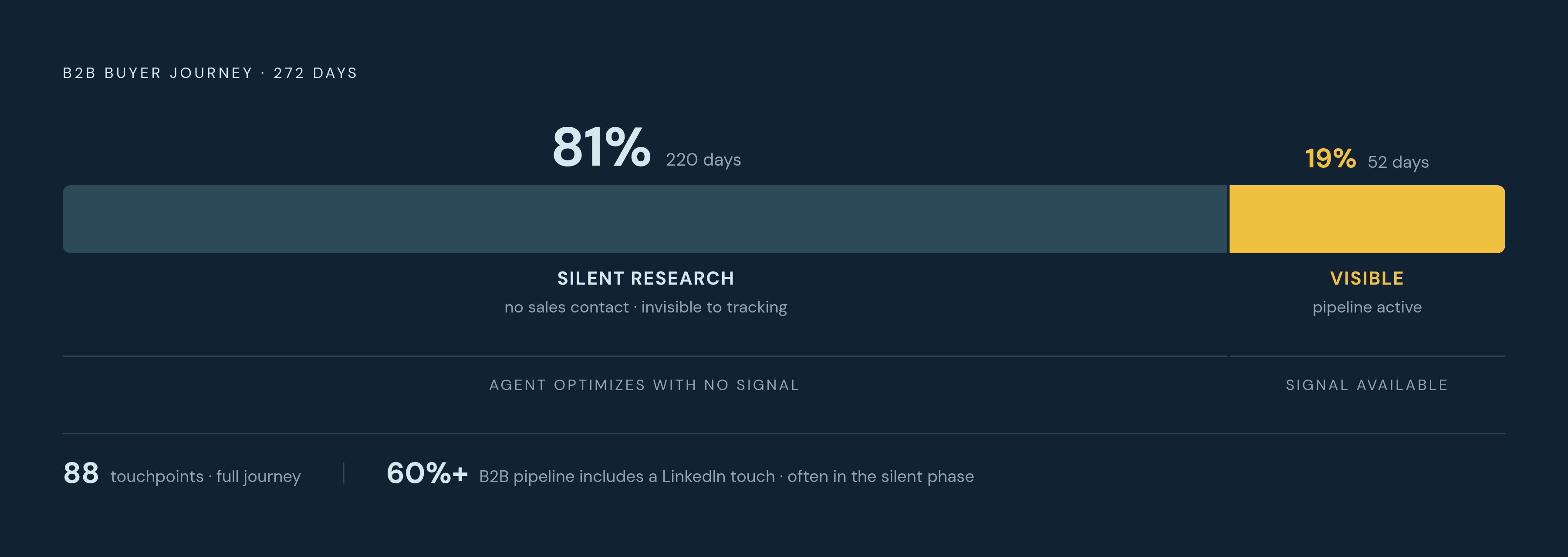
The average B2B buyer journey now runs 272 days and 88 touchpoints before a deal closes. Research covering 3.5 million customer journeys found buyers spend the first 220 days in a "silent" phase: researching, forming opinions, with no sales contact. That's 81% of the customer journey happening outside the sales pipeline, invisible to any tool watching for conversions.
An agent optimizing toward platform-reported conversions during those 220 days is optimizing toward signals that don't exist yet, making a confident decision with no data behind it. That's a confident decision made with no data behind it, and confident-but-wrong is worse than uncertain-and-cautious, because nothing on the dashboard flags the gap. It's a confident decision made with no data behind it, and confident-but-wrong is worse than uncertain-and-cautious, because nothing on the dashboard flags the gap.
The buying committee has gotten more crowded, too. Forrester's Buyers' Journey Survey found the average B2B purchase now pulls in 13 internal stakeholders and 9 external participants, and 74% of buyers report internal conflict somewhere in the process. More people, more opinions, more places for a deal to stall or change shape.
The shortlist has compressed hard in the other direction: down to a very short list, with most of the vendors a buyer will ever seriously consider landing on that shortlist on day one. Lose visibility during the silent phase and a team loses deals it never knew were in play.
This is where the optimization turns genuinely dangerous. An agent that cuts a channel because it shows weak last-touch attribution might be cutting the exact channel winning the silent phase. More than 60% of B2B pipeline includes a LinkedIn touch somewhere along the way, and last-touch attribution doesn't capture any of that influence. The agent is blind to the thing it's wrong about, with no signal telling it to look harder, so it can't correct the mistake later. It's blind to the thing it's wrong about, and there's no signal telling it to look harder.
Spend controls and guardrails, the first thing to examine before any other capability
Before asking what an agentic platform can do, ask what it can be stopped from doing. An agent with autonomous budget authority operates inside a company's P&L, not next to it. Spend controls are the line between delegating work and abdicating responsibility, and most vendor pitches spend far more time on the first than the second. That imbalance alone should raise a flag.
A vendor that wants to skip straight to full autonomy on day one is the wrong answer. That's a governance risk wearing a confidence costume, and it's the single clearest tell in the entire buying process.
What good looks like instead:
- Hard daily spend caps the agent physically cannot exceed. Not soft "recommended" limits, which are just suggestions with a different font.
- An observation-mode phase first. The agent recommends decisions, and those recommendations get checked against what a human team would have actually done, before autonomous execution ever gets switched on.
- A track record that builds before the leash comes off, not after.
Three questions do most of the work in an evaluation. Ask each one directly and pay attention to how fast the answer comes back:
- Walk through what happens when the agent wants to move budget from LinkedIn to Google. Who sees that, what triggers it, and what can stop it?
- If the agent makes a spend decision that violates a guardrail, how does that get surfaced, and who's accountable for it?
- Can the vendor produce a log of autonomous actions taken over the last 30 days for a customer roughly the same size and shape?
A vendor that gets vague on any of these has already answered. Not in the words used. In the silence around them.
Data quality and attribution (what the agent is optimizing toward)
An agent doesn't optimize toward reality. It optimizes toward the signals it's fed. An agent doesn't optimize toward reality; fed incomplete, delayed, or misattributed data, it still makes a decision, confidently, faster than any human team would. Speed just gets you to the wrong conclusion quicker without fixing bad inputs. It just gets you to the wrong conclusion quicker.
A few failure points matter more than others in B2B:
Browser-based pixel tracking keeps getting less reliable as third-party cookie deprecation continues. Client-side pixels miss conversions that server-side tracking would have caught. Inconsistent conversion definitions across platforms mean an agent comparing cross-channel data is comparing things that aren't actually comparable, even though the dashboard makes them look like they are. CRM disconnect is probably the biggest one. If the agent only sees ad-platform conversions and never sees what happens downstream in pipeline or revenue, it optimizes toward form fills instead of qualified opportunities. Those aren't the same thing, and the gap between them is where budget quietly gets wasted.
Multi-touch attribution is the fix that actually works here, because it spreads conversion credit across every touchpoint in the journey instead of handing it all to the last click. That gives the agent a far more accurate read on which channels are genuinely contributing to pipeline, which matters enormously across a 272-day buying cycle where the last click captures only a fraction of the influence built across the journey.
Before signing with a vendor, run this audit directly:
- Compare conversion numbers across the ad platforms, the analytics tool, and the CRM. Big discrepancies mean a data quality problem that flows straight into the agent's decisions.
- Ask whether the vendor supports server-side tracking and Conversion API integrations for both Google and LinkedIn.
- Ask whether the agent can actually ingest CRM opportunity and revenue data, or whether it's stuck looking only at what the ad platform reports.
How the major platform categories approach agentic execution and accountability
The differences between platforms are about who holds control, and how that control gets logged and reviewed. They're about who holds control, and how that control gets logged and reviewed. That's the comparison that actually matters, and most feature-by-feature evaluations skip it.
Demandbase is built for enterprise teams that want account-level data driving every bid decision. Its core piece is Piper, a DSP built specifically for B2B auctions from the ground up rather than adapted from a consumer ad model. In 2025, Demandbase launched three AI agents that all work from the same account data. Demandbase's own research, covering 1,452 companies and more than 429,000 ad campaigns, found accounts backed by sustained buying-group advertising convert to opportunities at two to three times the rate of accounts that saw no advertising. The open question for a buyer: when the agent shifts budget based on an intent signal, what human override exists, and is that override actually logged anywhere reviewable?
6sense leans toward a revenue-team orientation rather than a pure media-buying frame. Its intent-signal model is built around the well-documented problem of buyers locking in shortlist vendors early in the silent research phase. Demandbase faces the same accountability question: how clearly the platform shows which intent signals triggered which specific agent actions, so a team can go back and audit the trail later.
Meta's Advantage+ points somewhere different entirely, and it's worth being direct about the mismatch. Meta has announced plans to fully automate ad creation by the end of 2026, where an advertiser submits a product URL and a budget and the AI handles images, video, copy, targeting, platform selection, and budget allocation from there. More than 4 million advertisers already use Meta's generative AI tools, and Meta reports Advantage+ campaigns deliver 22% higher ROAS on average versus manually managed campaigns (a vendor-reported figure, not independently audited).
The more that system does on its own, the less room an advertiser has to override targeting or creative choices. That works fine for a direct-response consumer product with a same-day conversion. It's a bad fit for B2B, and running a long, 272-day B2B sales cycle through a platform oriented around short-cycle, high-volume conversion is the wrong move. Meta's model is tuned for volume and ROAS in a consumer-adjacent frame. It was never built to optimize for the kind of extended, silent research phase that defines B2B buying, and forcing that fit isn't a governance risk so much as a category error.
None of this means one platform category wins and the others lose. It means the real evaluation question is who answers for it when the system does the wrong thing, and how a team would even find out. Not what the platform can do. Who's on the hook when it doesn't. Settle that question before any budget moves.