Why Compounding Campaign Intelligence Separates Agentic Platforms From Quarterly-Reset Ad Tools
Persistent campaign memory beats quarterly resets for faster learning.

Compounding campaign intelligence for B2B growth marketing means retaining evidence from every campaign and using it to improve the next campaign’s audience, creative, and attribution decisions. The structural advantage of an agentic platform is not faster execution but this continuous inheritance of learning. A quarterly-reset tool can automate the work while still making the program pay to discover the same lessons again.
Why the quarterly reset is a structural problem, not a workflow inconvenience
The agency’s quarterly review deck recaps last quarter’s spend, explains the results, and recommends a new strategy. But where did the old strategy’s lessons go? The next brief shows little of what was learned from the audiences, messages, and offers already tested. A growth leader is left paying for another round of discovery, including some discoveries that look suspiciously familiar. The presentation has moved on. The program has not.
This is not simply a failure of diligence. Conventional tools and engagements often organize work around separate campaigns and quarterly deliverables. Campaign-specific delivery history and learning progress are not the same as reusable account-level assets, such as custom audiences and pixel history. Those assets can persist without preserving the reasoning that connects a previous result to the next decision.
An account manager may remember why a promising audience disappointed or why a popular offer produced weak leads. When that person leaves, the report may remain while the useful context disappears. Inheritance depends on someone remembering to supply it, so the program repeatedly purchases lessons it already owns.
What "compounding campaign intelligence" actually means mechanically
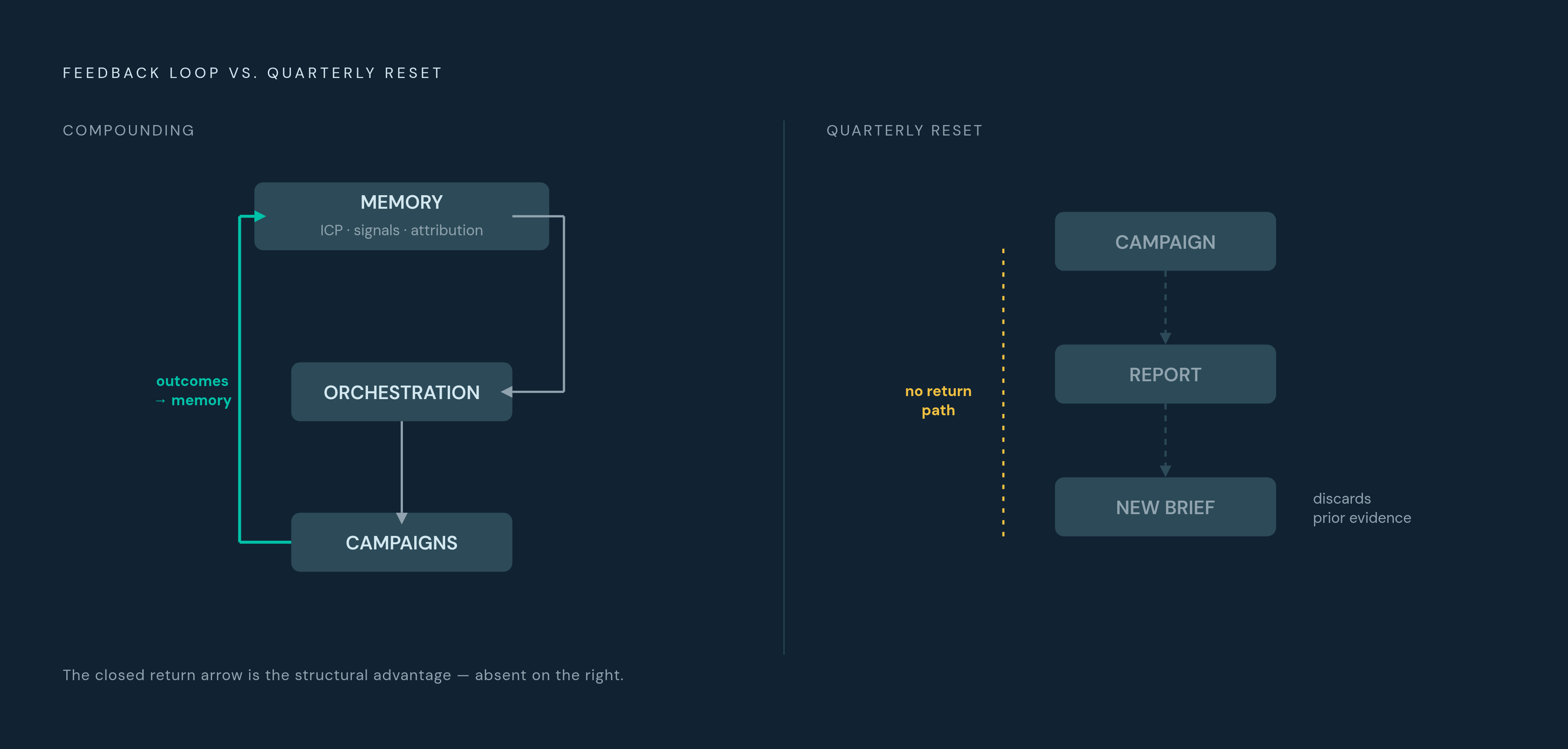
The alternative is a persistent evidence layer that each campaign both reads from and adds to. Memory is necessary, but not sufficient on its own. A folder of old reports preserves information without making it part of the next decision. Compounding requires a working connection between stored evidence, current audience understanding, execution, and feedback.
The memory layer keeps audience signals, the results of ideal customer profile scoring, data on creative performance, and attribution history. The orchestration layer then sequences the agents, passes context between their tasks, and determines when human judgment is needed. Without that coordination, agents can do useful work that stays cut off from the rest of the program. A creative agent remembering past messages does not help targeting if the audience decision never receives that context.
Enrichment and intent add a current view of the market to this history. They continuously validate ICP fit, map buying groups, and flag accounts showing intent, so yesterday’s evidence does not become a permanent audience definition. As campaigns run, they send conversion outcomes, engagement patterns, and attribution data back to memory. The loop has to close for learning to accumulate.
Draw the architecture as a loop. Persistent memory helps the system refine audiences and run campaigns together, and campaign feedback updates the evidence it can use for the next decision. Human escalation sits within that flow. That structure distinguishes a system that learns across campaigns from one that merely completes campaign tasks.
How the performance gap opens and why it widens over time
In week one, both programs have little campaign evidence to draw on. Their results may look much the same. It opens as the compounding program uses each cycle to narrow uncertainty while the resetting program revisits questions it has already paid to answer. The advantage grows as the program makes better choices from the start and reacts faster after launch.
Audience quality improves as engagement and conversion outcomes refine the picture of fit. Accounts that show no engagement can be deprioritized, while those that engage without converting can be re-examined. Choices about creative draw on the same record of what has been learned. A message that resonated with one segment becomes evidence for that segment.
Attribution gives this difference a longer reach. As more conversion data comes back, multi-touch measurement can better link earlier interactions to what happens later. Short lookback windows and manual last-touch tracking can instead hide the professional interactions that helped create demand. Budgets then favor channels that capture demand that already exists and starve those that helped create it. If the missing history is never recovered or retained, the same distortion shapes the next quarter.
This makes the gap harder to close over time. The resetting program needs more than a new creative idea or a quicker campaign build because its rival has a growing base of audience, message, and conversion evidence. As platforms automate more targeting, bidding, and creative work, differentiation shifts upstream to those inputs. Better execution cannot fully compensate for a poorer account of what success looks like.
What Google and LinkedIn's own platform direction says about the compounding model
Google and LinkedIn’s broader direction is toward more platform-managed execution, with advertisers supplying goals, data, and creative inputs. Whether either platform provides a complete cross-campaign intelligence system remains unproven. Automation within an advertising platform and learning that builds across a B2B program address problems that are related but different.
LinkedIn’s Accelerate automates targeting, creative, bidding, and placement. This gives the platform control over more of the campaign’s work while the advertiser remains in charge of the goals and inputs that guide it. Google’s broader move toward AI-led operational work points to the same supervisory model. Neither direction removes the need to connect advertising decisions to what happens on landing pages or later in the sales funnel.
Platform learning is therefore not a substitute for program memory. A team can use automated bidding while giving the platform only some of its conversion signals or rebuilding its audience strategy each time. The automation may be continuous even though the program’s reasoning resets. Compounding intelligence supplies the continuity across those boundaries, so the system is not asked to optimize against a partial account of each campaign.
As the platform takes on routine work, people spend more of their time setting rules and direction, handling exceptions, and making calls with big consequences. A quarterly review can still be useful for oversight. It becomes a problem when it is the only point at which campaign evidence changes the program’s direction.
How do you build a B2B paid media strategy where campaign data compounds over time?
A B2B paid media program compounds when creative, landing pages, attribution, and reporting operate as one closed loop. Each must provide evidence that changes decisions elsewhere in the program, so a campaign’s results become useful beyond the team or vendor responsible for producing them. That requires program design.
Creative starts with prior evidence about which messages, formats, and offers moved which audience segments. Landing-page results then sharpen that evidence. A page that converts well for a particular segment offers information about that segment’s readiness and objections, which can inform the next audience and message decisions. Conversely, engagement without conversion gives the program a reason to examine the handoff between the ad and the page.
Attribution connects these local responses to the business outcome. Google and LinkedIn’s optimization depend on the conversion data returned to them, so incomplete signals can leave campaigns optimizing toward an incomplete target. For B2B, pipeline influenced is the useful measurement frame. An inbound demo request and a content-download MQL do not convert at the same rate. Treating them as interchangeable teaches the system to pursue volume without learning enough about its value.
The measurement window must also fit the buying cycle. A short lookback suited to consumer e-commerce can misrepresent where a long-cycle B2B opportunity began, leaving earlier activity out of the account. Retaining attribution history allows later outcomes to inform the next campaign instead of arriving after the program has effectively forgotten the first. Reporting then becomes a forward-looking input. Its audience, creative, and conversion findings form the next brief rather than a retrospective document that must be manually translated into action.
Why the human judgment layer is what makes compounding intelligence governable at scale
A persistent learning loop can also reinforce the wrong lesson. That is the strongest objection to the model. An agent optimizing cost-per-click may improve its chosen metric while the real constraint sits on the landing page. Another may generate more form fills while lead quality deteriorates downstream. Continuous execution does not, by itself, distinguish a better number from a better business outcome.
A named expert diagnoses whether the growth constraint is creative, the landing page, attribution, or funnel fit, rather than assuming every problem belongs inside the ad platform. That person sets goals and guardrails, changes them when the business context shifts, and handles exceptions outside the system’s learned patterns. Accountability sits with someone who can explain the outcome.
This is different from manually supervising every campaign adjustment. Continuous execution needs to be separated from decisions that require business judgment. Orchestration makes that separation workable by passing context through the system and escalating decisions.
Without this layer, errors can build up along with the evidence. A falling cost-per-click looks good until someone spots the landing-page mismatch that keeps that traffic from turning into pipeline. The diagnostic task is to locate the actual constraint, then align the system’s goals and actions with it. Governance makes the learning loop durable because it can correct the direction of optimization.
What a B2B marketing or growth leader should ask to tell compounding from quarterly-reset in disguise
For a leader evaluating a system, the test is inheritance. Building campaigns fast and adjusting them all the time shows automation, but neither proves that the next campaign draws on more of what has been learned. A leader should first check that context passes from one campaign to the next without someone having to enter it again. Prior evidence should shape audience, creative, and attribution decisions, rather than leaving the team to reconstruct that context from a template or blank brief.
Does the system retain and structure evidence about which segments responded, which offers converted, and which approaches failed? Storage alone does not pass this test. The evidence needs a route into the next decision, rather than an eventual home in a report that someone may remember to read.
A third question is whether the program can diagnose a constraint or only tune the platform. Identifying a landing-page problem or an attribution gap is different from adjusting bids and budgets within a campaign. Fourth, a leader should establish who is accountable when those adjustments improve the tracked metric but not the business outcome. A named expert with responsibility for goals, diagnosis, and exceptions makes governance part of the operating model.
The delegation test connects these questions to everyday work. If the customer must prompt the tool, interpret every output, and translate it into action, the work has not been delegated. It has acquired another interface. Genuine delegation means continuous execution, surfaced decisions that need judgment, and accumulated evidence that lets the customer’s next decision begin with history.
The first campaign is the most expensive intelligence a program produces because everything after it should cost less to learn. A quarterly-reset program pays that first-campaign intelligence cost every quarter. A compounding system pays it once and builds from there.