B2B Demand Generation Platforms With Native AI Agent Execution
Native AI agents need one closed loop, not automation dressed up with a new name.

What "native AI agent execution" means, and what it doesn't
Automation follows fixed, pre-programmed steps, while an agent adapts its actions based on a goal, and most of the confusion in this whole category lives right here.
Automation follows fixed rules. A lead downloads a PDF, an email goes out three days later. That's the whole system. It doesn't think, doesn't adjust. It waits for the trigger and fires.
An agent works differently. Give it a goal, like "generate 15 qualified demos from mid-market SaaS accounts this quarter." The agent figures out the channels, builds the content, sets the targeting, and changes course when something isn't working. No human signs off between each step.
Goal versus rule. That's the whole ballgame. But it gets murkier once you ask whether the agent is native or layered on top of something older.
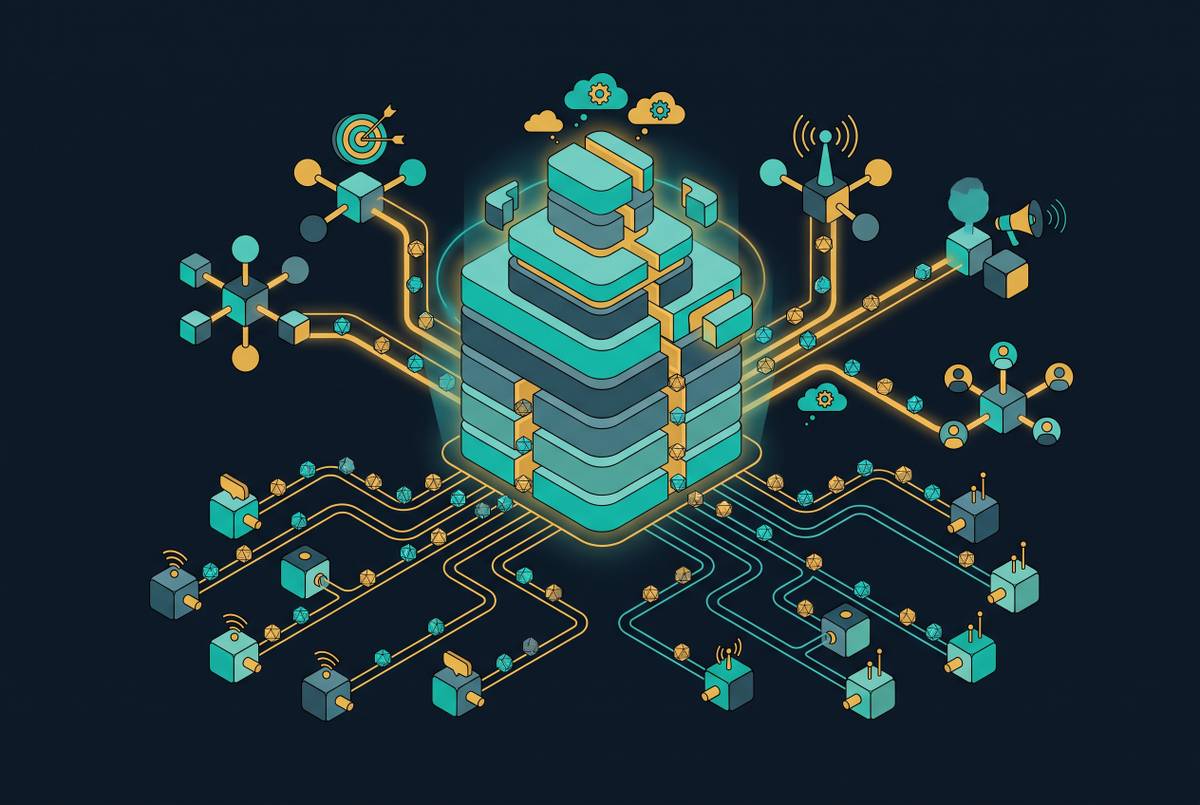
Native agent execution means research, build, launch, monitoring, and optimization all run in one loop, sharing the same data the whole way through. Layered execution means someone bolted an AI feature onto a workflow that still hands off between disconnected systems, the same way it always did. Picture a relay race. Traditional demand gen passes a baton between runners, each one blind to what the last leg learned. AI-assisted tools make each runner faster. Agentic execution turns the race into one continuous motion, where every step already knows what came before it.
So what doesn't count as agentic? Renaming a sequence of automated steps "agents." Wrapping a chatbot around a form. Sprinkling model-generated text on top of what's still a manual list-pull. These moves are everywhere in 2026, and calling them agentic is where most of the industry is currently lying to itself.
Adoption numbers make the confusion worse, not better. Gartner projects that by the end of 2026, 40% of enterprise applications will include task-specific AI agents, up from under 5% in 2025. Scott Brinker's Martech for 2026 research found that 90.3% of marketing organizations already use AI agents somewhere in their stack, with content production agents leading at 68.9% adoption and audience discovery agents at 40.8%. Those numbers sound like victory. They aren't proof the loop is closed. A tool can sit inside a stack and still hand off to a human, or to a different disconnected system, at the exact point where speed actually mattered.
Agents amplify whatever process feeds them. A broken demand gen motion running at agent speed doesn't get fixed. It breaks faster. Strategy calls, budget decisions, the ambiguous exceptions, still need a person accountable for the outcome. Nobody has built a system where a machine takes that blame for you, and nobody should want one that tries.
The three distinct demand gen motions and why conflating them breaks platform selection
Before evaluating any platform, separate three things that get lumped together constantly. ZoomInfo's demand gen tools guide draws this line clearly: before evaluating any platform, separate three things that get lumped together constantly.
Demand creation builds awareness among the 95% of buyers not yet in-market. It needs ungated content and intent data that reaches a buying committee before it even forms as a committee.
Demand capture intercepts the roughly 5% actively evaluating right now. It needs real-time account identification and a fast handoff to sales. Google Search and listings on sites like G2 and Capterra live here.
Lead generation is the narrowest of the three: capturing contact information from someone who raises their hand. Gated content, forms, that kind of thing.
They blur all three into one motion, default to grabbing form fills from people already in-market, and call the whole operation "demand generation," when really it's lead gen wearing a bigger hat. A 2026 agency guide from GrowthSpree makes the point bluntly: agencies ignoring the 45 to 60% of MQLs sales rejects as junk aren't doing demand gen at all. They're running a lead mill.
A deeper measurement problem underneath this, sometimes called the dark funnel, causes attribution models to miscredit the touchpoints that actually moved a buyer. A buyer reads a LinkedIn post, sits on it for three weeks, then fills out a form. Most attribution models hand full credit to the form and none to the post that did the actual work. Crediting the last visible touch instead of the one that mattered is the defining measurement headache of demand gen in 2026.
So how do you judge a platform against this? ZoomInfo's Demand Gen Stack Audit breaks the funnel into three stages, and each stage asks a different question.
- Identify and target: intent data, audience building, account-based marketing. Is the signal verified and first-party, or a broad third-party guess based on topic browsing?
- Engage and convert: marketing automation, conversational tools, content distribution. Do campaigns run off one shared audience definition, or are different tools pulling from different data sources and quietly working against each other?
- Measure and optimize: attribution, CRM integration. Does the platform connect activity all the way to closed-won revenue, or does it stop counting at MQL volume and call it a day?
This matters directly for judging agent claims. A platform can have real, working agent execution at the identify-and-target stage and nothing resembling it at the measure-and-optimize stage. Know exactly where the gap sits before believing a platform's "agents" close it.
Platform-by-platform breakdown: what each tool's agent layer does
Every platform below gets judged on the same things: data quality and freshness, signal coverage and how fast that signal arrives, whether AI moves from signal to outreach without a human in the loop, how deep the CRM connection runs, and how far attribution actually reaches.
ZoomInfo Marketing
ZoomInfo has been named a Leader in the Gartner Magic Quadrant for ABM Platforms in both 2024 and 2025, and a Leader in the Forrester Wave for Intent Data Providers B2B in Q1 2025. The data behind it is extensive, drawing on a large volume of professional contacts, company profiles, verified phone numbers, and verified business emails, along with a massive number of data points processed daily with help from 300-plus human researchers.
Its GTM Context Graph combines that data with CRM records, conversation intelligence, and behavioral signals to explain why an account is behaving a certain way, tying marketing activity back to closed-won revenue instead of stopping at MQLs.
On the agent side, ZoomInfo runs an MCP server that connects its contact and company data directly to outside AI agents or custom pipelines through a standard interface. GTM Studio lets marketers build an audience just by describing it in plain language, then launch a multi-channel play without filing an engineering ticket. Its Guided Intent feature flags topics that have historically correlated with closed deals, instead of leaving a marketer to guess which topics to track by hand, a real step up from raw topic aggregation. WebSights de-anonymizes website visitors and surfaces the actual buying-team contacts while intent is still live, not three weeks later.
This fits teams that want one platform spanning identification through measurement, and teams wiring ZoomInfo's data into their own custom agent pipelines. A platform this broad won't out-depth a narrow point solution on any single feature, and accuracy on niche geographies or smaller segments should get tested before committing budget.
Demandbase
Demandbase combines intent data, ad targeting, and CRM integration to coordinate demand gen across channels for account-based motions. It has a named agent system, Agentbase, which automates repetitive go-to-market tasks. It also offers sales intelligence for outbound prospecting and measurement tools connecting ad spend to pipeline.
This fits enterprise sales motions built around specific named accounts, where outbound and paid media both need to pull from the same intent data.
The catch, per Perspective AI's ranking: Demandbase's signals are inferred. The platform can tell an account is researching something, but it's guessing at the why, and users report a chunk of those signals amount to noise. Pairing it with first-party qualitative research before spending on messaging is a reasonable safeguard.
6sense
6sense predicts what buying stage a target account is in, using behavioral signals pulled from the dark funnel. The signal here is inferred rather than stated directly by the buyer, like Demandbase, so the why behind a spike in activity is an approximation, not a fact.
6sense's own Buyer Experience Report found that 94% of B2B buyers already use large language models somewhere in their buying journey, a stat 6sense surfaces itself. It also points at something uncomfortable for the platform: buyers are forming opinions well before the behavioral signals that 6sense monitors can capture them.
This fits enterprise teams that want account-stage prediction to prioritize where outbound effort and ad spend go. It's strongest at the identify stage. Getting from there to a documented closed-won attribution takes real CRM integration work, and because the signal is inferred, testing message resonance still needs a separate tool.
Perspective AI
Perspective AI takes a different approach entirely: AI interviewer agents hold live conversations with people matching the ideal customer profile, follow up when an answer is vague, and capture what buyers say in their own words.
That covers three jobs intent platforms can't touch. First, testing messaging before spending a dollar, using the buyer's actual language in ads and landing pages instead of a marketer's guess. Second, running win/loss and "why now" research at scale. Third, replacing the static gated form with a conversational agent that qualifies and routes a lead while feeling far less like filling out paperwork.
Its signal is first-party and stated, the only entry here where the why comes straight from the buyer instead of getting inferred from clicks. 79% of leads never convert, the average form converts at 4.3%, and the most valuable context a buyer could give ("we're evaluating because our renewal is in Q3") never fits into a text field anyway.
This fits teams that need to understand message resonance before spending, and teams looking to replace gated forms with something conversational. It's not an ABM orchestration engine, and it doesn't push audiences into ad platforms. It needs pairing with an intent or ABM tool for activation. It is the insight layer.
HubSpot (Marketing Hub + Sales Hub)
HubSpot keeps marketing automation, contact management, and sales sequencing inside one CRM-native system, no separate data platform required. Its plans unlock progressively more automation, reporting depth, and team controls at each tier.
Its automation is rules-based and mature. Its agentic capability, the goal-directed, self-adjusting kind, trails platforms built agent-first from the ground up, and that gap is unlikely to close soon given how HubSpot's architecture is built around sequences rather than open-ended goals.
This fits teams that want marketing and sales data living in one place without a separate intent data investment, especially earlier-stage companies before that spend is justified. Being all-in-one means no single feature area is best-in-class, pricing climbs fast for small teams, and MQL-centric reporting takes extra work to connect to actual closed-won revenue.
Clay
Clay is a data enrichment and go-to-market automation layer. It builds enriched, AI-researched account lists from third-party sources and automates the path from an enriched signal straight into an outreach sequence.
The signal here is enriched third-party data, not first-party, not inferred behavioral. The value is speed and how customizable the enrichment workflow is, not proprietary signal coverage nobody else has.
This fits RevOps and growth teams that want to build their own custom workflows and connect data sources like ZoomInfo and LinkedIn into a pipeline they control. It takes real technical setup, and it isn't a stand-alone demand gen platform. It works as connective tissue inside a stack made of other tools.
Salesforce Agentforce
Agentforce is a CRM-integrated agent environment. In December 2025, it launched as Agentforce Sales, a native ChatGPT app in open beta, letting teams manage leads, update CRM records, and delegate prospecting tasks from inside a ChatGPT conversation.
This fits organizations already deep in the Salesforce ecosystem, where the value is CRM-connected execution (lead management, sequencing, pipeline updates) rather than generating intent signals from scratch. Its agent capability is strongest inside Salesforce's own data model. Intent data and cross-channel ad coordination still need separate platforms.
Where paid media agent execution is and isn't mature in 2026
Channel choice maps directly onto the demand capture versus demand creation split from earlier.
Google Search is a demand capture channel. It intercepts people already searching for a solution. Agent execution here occurs in bid management, signal quality, and integrating offline conversions. LinkedIn straddles both demand creation and capture: it builds preference among the 95% not yet shopping, and agent execution there means audience targeting, creative rotation, and routing engagement signals.
There's a specific trap on the Google side, and it's one of the more expensive mistakes a team can make. Feeding form fills and whitepaper downloads into Google's bidding algorithm as "conversions" tells the machine about surface-level clicks, not real commercial intent. Google's automated bidding runs on whatever signal it's given. A weak signal produces a weak result back. The fix that actually moves outcomes is feeding CRM data back into the loop, sending MQL, SQL, opportunity, and closed-won stages back to Google Ads as offline conversions. Documented stack configurations combining Google DV360 with GA4 have shown 15 to 25% gains in cost per acquisition.
On the LinkedIn side, B2B advertising budgets on LinkedIn are growing faster than Google budgets in 2026, which tracks with where B2B buyers are actually forming opinions about vendors. Personal profiles on LinkedIn consistently generate substantially more engagement than company pages do. LinkedIn also opened Thought Leader Ads to non-employee profiles starting in March 2025, widening the pool of voices a brand can pay to amplify beyond its own staff.
Meta is pushing further than either. The company has announced plans to fully automate ad creation by the end of 2026: an advertiser submits a URL and a budget, and the AI handles images, video, copy, targeting, and where the money goes. Advantage+ campaigns already report 22% higher return on ad spend on average versus manually managed campaigns, and more than 4 million advertisers already use Meta's generative AI tools.
None of this fixes a bad landing page. Agent execution can't repair a weak bidding signal, a page that doesn't match what the ad promised, or attribution that quietly stops the moment a click leaves the ad platform. Those are architecture problems, and an agent running on top of a broken pipeline just breaks it faster and with more confidence.
Budget maturity matters here too, and the temptation to skip straight to agent-level optimization is exactly backward. A team just getting started benefits most from clean signal setup and disciplined audience targeting, the unglamorous groundwork nobody wants to spend a quarter on. Agent-level optimization only compounds once there's enough conversion data for the model to actually learn something from. Skipping that step leaves the agent just guessing, faster than a human would, and with more confidence than the guess deserves. It's just guessing, faster than a human would, and with more confidence than the guess deserves.