Mid-Market B2B Stack Rationalization Before an Agentic Platform Deployment
Clean up your stack before deploying an AI agent.
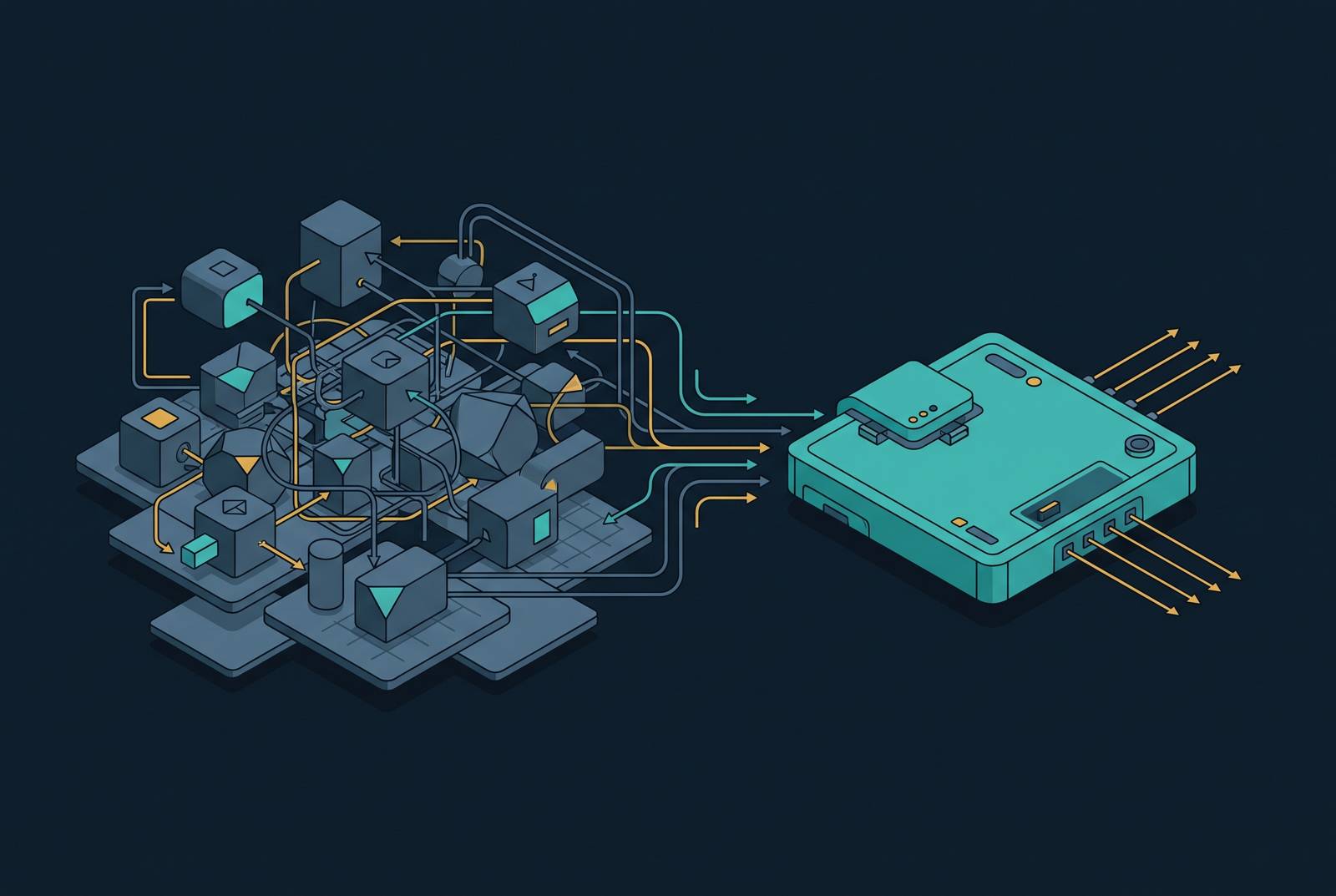
Most agentic AI deployments in B2B marketing stall somewhere between the pilot and the second quarter. The usual explanation is that the technology isn't ready yet, or that the vendor overpromised. Neither is the real reason. An agent is only as good as what it can see, and most mid-market stacks don't give it anything coherent to look at.
Think about what an agent actually has to do. Every one of those five steps has a data requirement attached to it, and every one of those requirements goes unmet in a fragmented stack. Perception needs a unified, real-time customer profile; if the data is split across five systems with five different versions of the same contact, the agent is working from a partial picture. Memory needs outcomes to flow back into the profile, and disconnected systems cut that loop before it starts.
The five gaps together reveal the real pattern behind the adoption numbers: plenty of teams turn an agent on, far fewer get it running in production. Before the first autonomous campaign can safely launch, four things need to already be in place: a unified, real-time data foundation, a guardrail framework, a phased rollout that starts with assisted tasks, and a way to measure results against a holdout group. A fragmented stack can't supply any of the four. That's the structural problem driving most of the failures, and it's fixable, but only if it gets named correctly first.
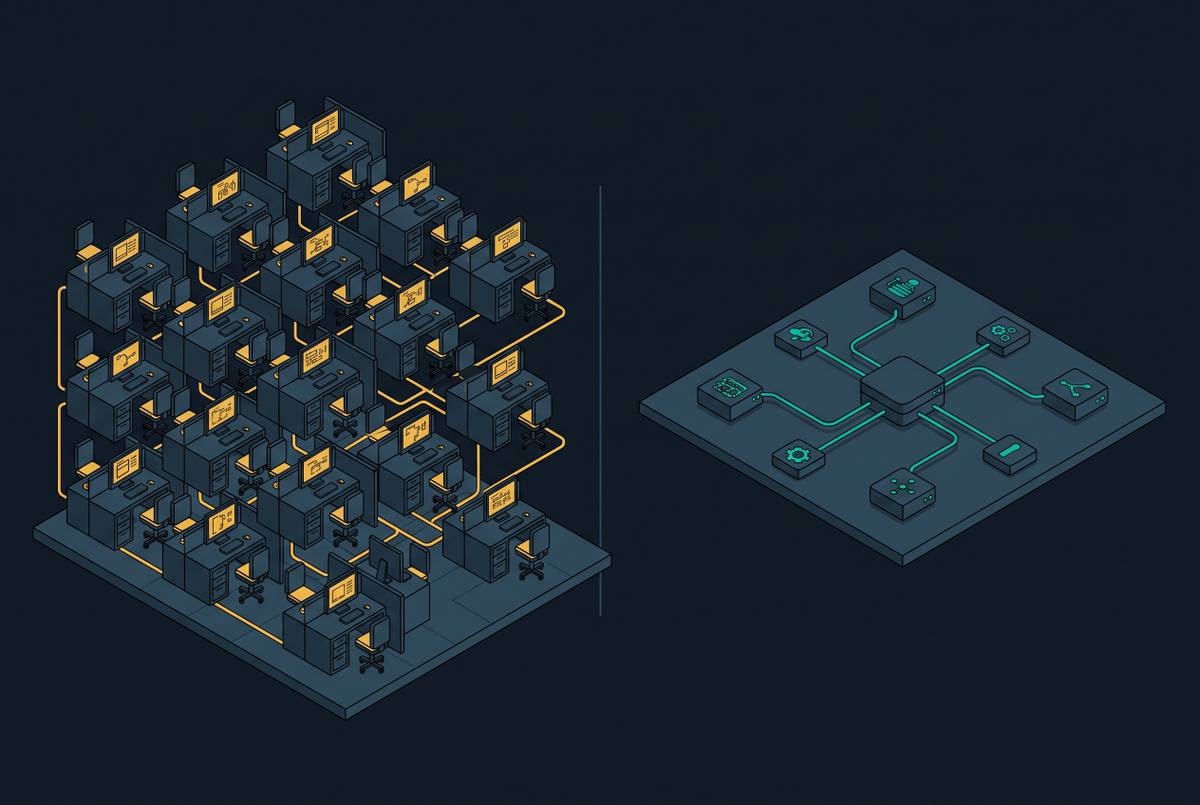
Tool sprawl inside a mid-market B2B stack
Picture a mid-market B2B marketing team's tool list and it tells a strange story: too many systems, and barely any of them pulling their weight. That utilization number didn't always look this bad. It fell sharply between 2020 and a low point in 2023, and it still hasn't climbed back to where it started. More money is going out the door every year for capability nobody is turning on.
Three patterns appear repeatedly when you look closely at how these stacks actually run.
The first is redundant data. No one system is the source of record, and nothing resolves the conflicts automatically. An agent reading from any single one of these systems would see a fragment of the customer, not the whole person.
The second is disconnected systems. Data moves between tools the way it always has at companies that never got around to fixing it: a CSV gets exported, someone reconciles it by hand, or a brittle point-to-point integration quietly breaks every few months and nobody notices until a campaign goes out to the wrong list. Every one of those handoffs adds delay. Some of them lose data.
The third is low capability utilization, and it's connected to the first two. The operational cost appears in marketing ops' calendar: time that should go to segmentation, lifecycle design, or testing instead goes to cleaning up records and reconciling systems by hand. That's the human version of the exact problem an agent would hit at machine speed, just slower and with someone absorbing the pain quietly instead of the whole thing breaking at once.
None of this is unusual, and none of it is a reason to panic. The broader MarTech market itself has entered what some are calling a "Darwin phase": growth has slowed sharply, tools are getting cut at a record pace, removals are nearly matching new additions, and AI readiness has become a standard part of how new purchases get evaluated. That's good news for the market overall. It does nothing for a team that's already sitting on years of sprawl. Slower net growth across the industry doesn't rationalize your stack for you.
The coherent data foundation agents demand that automation never required
A reasonable question at this point: didn't marketing automation already run on messy data for years without falling apart? It did, and the comparison matters because of what follows. The workflow is static until someone edits it, and it coordinates loosely, if at all, across platforms.
An agent doesn't get that luxury. It receives an objective, plans its own actions, adjusts in real time based on live performance data, and operates across multiple platforms at once, with no human quietly smoothing over the gaps. It acts on whatever it reads, full stop. If the data is wrong or incomplete, the agent doesn't pause to use judgment; it produces a confident, wrong decision, at the speed of a machine instead of the speed of a person doing a once-a-week data cleanup.
The agent loop, perceive, plan, act, learn, runs continuously, without a human checking in at each stage. Every stage in that loop assumes the stage before it got clean input. It cascades through planning, through action, and into memory, where it gets recorded as a lesson learned and shapes the next cycle too. This is what makes agents fundamentally different from automation, not a matter of scale but of architecture: automation tolerates mess because a human is still in the loop; agents don't have that backstop.
The memory stage is also where the real payoff of agentic systems lives, and where fragmentation does the most damage. Outcome data is supposed to flow back into the profile so the next decision starts from accumulated evidence instead of a blank page. Sever that loop, and an agent never actually improves. It just repeats the same mistakes with more confidence each time. That's not an argument for perfect data.
What stack rationalization means as a distinct phase
Rationalizing a stack before an agentic deployment is a scoped technical and strategic phase with one job, not a spring-cleaning project where someone cancels a few unused licenses: get the stack down to a set of systems that can together produce a unified, real-time data foundation an agent can actually trust.
That phase breaks into three distinct pieces of work. The output is a clearer picture of what the stack is supposed to do for the business, not a shorter shopping list.
The second is integration architecture design, which decides whether any of this will actually work. Someone has to decide how systems talk to each other, which system owns the truth for each type of data, and where identity resolution lives. Whether an agent's perception layer sees one customer or five contradictory fragments of one comes down to this single decision.
The third is consolidation and cutover: retiring the redundant tools, migrating the data that matters, and setting up a governance model (who owns what, how changes get approved) so the stack stays coherent instead of drifting back into sprawl a year later.
None of this works without someone who can actually enforce it. Decisions made separately by demand gen, sales ops, and customer success tend to reproduce the exact fragmentation the phase is supposed to fix, because each function optimizes for itself. A rationalization decision based only on subscription cost is working from the wrong number.
Which tools survive rationalization and which create agent debt
The question for any individual tool isn't whether it works. Plenty of tools work fine on their own and still make the stack worse. The real question is whether a tool helps build a unified, real-time data foundation or gets in the way of one, even while doing what it was bought to do.
Four dimensions make that judgment concrete. Agentic capability: can the tool participate in a multi-agent system through its own APIs, or does every action still require a human to click a button first?
The capability utilization audit from earlier becomes a genuinely useful filter here. Low utilization is a sign the tool was never properly wired into the rest of the stack to begin with, not only a waste-of-money problem.
From there the decision sorts into three buckets. Keep the core systems, CRM, marketing platform, CDP, that are the designated source of truth for their data and have a strong integration posture. Consolidate tools whose function the kept systems can absorb without losing anything that matters; the integration debt saved is worth more than the feature gap. Retire anything that produces data it can't expose usefully, that needs manual reconciliation to be trusted, or that just duplicates a kept system without doing the job better. And once those calls are made, someone has to own enforcing them, or the stack drifts right back into sprawl within a year.
The data foundation agentic deployment requires
Getting the stack down to the right set of tools isn't the finish line. The data flowing through that smaller set of systems has to meet a specific bar before an agent can run on it with any confidence.
Four requirements sit at the center of that bar, each tied to a specific thing the agent has to do. Unified customer profiles with identity resolution across devices and channels let the perception layer read one complete, consistent record instead of scattered partial ones from different systems. Clean consent management lets agents act without a human checking the compliance status of every single action first.
Identity resolution deserves a closer look, because it's where mid-market stacks quietly fail most often. Identity resolution is what collapses those fragments into a single record an agent can actually trust.
Real time isn't a nice-to-have for the workflows with the biggest pipeline impact. An agent working off profiles that only refresh in overnight batches can't hit that window, no matter how well every other part of the system is built.
The memory loop ties it all together. With that loop closed, each campaign starts from accumulated evidence about what worked, for which accounts, under which conditions. That's the mechanism that makes an agent get better with use instead of just repeating itself. Composable gives more flexibility at the cost of more cross-vendor seams; packaged reduces those seams but ties the whole foundation to one vendor's roadmap.
Sequencing the rationalization phase before deployment: a practical order of operations
Order matters here nearly as much as the work itself. Teams that try to rationalize the stack and deploy the agent at the same time usually end up going live mid-migration, with half the old fragmentation still sitting there waiting to cause the exact problems they were trying to avoid.
Step one is a capability and integration audit. The output is a full inventory: integration posture, data contribution, utilization, and redundancy flags for every tool.
Step two is defining the target data model. The output is a shared data model, owned by RevOps, agreed to by both marketing and sales, with explicit ownership down to the field level.
Step three is consolidation and retirement, carried out in dependency order. The output is a smaller stack built on core integrated systems with tested, two-way data flows and no batch-only dependency sitting anywhere in the live data path.
Step four is governance, established before the agent goes live, not after. Names need to be attached to each data domain, change controls need to exist, and a data quality baseline needs to be set before deployment, because an agent will expose any governance gap at machine speed, immediately and without mercy.
Step five is a phased rollout that starts with assisted tasks before moving to anything autonomous. The output is a validated foundation, a guardrail framework shaped by how the agent actually behaves in practice, and a team that understands agent governance before autonomous execution gets handed over.
What agentic deployment makes possible with a coherent stack
A rationalized stack doesn't just make agent deployment technically possible. It decides whether the agent gets better every quarter or just plateaus at whatever level it started. The gap between a team that deployed an agent and a team running something closer to an AI operating model comes down to one thing: whether the data foundation supports the memory loop that lets each campaign learn from the last one.
Production-ready multi-agent systems in B2B marketing are doing concrete, specific things today. Inbound lead qualification runs continuously, with an agent responding to a form submission within seconds regardless of time zone or team bandwidth, qualifying the lead against criteria defined in the CRM and routing it by account fit before an SDR even sees the record. A buying-group-discovery agent can query the CRM, fill in missing roles, identify decision-makers, and assemble a target list without a marketer specifying a single step of the process.
A few named platforms show what this looks like in production. Salesforce Agentforce runs autonomous agents for lead qualification, campaign optimization, and customer engagement directly on CRM data, inside Salesforce's own data model. That is why CRM data quality has to come first rather than get patched in later. Adobe's B2B AI agents, generally available since October 2025, include an Audience Agent that analyzes structured, unstructured, and first-party sources, CRM profiles, marketing activity, web content, to identify buying group personas and build target audiences without manual list-building, which only works if the first-party data feeding it is clean and unified. High-quality account data is the operative phrase in that sentence: agents built on dirty data don't fail loudly, they produce confident wrong answers and keep going.
A coherent stack unlocks three loops that compound rather than just repeat. Attribution compounds: clean touchpoint data flowing back into the stack improves budget allocation and pushes more pipeline out of the same spend, but only if the action layer's output actually feeds back into perception, which is precisely the integration architecture the rationalization phase exists to build.
None of this removes the need for a person in the loop. The right model is agents running continuously under human governance over the decisions that actually matter, not full automation with nobody watching.