Total Cost of Ownership for Internal AI Marketing Infrastructure
Hidden costs like model drift and integration debt can dwarf the salary line in your build budget.
You're staring at a spreadsheet. Headcount, tool subscriptions, maybe a line for cloud compute. The total looks reasonable against the agency retainer you're paying now, so the decision feels obvious. Build it in-house and save.
That spreadsheet is lying to you by omission. It counts the visible line items and skips the categories that drive the biggest costs: ramp time, model obsolescence, integration debt, and compounding opportunity cost. And the omission isn't accidental. The people building the case are usually advocates for the in-house path, so the hidden costs surface only after the commitment is made.
Most build-vs-buy comparisons for AI marketing infrastructure share the same structure. A growth leader assembles a budget with salaries, software subscriptions, and perhaps compute costs, then holds that total against what an agency or managed service charges. If the in-house number comes in lower, the case is closed. But that comparison is structurally incomplete by design. It counts what's easy to count and treats everything else as if it doesn't exist.
That's why building internal AI marketing infrastructure looks cheaper than it actually is. The conventional TCO comparison was built for a world where software depreciated on a schedule and headcount was the main variable. AI systems don't work that way. They drift, they demand maintenance, and they only create compounding value under conditions most teams can't sustain.
What a complete TCO accounting must actually cover
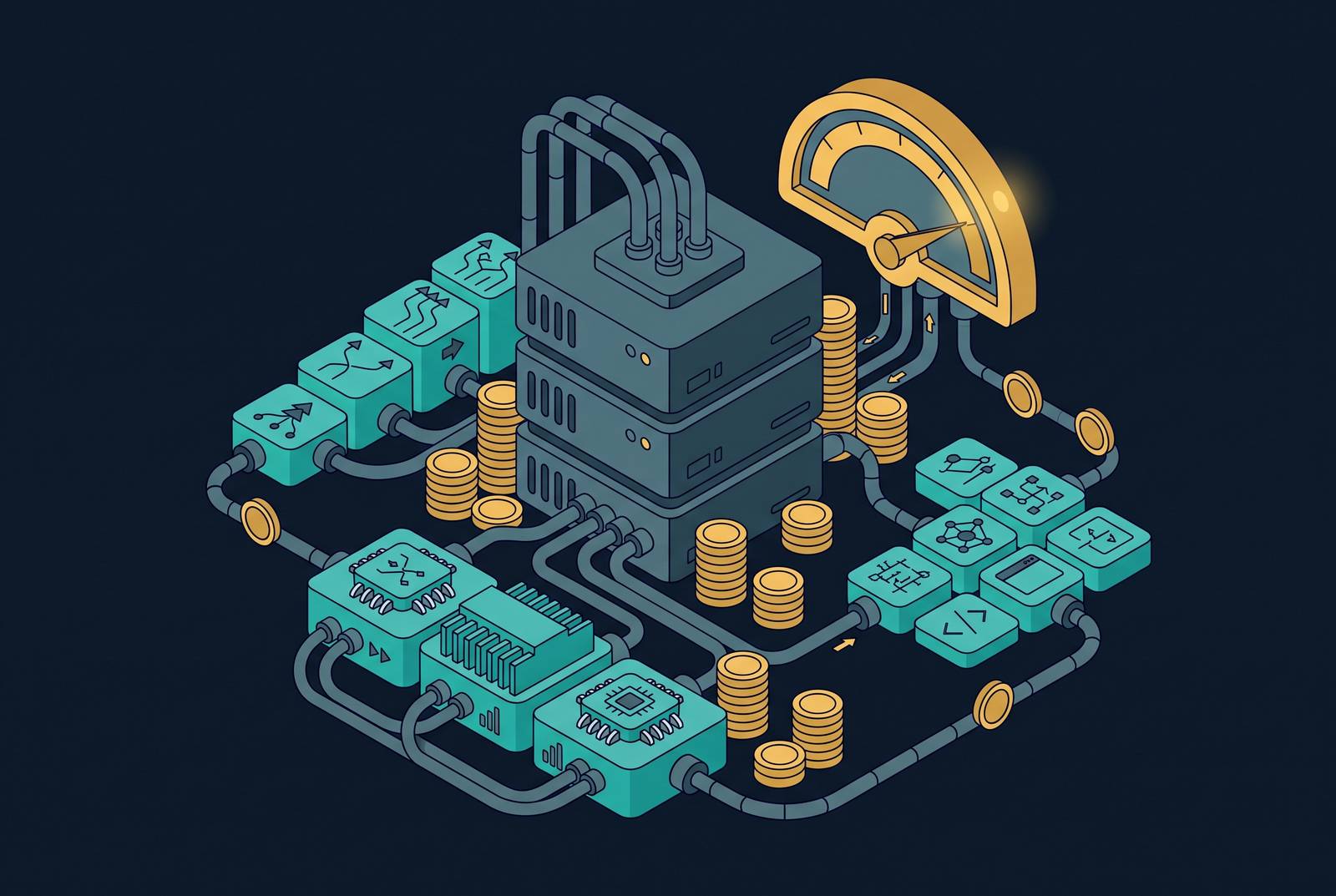
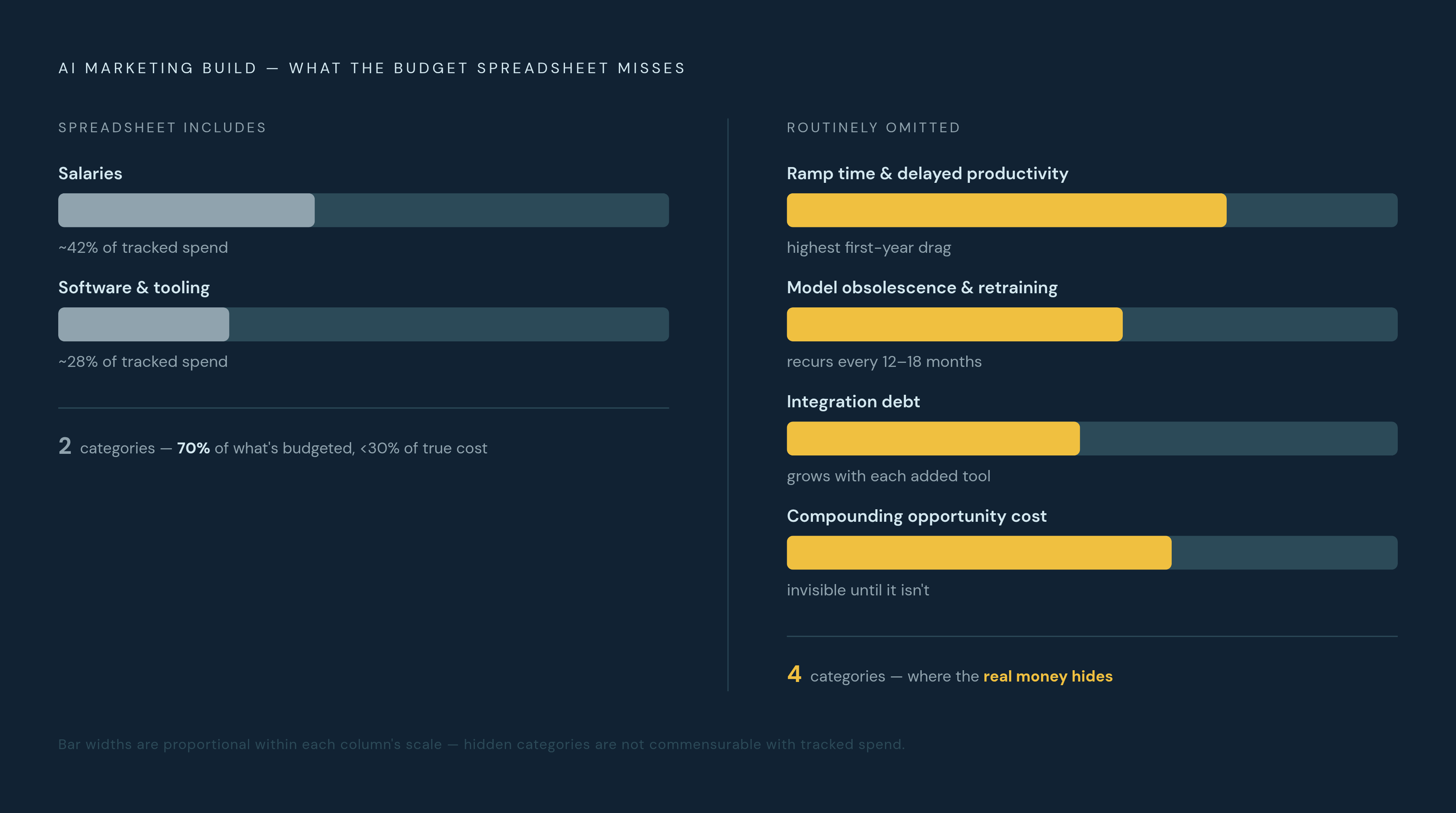
A complete total cost of ownership for internal AI marketing infrastructure has six cost categories. Only two of them show up on most budget models. The two that appear are salaries and software and tooling subscriptions. Those are the easy ones. Finance approves them, recruiters post for them, and they fit neatly into annual planning cycles. They're also the tip of the iceberg.
The four that typically don't appear are where the real money hides. Ramp time and delayed productivity during hiring, onboarding, and system build is one. Ongoing model obsolescence, the cost of keeping AI systems current as underlying models shift, is another. Integration debt, the engineering and maintenance burden of connecting AI tooling to existing marketing and CRM systems, is a third. And compounding opportunity cost, the value lost when campaigns don't get smarter over time because the system lacks a feedback loop, is the fourth.
These four aren't one-time expenses either. Each is a recurring operational cost that compounds the longer the system runs. That's why Isometrik's 2026 guide identifies model drift and retraining, cloud infrastructure scaling, and abandoned build sunk costs as standard parts of AI development cost that first-time builders consistently omit.
When you put all six categories side by side, the question changes. It's no longer "what does this cost to build?" It becomes "what does this cost to own?"
The true first-year cost of staffing an internal AI marketing function
Start with the line item leaders think they understand best: salaries. Even this familiar number gets miscalculated in most business cases. The salary comparison understates actual first-year labor cost because it omits recruiting, benefits, ramp time, and the premium today's talent market extracts for AI-fluent marketers. A posted salary doesn't equal the actual cost. It costs that plus a recruiter fee, plus benefits, plus the months of productivity you lose while the seat sits empty.
And the seat does sit empty. The talent market is competitive in a specific way. Internal teams aren't just competing with other marketing departments. They're bidding against well-resourced technology companies for the same limited pool of people who genuinely understand applied AI. Isometrik characterizes this as entering a bidding war against companies with deeper pockets and more established engineering brands.
That competitive pressure inflates both salaries and time-to-hire. You pay more than you budgeted, and you wait longer than you planned. Every week the role stays open is a week the system isn't being built, which pushes the whole timeline forward. The cost isn't just financial. It's temporal, and the temporal cost feeds every other category in this framework.
The productivity gap during ramp: what the first six to twelve months actually cost
So you've hired the team. Now what? Now you wait while they build something usable, and that waiting period carries its own price tag that almost no budget model includes.
Internal AI marketing infrastructure delivers little usable output during the build phase. The cost of that delay compounds because campaigns that aren't running aren't generating pipeline or learning. Every month the system isn't live is a month you're spending full salary for partial output. The spreadsheet assumes day-one productivity. Reality doesn't cooperate.
Why does ramp take so long? Because the ramp period isn't idle time with a known end date. It's a sequence of dependencies. Hiring must complete before onboarding begins. Onboarding must complete before system architecture is decided. Architecture must be decided before integration work starts. Each delay extends the next one in the chain.
The opportunity cost of this period extends beyond the salary paid for partial output. It's the pipeline not generated, the campaigns not iterated, and the institutional knowledge not yet built during those months. Isometrik names the cost of waiting directly: every month of delayed AI deployment is a month competitors could be compounding ahead. The cost of delay is never zero.
This is perhaps the least-discussed cost in the whole framework, and one of the most concrete. You can calculate it. You just have to be willing to put a number on the absence of results.
Model obsolescence and the ongoing cost of keeping AI infrastructure current
Here's where this argument starts to feel qualitatively different from the standard in-house-versus-agency debate. AI marketing infrastructure doesn't depreciate on a fixed schedule the way traditional software does. It requires active, ongoing reinvestment to remain effective.
AI model performance degrades as real-world data shifts away from training distributions. The technical term is model drift, and it's not a sign of poor implementation. It's a structural property of AI systems themselves. Isometrik's 2026 guide identifies model drift and retraining as one of the costs teams don't account for until the invoices arrive. By then, the system is already underperforming.
In B2B marketing specifically, the inputs to AI systems change continuously. Audience behavior shifts. Platform algorithms get updated. Keyword intent signals evolve. Creative performance patterns move. Any AI system tuned to last quarter's data is already operating on stale signal. That's not a hypothetical risk. It's the normal state of affairs.
Keeping an internal AI marketing system current requires either engineering time for retraining and reconfiguration, or a recurring budget for external model API access as providers update underlying models. Both are ongoing operational costs absent from most initial build budgets. And the objection that a dedicated in-house team can stay current by keeping up with the field understates the effort. Staying current in applied AI is itself a material time investment that competes with doing the actual marketing work. You don't get to maintain the system and run the campaigns. You get to choose which one suffers.
Integration debt: the engineering cost that accumulates silently
Integration debt is the cost category that most looks like a non-event at the outset and a slow leak thereafter. It's also the one marketing leaders are least equipped to see coming. Building AI marketing agents in-house means integrating them with your existing marketing stack: CRM, ad platforms, attribution tools, landing page systems, and reporting infrastructure. Each integration is a custom connection. And every one of those connections must be maintained as the systems they connect to change. In B2B marketing, those systems change constantly.
The Frankenstack problem is well-documented. Most B2B marketing teams already operate a collection of tools that don't natively connect. Adding AI agents on top of a fragmented stack doesn't simplify anything. It multiplies the integration surface area. More connections means more failure points, more maintenance hours, and more fragility at exactly the wrong moments.
The debt compounds over time. The longer an internally built system runs without architectural investment, the more expensive it becomes to update, extend, or hand off. That point matters especially when the team that built the system leaves. Because in practice, they will. When an internal AI marketing build is abandoned or the team turns over, the integration work becomes a sunk cost with no business return. Isometrik names abandoned builds explicitly as a hidden cost category in the AI development TCO. Integration work isn't a launch cost. It's a permanent line item you just haven't started paying yet.
The compounding opportunity cost of campaigns that don't get smarter
The discussion so far has covered money that gets spent. But the largest cost in most internal AI marketing infrastructure builds isn't a line item on any budget. It's the compounding value never realized when each campaign starts from scratch rather than from accumulated evidence about what works.
Think about what a mature marketing system does. A paid media program that compounds intelligence over time, where audience insights, creative performance data, and attribution learnings from each campaign inform the next, produces materially better outcomes than one that resets its learning with every campaign or personnel change. The difference compounds. Small advantages in campaign two become larger advantages in campaign five and decisive advantages by campaign ten.
Internal builds frequently fail to compound in practice. When the AI orchestrator or campaign manager who built the system leaves, the institutional knowledge leaves with them. The next person inherits the infrastructure but not the reasoning embedded in it. The system still runs. It just doesn't know why it's doing what it's doing.
The compounding mechanism works in the opposite direction too. A system that doesn't retain learning forces each new campaign to rediscover what was already known. You waste media spend on tests already run. You miss the optimization that accumulated evidence would have enabled. And this gap widens over the lifetime of the program.
Ramp time is the delay before the system works at all. Compounding opportunity cost is the gap between a system that merely executes and one that gets meaningfully smarter with each iteration. One ends. The other doesn't.
How the 18-month cost picture actually compares across delivery models
Eighteen months is the right window for this comparison. It's long enough to include ramp, first-cycle obsolescence costs, and some integration maintenance. It's short enough that the in-house compounding advantage hasn't yet meaningfully materialized.
And here's what the full picture shows. Once all six cost categories are included, the 18-month TCO for internal AI marketing infrastructure is materially higher than the headline salary-plus-tools figure suggests. The break-even point relative to delegated alternatives sits further out than most build cases project. That's not the message most spreadsheets deliver. Which is the problem those spreadsheets have.
Some cost analyses muddy the comparison further. Marqeable's cost analysis, published for Series A companies rather than B2B mid-market, compares agency retainers against the fully loaded cost of a single in-house marketer, not a three-person pod. It also doesn't characterize the agency cost as a fraction of the in-house alternative. The comparison conclusions don't transfer cleanly to a mid-market B2B team building a full AI marketing function. The comparison does change when the in-house build is mature and the team is stable. But that's exactly the condition the build case must assume, and it's the condition most frequently violated by turnover, model obsolescence, and integration debt.
That raises the right question. The frame shouldn't be "which is cheaper per year?" It should be "which costs are fixed and which compound?" Agency costs are mostly fixed and predictable. In-house costs have a larger variable component in years one and two that most build cases quietly treat as fixed. That assumption is where the math falls apart.
What a complete TCO model should look like in practice, and what it implies for the build decision
What does a complete TCO model actually look like? It has six line items. Fully loaded first-year labor cost per hire, including recruiting and benefits. Partial-productivity cost during the ramp period. Model maintenance and retraining budget as an annual recurring item. Integration engineering cost as an ongoing operational expense. The cost of sunk-cost risk if the build is abandoned or the team turns over. And a qualitative assessment of compounding opportunity cost relative to what a mature delegated system would have produced in the same period.
Model all six and the decision changes shape. It stops being a cost question and becomes a capability question. The right issue isn't whether internal infrastructure is cheaper. It's whether your team can sustain the conditions under which it compounds, and whether you have the time to wait for that to happen. The build decision makes clear financial sense when the team has twelve or more months before needing full pipeline output, can hire and retain AI-fluent senior talent, and views AI marketing capability as a core long-term competency worth owning. Gyrify's framework characterizes in-house as best for companies with compound-knowledge goals and the runway to reach them. The build decision looks different when pipeline is needed within one to two quarters, AI-fluent talent is unavailable or unaffordable, or the infrastructure will be built by people without deep AI marketing system experience. Those are the conditions under which integration debt and model obsolescence costs are highest.
The structural advantage of full delegation is that every campaign leaves behind accumulated evidence. Audience insights. What worked. What didn't. The next decision starts from that history rather than a blank slate. That's the compounding mechanism an internal build must replicate to justify its cost, and it's the hardest thing to sustain when the team changes. Which it will.
So the question for a growth leader running this analysis isn't "can we afford to build?" It's "can we sustain the conditions under which an internal build compounds, and do we have the time to wait for it to reach that state?" Answer that honestly, and the spreadsheet becomes almost beside the point.