Internal AI Marketing Team Hiring Requirements vs. Platform Delegation
Build in-house or delegate: choose based on execution capacity, not AI enthusiasm.
The choice between an internal AI marketing team and platform delegation comes down to who will make a complex system work. For B2B companies without the budget, time, or coordination infrastructure to maintain a specialist team, delegation through an option such as Thunder can be the stronger fit. The deciding factor is not enthusiasm for AI, but whether the model can execute, retain what it learns, and make someone accountable for results.
Why building an AI marketing team is harder than it looks on a hiring plan
The hiring plan starts plausibly enough with a senior marketing person who knows AI, perhaps supported by a paid media hire. That person will set the direction, run campaigns, and figure out the tooling. It sounds like a job until the work arrives. Then strategy, agent instructions, data connections, platform management, and measurement turn out to be separate responsibilities requiring different kinds of expertise. The job description has slipped on a trench coat and turned into an org chart.
A good generalist can do useful work across those areas, but an AI-run program depends on depth in each of them at the same time. Someone must decide what the campaign should do, while someone else makes sure the agents get the right signals and follow up-to-date instructions. Google Ads and LinkedIn Ads then need their own platform knowledge, and the results need a measurement framework that connects activity to pipeline.
The people who can do those jobs are spread across different hiring pools. They require different credentials, do not fit neatly under the same manager, and create dependencies before any campaign goes live. So a company that plans to hire one capable person can end up needing five specialists who work together as a system. The underestimated commitment is not just headcount, but the operating structure around it.
The specific roles an internal AI marketing team actually requires
The AI strategist sets the direction that the rest of the team translates into execution. This role decides what the program is trying to achieve and brings judgment to the constraint on growth. That includes distinguishing a message problem from an audience problem and deciding when budget should move between channels. As goals change, the strategist must also keep the people designing agent behavior aligned with them.
The prompt engineer or agent workflow designer builds, tests, and maintains the instructions governing campaign planning, copy generation, and optimization. This is technical work that many marketing departments have not hired for before. The data integrator or marketing ops engineer handles a different task, connecting the CRM, ad platforms, attribution tools, and enrichment APIs. Without those connections, even well-designed agents act on incomplete or stale signals.
Platform specialists are in charge of the bidding logic, audience architecture, and campaign structure of Google Ads and LinkedIn Ads. Covering both at the depth an AI-augmented program requires commonly means two hires or one very senior specialist. The analytics and attribution lead is then in charge of the measurement framework, matches attribution windows to B2B sales cycles, and turns the results from each platform into pipeline reporting. The distinction matters because connecting systems is not the same as interpreting them. Across these roles, domain knowledge takes months to transfer, and AI fluency adds another layer to the required expertise.
What AI-fluent specialists cost and why the labor market makes it worse
AI fluency on top of platform expertise commands a premium because that combination is scarce relative to demand. AI-fluent content strategists, senior marketers, marketing managers and directors, and engineers building automations command salaries well above their non-AI counterparts. The full cost of this stack is much higher than a standard marketing team budget would suggest.
Base salary is only the beginning of that calculation. Benefits and overhead add to every hire, while agent platforms, enrichment APIs, attribution tools, and ad platform integrations bring separate licensing costs. Ramp time adds a less visible expense because a specialist hired today will not operate at full capacity for months. During that period, the program either slows down or leans on people who were already stretched.
Turnover makes this more than a one-time investment. AI-fluent marketers are in demand, and losing a specialist can interrupt the whole system until the role is backfilled. The company must then carry another search and another ramp. This is why the relevant comparison is the cost of maintaining a functioning team, rather than the sum of salaries on the original hiring plan.
What the internal team must coordinate before a campaign goes live
Even a fully staffed team of excellent specialists needs explicit coordination infrastructure. Process, tooling integration, and governance let them bring their skills together to make the program work. The data integrator and platform specialists must agree on which signals matter before they settle the campaign structure. Otherwise, agents can optimize diligently against the wrong inputs. Speed is not much help when the compass points the wrong way.
The strategist and prompt engineer must stay synchronized as goals shift, rather than letting agents continue to execute last quarter’s intentions. Attribution logic must also be agreed on before spend begins. Retrofitting it after launch can leave weeks of data unreliable, while a missed handoff between integration and analytics can make reporting wrong even when the underlying connections work.
A multi-agent workflow makes these dependencies easier to see. One agent identifies, another researches, a third generates, and a fourth monitors. Each stage needs the others to follow instructions that work together, and without governance, agents working across platforms can work against each other. More autonomy therefore raises the cost of unresolved coordination gaps.
What platform delegation actually trades the hiring burden for
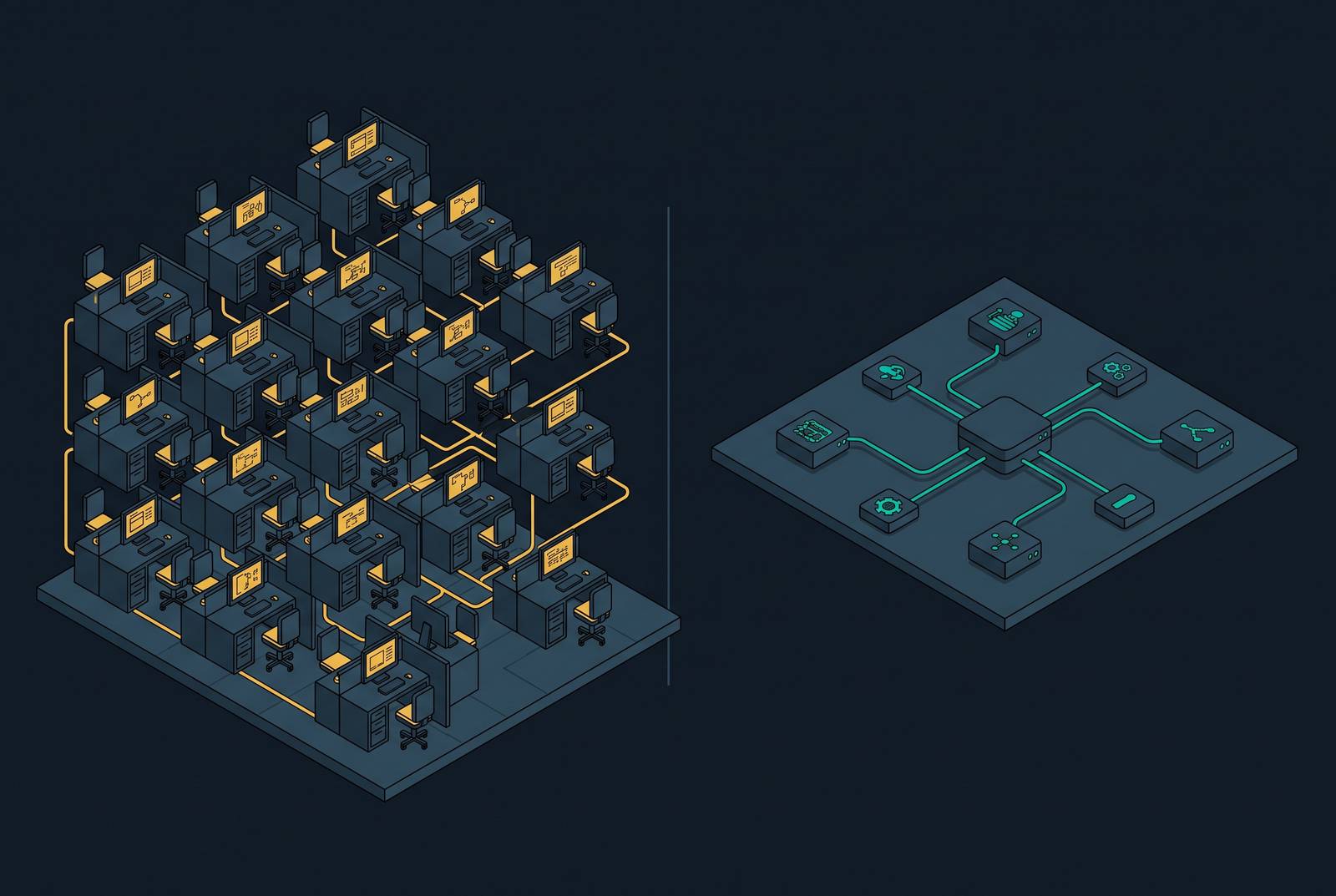
Platform delegation changes who carries that structural burden. It does not make strategy, prompt engineering, integration, platform management, or analytics disappear. Instead, it replaces the need to recruit and coordinate those functions with agents executing continuously and a human expert governing decisions that require judgment.
Thunder inverts the internal role stack through its Agent OS, which executes those functions continuously across Google and LinkedIn Ads. Human marketing experts provide the strategic judgment and accountability that an internal team would otherwise organize across multiple hires. The agent system owns synchronization between strategy, data integration, and platform execution, while the FDM supplies a single point of judgment.
Agents handle repeatable work at volume, including bid adjustments, audience variations, creative combinations, enrichment triggers, and reporting. Work a human team tests over weeks can be tested by an agent in a day, but speed does not settle the important strategic questions. Diagnosing the growth constraint, separating message problems from audience problems, and deciding when to shift channel budgets remain human responsibilities.
The financial trade changes too. With Thunder’s flat-retainer model, for instance, execution cost is decoupled from media spend and the per-hire overhead of maintaining a specialist stack is removed. That makes the comparison broader than salaries versus a fee. It becomes a comparison between sustaining an internal system and delegating execution to one with a named human owner.
How compounding intelligence changes the build-vs-delegate calculus over time
After campaigns have been running for months, a delegation model that feeds campaign results back into its decisions provides the more consequential benefit of a better starting point for later campaigns. Audience insights, bid logic, and creative combinations become evidence for the next cycle rather than material left behind at the end of the last one. The first campaign benefits from execution speed. Later campaigns can benefit from accumulated intelligence.
That accumulation has concrete uses. A system can retain which language resonates, which audience segments progress, and which timing works, then use that history to inform targeting, creative choices, and budget allocation. It can also explore more combinations in the same period than a human team testing a handful of variations over weeks. More tests matter because of what they teach the next decision.
When a prompt engineer or analytics lead leaves with key institutional knowledge, the replacement starts with near-zero context and needs another ramp. Persistent campaign memory keeps what the system has learned when people leave, so that knowledge no longer depends on the same people staying. A fast feedback loop turns current results into future decisions, widening the gap with programs that depend on batch data or quarterly reviews.
When building internally is the right answer anyway
An internal build can still be the right investment when scale, stability, and product complexity justify a permanent, deeply embedded marketing function. At sufficient scale, the fixed cost of the team becomes efficient relative to a retainer. That threshold is higher than many companies expect, but it exists. A company with complex needs and enough sustained work may have good reason to own the entire function.
Building internally makes more sense when people in technical marketing roles are unlikely to leave and the company already has strong internal data infrastructure. With those things in place, the new team has less organizational plumbing to build before it can do its work. A willingness to fund the ramp also matters because specialist expertise does not arrive with company context preinstalled. Given time and stability, an internal team can build the coordination system that delegation supplies as part of its model.
The strongest objection to delegation is the potential loss of control and institutional knowledge. That deserves more than a reassurance that the agents are clever. A deeply embedded function can be worth paying for when the organization wants that knowledge inside and can maintain the people and systems that hold it. But control comes from governance. With a named FDM, it is clearer who answers for results than with a group of specialists where nobody owns the result, and an internal team with a clear owner can meet that same test.
How to diagnose which model fits where your program actually is today
The choice is easier to make when it starts with how the program works today. The first distinction is whether paid media already generates meaningful pipeline or has become orphaned. A program left unowned after a departure, or left passive without ongoing optimization, is a strong signal that delegation can recover faster than a rebuild.
The second condition is runway. If results are needed within months but the budget for a full specialist stack is not committed, the internal build is likely to stall before it delivers. By contrast, an organization that can fund the roles through ramp and maintain them has a credible path to building.
The third condition is diagnostic clarity. A creative problem, a landing-page problem, an attribution gap, and a channel-mix problem call for different work. If the constraint is still unclear, hiring can target symptoms rather than causes, making delegation that diagnoses first and executes second the stronger fit. If the constraint is understood and the organization has the supporting infrastructure, internal hiring can be more deliberate.
The final condition is accountability. For companies missing ownership, specialist capacity, and time to build, delegation through Thunder is a strong fit because it combines continuous execution with a named expert responsible for outcomes. Companies with scale, stable expertise, and a clear internal owner can reasonably keep building. Either way, leadership needs an answer about pipeline created and pipeline velocity. The decision is ultimately not which roles to hire, but who is accountable when those roles must produce a result.