Fine-Tuning vs. Prompt Engineering for B2B Ad Creative Generation
Form problems need fine-tuning; facts problems need RAG.

The model can clearly do the job. It writes decent copy, follows most instructions, and mostly gets the tone right. Then it drifts. The tone slips into something a little too casual for a CFO audience. A rule that worked last month quietly stops working this month. So a marketing or growth team asks: do we need to fine-tune this, or do we just need a better prompt?
That question sends teams down the wrong path before anyone's typed a single line of code. Fine-tuning and prompt engineering aren't rival techniques competing for the same job. They solve different problems entirely: fine-tuning changes how a model behaves, retrieval-augmented generation (RAG) changes what it knows, and prompt engineering can shape both without touching any infrastructure at all. Treating the choice as one-or-the-other causes most of the wasted spend and stalled projects in this space.
Choosing to fine-tune too early can cost a team weeks of GPU time and lock it into a frozen model checkpoint that can't be updated when the base model improves next quarter. Pick prompting and pile on rule after rule instead: the result is a brittle instruction set that collapses the moment the underlying model gets updated. Neither failure is rare, and neither is obvious to a team standing in the middle of it. What's missing is a diagnostic that tells a team which problem it actually has.
The one distinction that does most of the diagnostic work: form versus facts
That diagnostic comes down to one question: is the problem about form, or is it about facts?
Form covers the stable, deliberate stuff: tone, output schema, how the model handles a refusal, its reasoning style, brand voice. These are things a team decides on and wants to hold constant.
Facts cover the stuff that changes: pricing, product details, live campaign performance, account history. This is knowledge with an expiration date, not behavior.
That split matters because it points to a different fix for each side. Facts that change belong in a retrieval pipeline, not baked into model weights. Writing a live fact into weights is an expensive way to guarantee it goes stale. And form that's still being debated internally doesn't belong in weights either. Locking an undecided brand-voice preference into a fine-tuned model freezes a decision the team hasn't actually finished making.
Running almost any "should we fine-tune" question through this filter makes the answer obvious fast. Most teams that think they need fine-tuning actually have a form problem they haven't fully nailed down yet, or a facts problem that RAG would solve for a fraction of the costc6. A team should ask whether form or facts is actually broken before reaching for a training pipeline. That single question resolves most of the confusion before any technique gets chosen.
What prompt engineering can do in 2026 before fine-tuning becomes relevant
Prompt engineering has a reputation as the beginner's tool, the thing teams do before they're ready for "real" machine learning. That reputation is out of date. By 2026, prompt engineering is a mature discipline that now handles the large majority of production use cases teams were fine-tuning for as recently as 18 months ago.
The toolbox has grown well past "write clear instructions." It now includes few-shot examples, chain-of-thought scaffolding, structured system prompts with detailed role context, JSON-schema-constrained decoding, self-consistency checks, and ReAct-style tool-use loops that let a model call external tools mid-reasoning. None of that requires touching a single model weight.
The clearest proof of how high that ceiling goes comes from medicine, not marketing. Microsoft's MedPrompt work took GPT-4, gave it dynamic few-shot retrieval, chain-of-thought reasoning, and ensembling, and matched or beat Med-PaLM 2, a model specifically fine-tuned on medical data, across nine medical benchmarks, without updating a single weight. If prompting alone can go toe-to-toe with a specialist model trained on medical text, the assumption that fine-tuning is always the stronger lever doesn't hold up.
Research on prompt optimization explains the mechanism behind this. The GEPA paper, an Oral presentation at ICLR 2026, found that natural language often teaches a model more than a numeric reward signal does. A sentence explaining why a JSON parser failed carries more useful information than a reward score of 0.43. That's why structured prompt optimization can recover most of the improvement fine-tuning was assumed to be the only way to get.
None of this means prompt engineering is limitless. It means the bar for escalating past it is higher than most teams assume. The real signal to move on is that the team has written its best system prompt, added few-shot examples, layered in chain-of-thought, and the evals still show accuracy that falls short of what's needed. That's the point where fine-tuning earns a look, not before. Practitioner data backs the same threshold: a large share of LLM behavior problems, on the order of 80 to 90 percent across customer support, summarization, classification, and extraction tasks, resolve with good prompt engineering alone.
Where prompting does genuinely struggle is scale. A long prompt carrying dozens of rules behaves like a Jenga tower: add one more rule near the top, and an earlier rule quietly stops getting followed, with no error message telling anyone it happened.
Where B2B ad creative specifically strains prompt engineering's limits
Most B2B teams treating fine-tuning and prompting as a binary choice between two competing techniques are already off track: the methods solve fundamentally different problems.
Brand voice is a form problem. It's stable and deliberate, but it starts slipping once a prompt gets long enough and complicated enough to hold at scale. That makes it a strong fine-tuning candidate, once the voice itself is settled.
Compliance and approval language is also a form problem, but with a catch: compliance rules change. Fine-tune a compliance constraint into a model and the constraint might be outdated by next quarter's regulatory update. A prompt-enforced rule can be edited in minutes. A fine-tuned one requires a retraining cycle to fix.
Offer messaging and product details are a facts problem, full stop. Pricing changes, features ship, positioning shifts. None of that belongs anywhere near model weights. It belongs in a retrieval index that gets updated the moment the facts do.
Audience-specific framing, tailoring a message for a CFO versus a VP of Engineering, splits down the middle. The reasoning pattern behind how to speak to each persona is a form problem, and a candidate for fine-tuning or strong few-shot prompting. But the specific facts about any one account, deal size, industry, prior engagement, are a RAG problem.
Output schema consistency, reliably generating a headline, sub-headline, and CTA in the right structure every time, is a form problem that fine-tuning handles well. Enforcing that same structure through prompting alone gets shakier the more volume runs through it.
Fine-tuning for output format consistency was combined with RAG for real-time product data.
When fine-tuning's economics make sense, and the LoRA shift that changed the calculus
Even where fine-tuning is the technically correct answer, it still needs to clear a second bar: does the math work?
The cost side of that math has changed a lot. LoRA and QLoRA cut fine-tuning costs by training small adapter matrices, a tiny fraction of a model's total parameters, instead of updating every weight in the network. That shift moved fine-tuning off multi-GPU clusters and onto hardware a much smaller team can access. A LoRA run costs a fraction of a full fine-tuning run, which itself runs around $8 as of early 2026. Full fine-tuning, updating every weight in the model, is almost never the right call for a product team in 2026: it's expensive, it takes GPU clusters running for days, it risks catastrophic forgetting where the model loses capabilities it had before, and it locks the team to one specific base-model checkpoint.
Cheaper training doesn't automatically mean fine-tuning pays off. Inference cost at scale is where the payoff appears most clearly. Highlighter.ai's 2025 study found a fine-tuned smaller model beat a prompted frontier model on accuracy while costing far less per million classifications, almost entirely because the fine-tuned model needed far fewer tokens to do the same job. That's a real advantage, and it illustrates a general principle (token efficiency compounds at volume) more than it sets a specific benchmark for creative generation, which is a messier task than classification.
The advantage appears only at high volume, and it takes about a year to materialize. Fine-tuning's ROI in comparable settings typically turns positive around month 12, and only at high sustained query volumes. Below that volume, the training cost never gets paid back.
There's a cost fine-tuning carries after training ends, too. A fine-tuned model is frozen. It doesn't pick up new facts once training is done, and the day a better base model ships, the team is back to square one, retraining from scratch.
Data requirements aren't trivial either. Fine-tuning needs a minimum of around 100 labeled examples to work at all, and closer to 500 or more for results that hold up reliably, plus ML expertise to build and maintain the pipeline. For an early-stage or mid-market B2B team without that labeled dataset sitting around, or without that query volume, the economics point back toward staying in the prompt-plus-RAG layer.
The decision framework: a staged progression from prompts to hybrid architecture
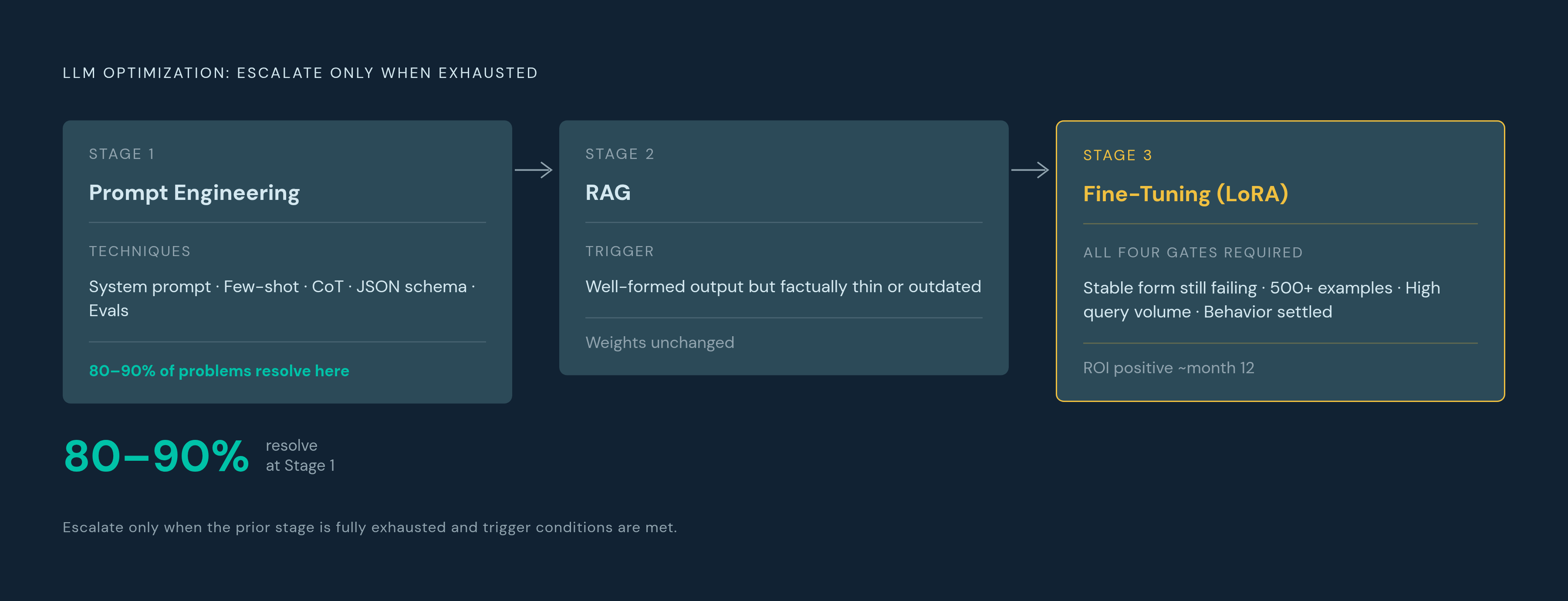
None of this adds up to a single architectural choice made once and left alone. It's a staged progression: start with prompts, add RAG once knowledge gaps appear, and fine-tune only once the business case actually clears.
Stage one means exhausting prompt engineering before anything else. Write the strongest possible system prompt, with real role context and brand guidelines built in. Add few-shot examples pulled from creative that's already been approved. Layer in chain-of-thought scaffolding for reasoning that needs to shift by persona. Lock the output structure down with JSON-schema-constrained decoding. Then run evals. If accuracy on the actual target tasks comes back acceptable, stop. Most teams should stop right here.
Stage two starts once real knowledge gaps appear in the output. If the creative a model produces is well-formed but factually thin or out of date, offer details, pricing, positioning, and account context are missing, and that's a retrieval problem. RAG handles the facts layer separately, leaving the model's weights unchanged.
Stage three, fine-tuning with LoRA, only makes sense once every one of these is true at once: there's a specific, stable form problem, brand voice or output schema or a domain-specific reasoning pattern, that's still failing at volume despite the best prompting a team can throw at it. There's labeled training data of at least 500 examples, either already sitting around or realistic to produce. Query volume is high enough that the savings on inference tokens will actually pay back the training cost over time. And the behavior being trained is settled enough that a frozen checkpoint won't be outdated by next quarter.
Where fine-tuning does happen, LoRA or QLoRA is the right tool, not full fine-tuning. Supervised fine-tuning (SFT) should come first to stabilize output format, with reinforcement-learning methods like GRPO added afterward if the goal is generalizing to creative variants the model hasn't seen yet. ICML 2025 research found SFT memorizes patterns while RL generalizes them: lock the format first, then teach flexibility.
The Internative case shows fine-tuning handling output format consistency and brand voice, RAG handling real-time product and offer data, and prompts enforcing escalation rules and edge cases, all running together. A B2B SaaS deployment fine-tuned its base model for product tone and standard response structure, used RAG to pull in each customer's specific account history and relevant knowledge-base articles, and used prompts to enforce output format and escalation rules. D|Fine-tune with LoRA only when all of the following are true. Firework's documented architecture for creative generation follows the same split: fine-tuning for output format consistency and brand voice, RAG for real-time product and offer data, prompts for escalation rules and edge cases.
Fine-tuning gives a brand voice a consistency no prompt fully replicates once volume gets high enough, and that's a fair point. But it comes with a real cost, labeled data, ML expertise, and an ongoing maintenance burden, and a brand voice that's still evolving is safer left in a prompt, where a revision takes an edit instead of a retraining run.
This staged approach is also appearing structurally inside marketing organizations. Research from Scott Brinker's Martech work found a large majority of marketing organizations now run AI agents somewhere in their stack, with content-production agents leading adoption. Those agentic pipelines increasingly build in this exact staged architecture, with individual agents coordinating prompting, retrieval, and fine-tuned components as separate specialized roles rather than one model doing everything.
Where the framework breaks down: data quality, model drift, and compounding risk
The framework holds up, but each stage carries a failure mode teams tend to underestimate until it appears in production.
At scale, prompt engineering fails the way Jenga does: a long prompt carrying many rules degrades quietly. Rule interactions are hard to test for exhaustively ahead of time, and the failure usually appears first in live output rather than in an eval run.
RAG's failure mode centers on the retrieval layer itself. Retrieval quality drives answer quality at scale, and if the vector store behind it is stale, incomplete, or chunked badly, the creative it produces will be confidently wrong in ways that are hard to catch without active monitoring in place.
Fine-tuning's failure mode compounds in a different way. When the conversion signals used to train a model are incomplete, delayed, or attributed to the wrong touchpoint, the model doesn't just make one bad call. It learns from those flawed signals and repeats the pattern at scale, shifting creative decisions based on a distorted read of what actually worked.
The gap between AI-enabled teams and non-AI teams in revenue outcomes stems significantly from data governance, not just AI. A team can get the form-versus-facts diagnosis exactly right and still get burned by a stale knowledge base or a mislabeled conversion event feeding the wrong signal back into the system. The framework tells a team which lever to pull. What feeds that lever still has to be watched.